


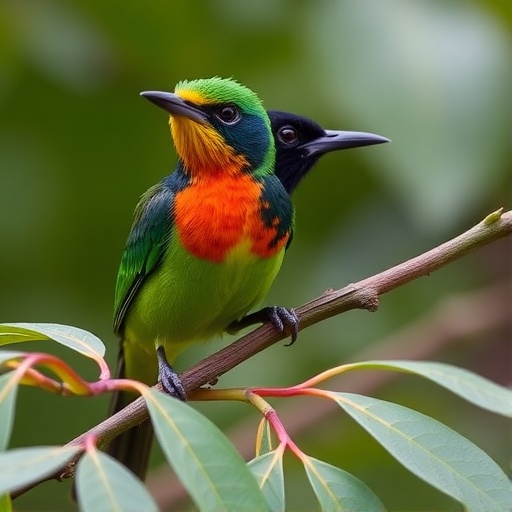
Smithsonian researchers have reconstructed the most comprehensive evolutionary map yet of Hawaii’s honeycreepers, a spectacular group of birds whose rapid diversification produced more than 60 species from a single ancestral population. The study, published in the Proceedings of the National Academy of Sciences, brings living, recently extinct and fossil honeycreepers into one genomic framework. It also reveals that the loss of Hawaiian honeycreepers has erased more evolutionary history than scientists previously recognized.
Hawaiian honeycreepers are considered one of nature’s clearest examples of adaptive radiation—the rapid evolution of many species from a common ancestor as populations occupy different ecological niches. Over millions of years, these birds developed remarkable differences in beak shape, body form, feeding behavior and habitat use. Some specialized in probing flowers, while others adapted to seeds, insects or fruit. Yet their evolutionary relationships have been difficult to resolve because the radiation occurred within a comparatively narrow period, leaving closely related species with limited genetic differences.
The new analysis examined genetic material from all 17 honeycreeper species that survive today, along with 18 species known to have existed when Europeans arrived in the Hawaiian Islands in 1778. The researchers also included two species represented only by fossil bones. By combining genomic data from living birds with DNA recovered from museum specimens and paleontological material, the team was able to compare lineages across time and identify relationships that could not be established through anatomy alone.
The results indicate that most honeycreeper species originated during a major burst of diversification approximately 2.5 million to 3.5 million years ago. This interval coincided with the formation of Oahu, an island that may have created a large supply of unoccupied ecological space. The researchers propose that ancestral honeycreepers colonized newly available habitats, split into distinct populations and later exchanged genetic material with lineages on older islands. Such a process would have produced a branching evolutionary history, but one complicated by repeated genetic exchange between populations.
This exchange, known as introgression, occurs when genes move between populations or species through hybridization and subsequent reproduction. It means that evolution does not always produce a simple tree in which each species branches once and remains genetically isolated. Instead, the honeycreeper history resembles a network, with some lineages retaining genetic contributions from other species. The researchers confirmed evidence of genetic mixing between the extinct ‘ō‘ū, Psittirostra psittacea, and the Lāna‘i hookbill, Dysmorodrepanis munroi. They also found that several ‘amakihi species, classified in the genus Chlorodrepanis, continue to share genetic material despite occupying different islands.
The findings carry a painful conservation message. Only 17 Hawaiian honeycreeper species remain alive, and many are declining rapidly. Habitat loss, introduced predators, invasive plants, climate change and mosquito-borne diseases have placed intense pressure on their populations. Avian malaria, caused by parasites transmitted by introduced mosquitoes, is especially destructive. As temperatures rise, mosquitoes and malaria are able to reach higher elevations, reducing the areas where honeycreepers can survive. Avipoxvirus, another introduced disease, has added to the threat.
Because the new evolutionary map identifies the relationships among surviving and extinct species, it can help conservationists determine which populations represent especially distinctive genetic lineages. Protecting a species is not only a matter of preserving its number of individuals; it can also preserve unique evolutionary history that is not found anywhere else. The genomic results may therefore help guide decisions about habitat protection, disease management, captive breeding and potential reintroduction efforts.
The research also demonstrates the growing scientific value of natural history collections. The team used minimally invasive sampling methods to remove tiny pieces of epidermis from preserved bird skins held in museums in the United States and Europe. These samples, although collected long before modern genomics existed, retained enough genetic material for sequencing. Researchers also recovered DNA from small fossil bones, showing that even fragmentary remains can provide information about extinct biodiversity when advanced extraction and sequencing techniques are applied.
“Improvements in genetic sequencing have transformed traditional natural history museum collections into vast repositories of historical and comparative genetic information,” said Helen James, curator of birds and chair of vertebrate zoology at the Smithsonian’s National Museum of Natural History. The study’s authors now plan to investigate how honeycreepers and their pathogens have evolved since the introduction of avian malaria and avipoxvirus. The genomic data may also clarify how genetic variation influenced disease resistance and shaped the extraordinary morphological diversity of a bird radiation now threatened with disappearing.
News Publication Date: 3-Aug-2026
Web References: https://www.pnas.org/cgi/doi/10.1073/pnas.2536533123; https://naturalhistory.si.edu/
References: Proceedings of the National Academy of Sciences; DOI: 10.1073/pnas.2536533123
Cite Scienmag News
Gavin Prescott. (August 4, 2026). Smithsonian scientists untangle Hawaiian honeycreeper evolutionary family tree. Scienmag. https://scienmag.com/smithsonian-scientists-untangle-hawaiian-honeycreeper-evolutionary-family-tree/
Gavin Prescott. "Smithsonian scientists untangle Hawaiian honeycreeper evolutionary family tree." Scienmag, 4 August 2026, https://scienmag.com/smithsonian-scientists-untangle-hawaiian-honeycreeper-evolutionary-family-tree/. Accessed 3 September 2026.
Gavin Prescott. "Smithsonian scientists untangle Hawaiian honeycreeper evolutionary family tree." Scienmag. August 4, 2026. https://scienmag.com/smithsonian-scientists-untangle-hawaiian-honeycreeper-evolutionary-family-tree/


