


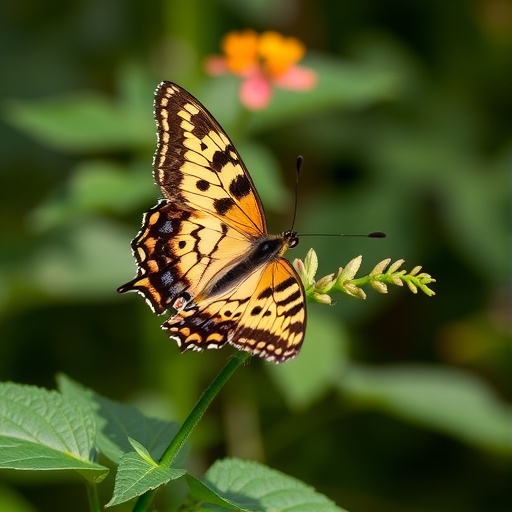
Butterflies are often treated as symbols of beauty, but their ecological importance is far more consequential. Because they respond quickly to changes in vegetation, temperature, habitat structure and human disturbance, butterfly communities can function as sensitive biological indicators of ecosystem health. A new study published in Insect Science shows that this signal becomes much clearer when butterfly species are classified according to multiple ecological traits rather than divided simply into “specialists” and “generalists.” The findings reveal that different functional groups respond to environmental change in sharply different ways, offering conservation scientists a more precise tool for tracking biodiversity loss and evaluating habitat restoration.
The international research team investigated butterfly communities in the western Qinling Mountains of China, a major biodiversity hotspot containing more than 400 butterfly species. The region’s steep environmental gradients and extensive human influence make it an important natural laboratory for studying ecological change. Decades of logging, agricultural expansion and habitat fragmentation have transformed large parts of the landscape, altering forest structure and reducing the continuity of suitable habitats. Using field surveys and ecological modelling, the researchers examined how butterfly abundance, species composition and community structure varied with altitude, plant resources, habitat quality and human disturbance.
Rather than relying on a conventional specialist-versus-generalist division, the scientists grouped the butterflies according to life cycle, ecological specialization and mobility. The first group consisted of univoltine specialists, species that produce a single generation each year and depend on relatively specific environmental conditions. The second included bivoltine specialists, which complete two generations annually but remain closely associated with particular habitats or resources. The third group comprised generalists, species capable of using a broader range of habitats and environmental conditions. This functional classification allowed the researchers to identify responses that would have been hidden if all specialists or generalists had been treated as ecologically uniform categories.
Univoltine specialists emerged as the most sensitive group. Their populations responded strongly to habitat quality and the availability of food resources, reflecting the narrow ecological requirements and limited reproductive flexibility associated with their life histories. A species with only one annual generation has fewer opportunities to recover from an unfavorable season, while dependence on particular host plants or microhabitats can make local populations especially vulnerable to forest degradation. In contrast, bivoltine specialists may have somewhat greater resilience because they reproduce twice per year, although their habitat requirements still leave them exposed to environmental disruption.
Across the butterfly community as a whole, human disturbance was associated with lower abundance. Higher elevations also supported fewer species, a pattern that may reflect cooler conditions, shorter growing seasons and reduced plant productivity. By comparison, areas with greater availability of plant resources supported larger butterfly populations. These resources include nectar-producing flowers used by adults and host plants required by larvae, whose feeding needs are often highly specific. The results underscore that conserving butterflies requires more than preserving forest cover alone: the quality, diversity and seasonal availability of vegetation are equally important.
The researchers also found that generalist butterflies were influenced more strongly by their capacity to move through the landscape. Mobility can enable these species to cross fragmented habitats, locate temporary food sources and recolonize sites after local declines. However, movement does not eliminate the effects of environmental change. Fragmented landscapes may still reduce connectivity, isolate populations and limit access to essential resources. The contrast between mobile generalists and habitat-dependent specialists demonstrates why conservation assessments based solely on species counts can be misleading. A landscape may retain many butterfly species while losing the most ecologically specialized and vulnerable members of the community.
The study carries an important warning for forest restoration. Increasing canopy density is often considered a straightforward sign of ecological recovery, yet denser canopy can reduce sunlight and alter the understory vegetation needed by some specialist butterflies. In the Qinling Mountains, restoration-driven changes in forest structure have reduced suitable habitat for several rare species, potentially contributing to population declines and local extinctions. This does not mean restoration is harmful, but it shows that successful management must be designed around the requirements of target species. Maintaining a mosaic of canopy conditions, flowering plants, open areas and connected habitats may be more effective than pursuing uniform, closed-canopy forests.
Several of the region’s rare butterflies, including Bhutanitis thaidina and Luehdorfia chinensis huashanensis, are already protected in China. Another species, Luehdorfia taibai, remains critically endangered but has not yet received national protection. The researchers argue that univoltine specialists should receive particular conservation attention because their restricted life cycles and habitat requirements make them early casualties of environmental change. Monitoring these species could provide an early-warning system for declining habitat quality, especially when their population trends are examined alongside vegetation, climate and land-use data.
By linking functional traits to community responses, the study provides a practical framework for biodiversity monitoring, ecological modelling and conservation planning. The approach can help scientists distinguish whether a decline is driven by habitat loss, reduced plant resources, changing elevation conditions or the breakdown of movement corridors. It may also improve the evaluation of restoration projects by measuring not only how many species return, but which ecological strategies are represented and whether sensitive specialists are recovering. The researchers conclude that trait-based analysis offers a more accurate picture of ecosystem resilience, helping managers protect the butterflies—and the complex forest systems they represent—before ecological degradation becomes irreversible.
News Publication Date: 30-Jul-2026
Web References: https://doi.org/10.1111/1744-7917.70332
References: Insect Science, “Functional structure and beta diversity of butterfly communities in a Chinese biodiversity hotspot,” DOI: 10.1111/1744-7917.70332
Cite Scienmag News
Gavin Prescott. (August 3, 2026). Butterflies offer clues to ecosystem health and changing habitats. Scienmag. https://scienmag.com/butterflies-offer-clues-to-ecosystem-health-and-changing-habitats/
Gavin Prescott. "Butterflies offer clues to ecosystem health and changing habitats." Scienmag, 3 August 2026, https://scienmag.com/butterflies-offer-clues-to-ecosystem-health-and-changing-habitats/. Accessed 3 September 2026.
Gavin Prescott. "Butterflies offer clues to ecosystem health and changing habitats." Scienmag. August 3, 2026. https://scienmag.com/butterflies-offer-clues-to-ecosystem-health-and-changing-habitats/


