


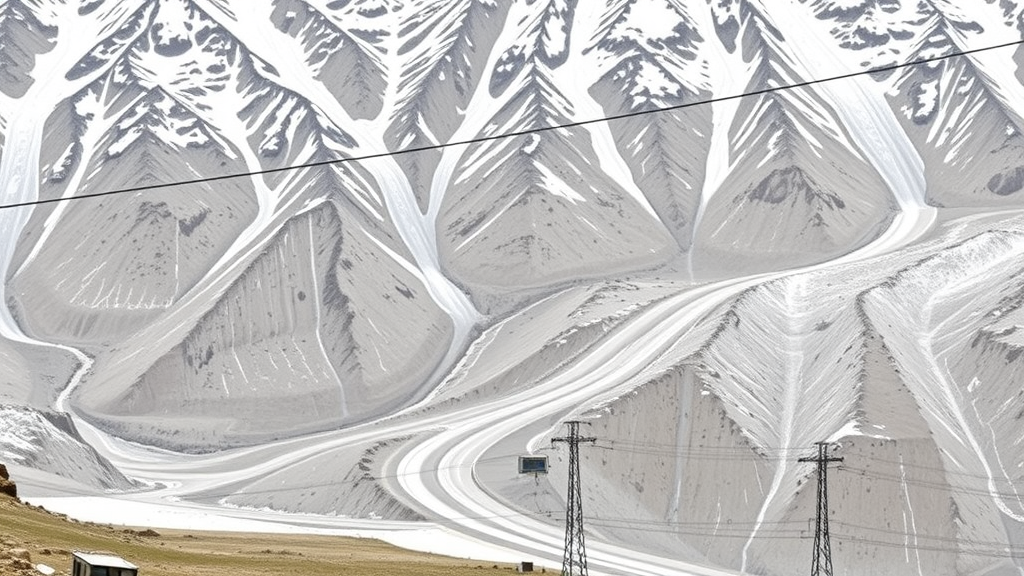
In the steep valleys of the Nepal Himalaya, the machinery of progress is producing something its architects never intended: a rising tide of manufactured disaster risk. A new study published in the Journal of Environmental Studies and Sciences argues that the very infrastructure projects meant to lift rural communities out of poverty—roads, hydropower plants, and hastily built settlements—are systematically deepening the region’s vulnerability to landslides, floods, and slope failure. The research, led by Kabin Maharjan of People in Need and The Australian National University, together with Dhanej Thapa, Dilli Prasad Poudel, and Eliza Shrestha, examines how well-intentioned but haphazard development has become a generator of risk rather than a shield against it.
The study draws on qualitative field data analysed through a critical-realist and political-economy lens, a methodological combination that allows the researchers to look beyond visible hazards and interrogate the hidden structures that produce them. Rather than treating landslides or dried springs as isolated technical failures, the authors trace them to entrenched mechanisms: political patronage networks that award contracts to allies, weak governance that fails to enforce safety codes, and a dominant narrative that equates infrastructure with development regardless of how it is built. These structures, the paper argues, are not background conditions but active causal engines behind Nepal’s growing disaster toll.
The empirical texture of the research is striking. The authors document bulldozer-led road construction that slices through unstable slopes without adequate drainage or retaining structures, a practice so aggressive that local communities have coined the term ‘dozer terrorism’ to describe it. They describe the annual fiscal-year budget rush, in which local governments scramble to spend allocated funds before the financial year closes, leading to projects approved and executed in weeks with minimal environmental assessment. Tunnel blasting for hydropower schemes has destabilised hillsides and drained the springs that mountain villages depend on for drinking water and irrigation. Unregulated extraction of sand, gravel, and stone from riverbeds and slopes further weakens the terrain, while unsafe settlement expansion pushes homes onto land that engineers would classify as hazardous.
The consequences are already visible across the landscape. The study records slope instability along newly cut road corridors, the drying of natural springs, displacement of communities, and biodiversity loss in fragile mid-hill environments. Crucially, the authors emphasise that these impacts do not remain confined to individual project sites. Disaster risk, they show, extends across roads, rivers, settlements, and entire infrastructure corridors, linking one community’s hazard to another’s downstream vulnerability. A road cut high on a ridge can deliver sediment and debris to villages far below; a tunnel that drains an aquifer can force families to abandon land their grandparents farmed for generations.
What makes the study analytically distinctive is its refusal to treat development as inherently safe or inherently risky. The authors argue that outcomes hinge on how, by whom, and under what conditions development is pursued. The same road, built with proper geological assessment, drainage design, and community consultation, can transform livelihoods; built hastily under patronage pressure, it becomes a scar that sheds landslides for decades. This reframing challenges both the triumphalist infrastructure narrative that dominates national politics and the simplistic view that all development in fragile mountains is destructive. The problem, in other words, is not development itself but the political economy that shapes its execution.
The critical-realist framework the researchers employ deserves attention in its own right. Drawing on the philosophy of Roy Bhaskar and the tradition of realist social science, the study seeks to identify the underlying generative mechanisms—patronage, fiscal incentives, institutional weakness—that produce observable events such as unsafe construction and subsequent slope failure. By blending this ontology with political-economy analysis, the authors offer what they describe as a methodological path for future research on the development-disaster interface, one that moves beyond correlational studies of hazards and toward explanations of why risky practices persist despite their known consequences.
The political-economy dimension of the analysis resonates with a broader international literature on disasters and corruption. Previous research has shown that corrupt practices in the construction industry, from substandard materials to rigged procurement, measurably increase disaster losses, and that the political economy of ‘natural’ disasters often determines who suffers and who profits. The Nepal study extends this line of inquiry into a mountain setting where the physical fragility of the terrain amplifies every governance failure. It also connects to earlier work by Nepali and international scholars documenting how road building in the Himalaya has repeatedly increased landslide activity, and how haphazard urbanisation in the Kathmandu Valley has followed a similar logic of risk creation.
The timing of the study is significant. Nepal’s post-2015 federal restructuring devolved substantial planning and budget authority to local governments, unleashing an unprecedented wave of rural infrastructure construction. While this decentralisation has delivered roads and electricity to communities long neglected by the centre, the new study suggests it has also multiplied the sites at which risk is being manufactured, often by local institutions that lack the technical capacity, environmental safeguards, or accountability mechanisms to build safely. The authors warn that disaster risk is likely to expand further as development penetrates ever more fragile landscapes and creates new exposure in places that previously had little built infrastructure at all.
The paper’s central prescription is correspondingly radical. Building mountain safety, the authors argue, demands more than coping capacity, early warning systems, or hazard management. It requires rethinking the very development processes that produce risk in the first place. Without a shift toward transparent, accountable, and risk-informed planning, Nepal’s present rural development model will, in the authors’ words, continue to normalise risk, reproduce disasters, and deepen vulnerabilities in the name of development. That means enforcing environmental impact assessment, curbing the fiscal-year spending rush, subjecting contract allocation to genuine public scrutiny, and treating geological and hydrological evidence as binding constraints rather than inconvenient formalities.
For the wider disaster research community, the study is a pointed reminder that the line between development and disaster is thinner than policy frameworks usually acknowledge. Every bulldozed slope, every blasted tunnel, and every budget-deadline project embeds decisions about risk into the physical landscape, decisions that will surface years later as landslides, floods, and displacement. The Nepal Himalaya, where some of the world’s most energetic tectonics meet some of the world’s most ambitious rural infrastructure ambitions, offers perhaps the sharpest available illustration of this development-disaster interface. Whether the region’s roads and dams become instruments of resilience or engines of catastrophe will depend not on the mountains, but on the politics that shape how they are built.
Subject of Research: Political economy of development-induced disaster risk creation in the Nepal Himalaya
Article Title: Development-disaster interface: Political economy of development-induced risk creation in the Nepal Himalaya
Article References: Development-disaster interface: Political economy of development-induced risk creation in the Nepal Himalaya. (n.d.). https://doi.org/10.1007/s13412-026-01139-3
Image Credits: AI Generated
DOI: 10.1007/s13412-026-01139-3
Keywords: Nepal, Himalaya, disaster risk, development, political economy, road construction, hydropower, landslides, critical realism, vulnerability, infrastructure governance, haphazard planning
Cite Scienmag News
Sloane Callahan. (September 20, 2026). Roads, Dams and Rushed Budgets Are Quietly Manufacturing Disasters in Nepal’s Himalaya. Scienmag. https://scienmag.com/roads-dams-and-rushed-budgets-are-quietly-manufacturing-disasters-in-nepals-himalaya/
Sloane Callahan. "Roads, Dams and Rushed Budgets Are Quietly Manufacturing Disasters in Nepal’s Himalaya." Scienmag, 20 September 2026, https://scienmag.com/roads-dams-and-rushed-budgets-are-quietly-manufacturing-disasters-in-nepals-himalaya/. Accessed 4 October 2026.
Sloane Callahan. "Roads, Dams and Rushed Budgets Are Quietly Manufacturing Disasters in Nepal’s Himalaya." Scienmag. September 20, 2026. https://scienmag.com/roads-dams-and-rushed-budgets-are-quietly-manufacturing-disasters-in-nepals-himalaya/


