


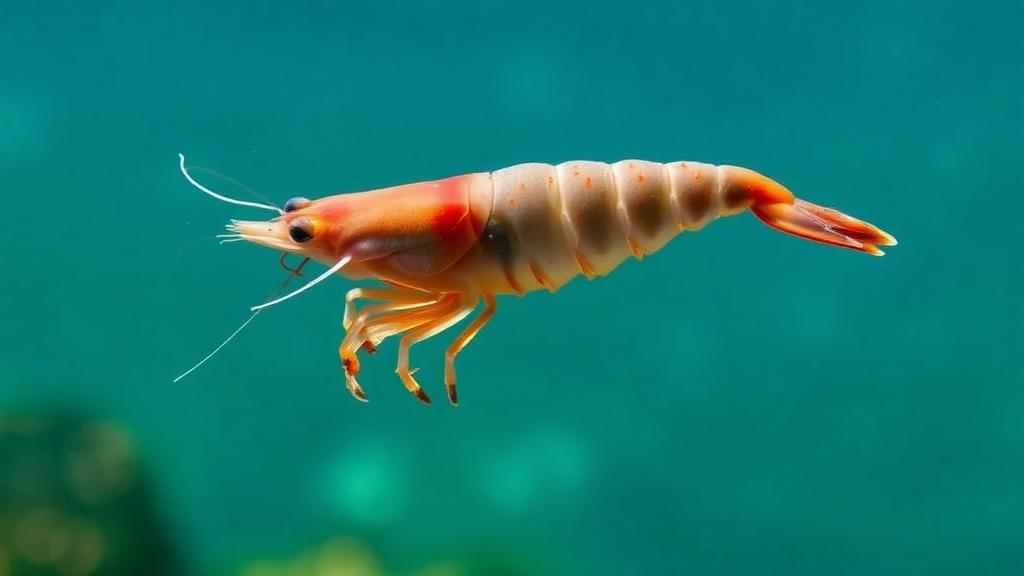
In the warm, brackish waters of shrimp aquaculture, a microscopic arms race unfolds continuously inside the digestive tracts of the animals themselves. Bacteriophages, the viruses that infect and kill bacteria, have long been recognized as central players in shaping the microbial communities that colonize animal intestines. A new study published in the journal Microbiome now shows that this viral policing of the shrimp gut is acutely sensitive to temperature, and that modest warming can strip phages of their ability to suppress one of aquaculture’s most notorious pathogens. The findings, from a team led by Zhixuan Deng and Zhijian Huang at Sun Yat-sen University in China, offer a mechanistic explanation for a familiar and costly pattern: digestive tract diseases in farmed shrimp that recur with alarming regularity during hot seasons.
The researchers focused on Vibrio parahaemolyticus, a bacterium responsible for devastating outbreaks in shrimp ponds, including acute hepatopancreatic necrosis disease and early mortality syndrome, conditions that have inflicted enormous economic losses across shrimp-producing regions. From the intestine of farmed shrimp, the team isolated a strain of the pathogen, designated V. parahaemolyticus-T6, along with a lytic phage that infects it, named VP-T6a. This natural pairing provided a clean experimental system in which the interaction between a single virus and its bacterial host could be manipulated and observed under controlled conditions, first in laboratory culture and then within living shrimp.
The central question was deceptively simple: does temperature change the outcome of the battle between phage and bacterium? The answer, established through a series of co-culture experiments, is a clear yes. At relatively low temperatures, between 20 and 33 degrees Celsius, VP-T6a replicated efficiently inside its host. Viral abundance climbed, the density of V. parahaemolyticus fell, and the multiplicity of infection, the ratio of phages to host cells, rose accordingly. In other words, under cooler conditions the phage behaved as classical phage theory predicts, tracking and suppressing its host population through density-dependent infection dynamics.
Yet even under these favorable conditions, complete eradication of the bacterial population never occurred. During prolonged co-culture, the researchers observed the emergence of phage-resistant V. parahaemolyticus variants, bacteria that had evolved defenses against VP-T6a and could no longer be lysed by it. This resistance prevented the phage from wiping out its host entirely, and it illustrates a well-known ecological principle sometimes described as kill-the-winner dynamics or arms race dynamics: viruses keep dominant bacterial populations in check, but bacteria continually evolve escape mechanisms, producing a fluctuating equilibrium rather than a decisive victory for either side. The coexistence of phage and bacterium, rather than the elimination of one by the other, appears to be the normal state of affairs in the shrimp intestine.
The picture changed dramatically when the temperature was raised. At 35 to 37 degrees Celsius, VP-T6a still managed to adsorb to the surface of V. parahaemolyticus, attaching to its host as usual. But after adsorption, the infection stalled. The expression of phage genes responsible for packaging viral genetic material into new particles was suppressed, and no progeny phages were produced. The virus had effectively boarded its host but could not complete its replication cycle. Meanwhile, the bacterium continued to replicate normally. Over time, V. parahaemolyticus abundance increased while VP-T6a abundance declined, driving the multiplicity of infection downward. At high temperatures, the phage was not merely failing to kill its host; it was losing ground.
Through integrated omics analyses, combining genomic, transcriptomic and community-level data, the team traced this failure to the temperature-dependent suppression of the phage’s packaging machinery, the molecular assembly line that packages viral genomes into capsids before they are released to infect new cells. The finding is technically significant because it localizes the temperature effect to a specific stage of the phage life cycle rather than to adsorption or entry. A phage can successfully attach to its host and still be rendered impotent if the intracellular steps of virion assembly cannot proceed. This distinction matters for anyone hoping to deploy phages as biological controls, because it suggests that environmental temperature can silently disable a phage therapy that looks perfectly effective on paper.
The experiments also revealed a sweet spot in the phage-host ratio. Within a multiplicity of infection range of roughly 0.001 to 0.01, co-cultures of VP-T6a and V. parahaemolyticus yielded the highest titers of progeny phages. Too few phages per cell, and the virus cannot propagate efficiently; the balance of phage to bacterium therefore shapes not only who wins the immediate contest but also how much viral offspring is generated for future rounds of infection. This density-dependent behavior is precisely what breaks down at elevated temperatures, when declining phage numbers and rising bacterial numbers push the system out of the productive range.
To test whether these laboratory dynamics held up inside a living animal, the researchers examined the shrimp intestine itself, where temperature similarly modulated the interaction between VP-T6a and the pathogen. The two temperature regimes produced distinct effects on the dominant taxa of the intestinal microbiota. Under low-temperature conditions, the phage reduced the influence of V. parahaemolyticus on the structure of the microbial network, dampening the pathogen’s capacity to dominate the community. At high temperatures, this buffering effect disappeared, leaving the pathogen free to exert its influence on the gut ecosystem. The low-temperature interaction pattern was also more effective at increasing the contribution of deterministic processes to community assembly, meaning that under cooler conditions the gut bacterial community was shaped more strongly by predictable ecological interactions, including predation by phages, rather than by random drift.
The broader implication is that a temperature-dependent phage-bacterium coexistence strategy operates in the shrimp intestine, maintaining a dynamic equilibrium between viruses and their bacterial hosts that underpins microbial diversity. When temperatures rise, that equilibrium collapses in a specific and consequential way: phages fail to suppress V. parahaemolyticus proliferation, the pathogen gains ground, and the intestinal microbiota’s resistance to exogenous invasion is weakened. This provides a plausible mechanistic link between seasonal warming and the recurrent digestive tract diseases that plague shrimp aquaculture, and it reframes the problem not simply as faster bacterial growth in warm water but as the failure of a viral regulatory system that normally keeps pathogens in check.
For aquaculture, the study points toward strategies that account for temperature when managing gut microbiomes. Phage-based biocontrol of V. parahaemolyticus, an approach that has attracted growing interest as an alternative to antibiotics, may need to be matched to thermal conditions, with phage candidates selected or engineered for efficacy across the temperature range that farmed shrimp actually experience. More broadly, the work adds to a growing body of evidence that phage-bacterium interactions are not a fixed backdrop to microbial ecology but a dynamic, environmentally sensitive force that shapes community structure in animal hosts. As coastal waters warm and aquaculture expands into hotter climates, understanding how temperature rewrites the rules of engagement between viruses and bacteria may prove essential for protecting the health of farmed animals and, by extension, the stability of the food systems that depend on them.
Subject of Research: Temperature-dependent phage-bacterium interactions shaping shrimp intestinal microbiota diversity
Article Title: Temperature-dependent phage-bacterium coexistence strategy mediates the intestinal microbial community diversity in shrimp
Article References: Deng, Z., Hou, D., Zhou, R., Zeng, S., Chen, Q., Zhang, L., Hou, Q., Wang, W., Wang, D., Weng, S., He, J., & Huang, Z. (2026). Temperature-dependent phage-bacterium coexistence strategy mediates the intestinal microbial community diversity in shrimp. Microbiome. https://doi.org/10.1186/s40168-026-02550-2
Image Credits: AI Generated
DOI: 10.1186/s40168-026-02550-2
Keywords: bacteriophage, Vibrio parahaemolyticus, shrimp, intestinal microbiota, temperature, phage-bacterium interaction, aquaculture, microbiome, multiplicity of infection, phage resistance, community assembly, gut health
Cite Scienmag News
Morgan Morrow. (October 3, 2026). Rising Temperatures Disable the Viruses That Keep Shrimp Guts Healthy. Scienmag. https://scienmag.com/rising-temperatures-disable-the-viruses-that-keep-shrimp-guts-healthy/
Morgan Morrow. "Rising Temperatures Disable the Viruses That Keep Shrimp Guts Healthy." Scienmag, 3 October 2026, https://scienmag.com/rising-temperatures-disable-the-viruses-that-keep-shrimp-guts-healthy/. Accessed 4 October 2026.
Morgan Morrow. "Rising Temperatures Disable the Viruses That Keep Shrimp Guts Healthy." Scienmag. October 3, 2026. https://scienmag.com/rising-temperatures-disable-the-viruses-that-keep-shrimp-guts-healthy/


