


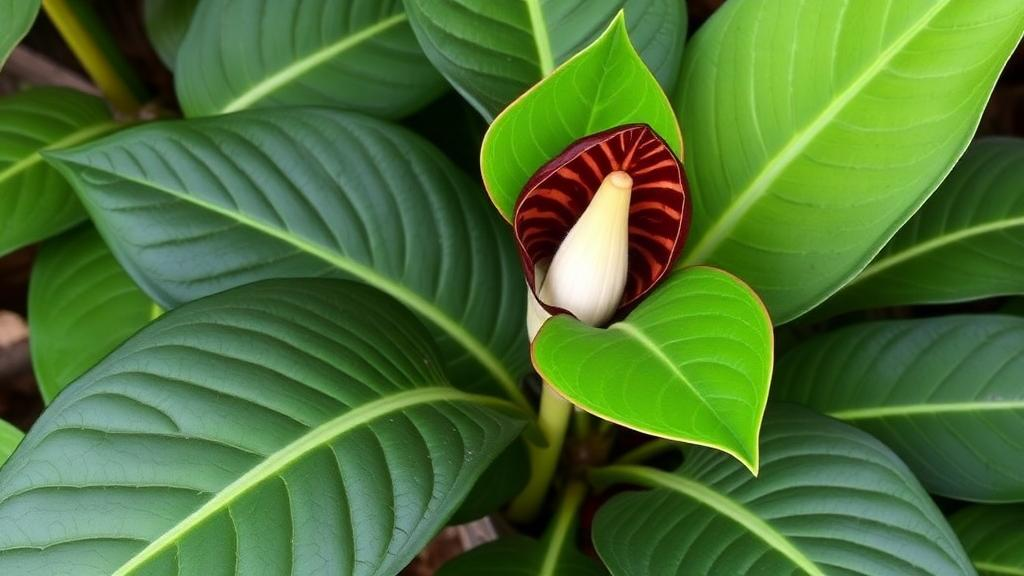
Deep in the misty hills of Jatinga, in the Dima Hasao district of Assam, a team of botanists from Gauhati University has documented something remarkable: a wild aroid previously known only from the mountains of Arunachal Pradesh, growing in profusion beside a waterfall more than a thousand kilometres of rugged terrain away from its type locality. The plant, Colocasia boyceana Gogoi & Borah, was first described to science in 2013 from material collected at around 1,600 metres elevation in the Lohit district of Arunachal Pradesh. Its discovery in Assam at roughly 560 metres above sea level represents a significant extension of the species’ known geographical range and adds a sixth species of Colocasia to the documented flora of the state.
The finding, published in the journal Discover Plants by Kanishka Ranjan Deka, Kapil Kumar Kemprai and Souravjyoti Borah, is more than a routine range extension. It offers a rare glimpse into the ecology of one of Asia’s least-studied aroid genera and underscores how much basic botanical exploration remains to be done in Northeast India, one of the world’s most biodiverse and least-surveyed regions. The genus Colocasia, famous for containing taro, one of humanity’s oldest cultivated root crops, comprises just fifteen accepted species, nearly all confined to tropical and subtropical Asia. Eight of those species have been recorded in India, and every one of them occurs in the country’s northeastern states.
The story of the discovery began in July 2025, when the researchers conducted a field survey in the Jatinga area, a landscape famous among ornithologists for its valley mists and, less happily, for historical reports of mass bird deaths. While exploring near a waterfall, the team encountered an unfamiliar Colocasia growing in massive, stoloniferous colonies in moist, shady terrestrial conditions. The plants were unmistakably members of the arum family: tuberous corms, large cordate to sagittate leaves angled downward, and petioles attached at the notches of the leaf blades. But several features hinted that this was not one of the five species already documented from Assam.
Careful dissection of fresh specimens in the field revealed the diagnostic characters that set the plant apart. The spadix, the fleshy spike that bears the tiny unisexual flowers, terminated without the sterile appendix found in several relatives. More strikingly, the male zone of the inflorescence was covered in white hairs on its creamy synandria, the fused stamen clusters that characterise the genus. Hairy synandria are a hallmark of C. boyceana and distinguish it from all other Colocasia species in Assam. The researchers also noted the light green spathe tube and petioles, and the stoloniferous habit in which creamy white horizontal stolons, sheathed in pinkish cataphylls, spread outward to produce new plants, allowing the species to form dense colonies.
Confirmation required more than field observation. The team consulted taxonomic literature spanning more than a century, from Hooker’s Flora of British India treatments of the Aroideae to modern revisions of the genus in Malesia, China, Myanmar and Bangladesh. They also examined digital images of herbarium specimens held in major collections, including the Royal Botanic Gardens Kew’s Plants of the World Online database, the Indian Virtual Herbarium, and the herbaria at the Central National Herbarium in Howrah and the Assam herbarium. The combination of ovate, cordate to sagittate leaf blades, a raised to reflexed yellow spathe limb, hairy male zone and stoloniferous corm matched C. boyceana exactly. A voucher specimen was prepared following standard herbarium protocol and deposited in the Gauhati University herbarium under accession number GUBH21068.
The morphological profile of the species, as detailed in the new paper, paints a picture of a robust perennial herb reaching about 90 centimetres in height. Its globose to subcylindric corms measure four to five centimetres across, and each plant carries three to eleven glossy leaves with dark green upper surfaces and pale green undersides, roughly 33 centimetres long, with five to seven pairs of lateral veins raised beneath and impressed above. The inflorescences, one to as many as six per plant, stretch nearly twenty to thirty-two centimetres, with a green spathe tube about four centimetres long and a yellow limb more than thirteen centimetres long that lifts and reflexes as the flower matures. The female zone, tucked inside the tube, is whitish green and studded with interpistillar staminodes, while the male zone bears six- to eight-stamened synandria clothed in white hairs.
Perhaps the most ecologically interesting detail concerns where the species grows and how far its range now spans. In Assam, the plants occupy moist terrestrial habitat near a waterfall and stream at about 560 metres elevation, growing alongside Impatiens tripetala, Hellenia speciosa, Elatostema species and Hedychium species. In Arunachal Pradesh, by contrast, the species was collected at around 1,600 metres in subtropical conditions. This elevational and climatic breadth, from warm tropical valleys to cooler subtropical mountains, suggests a species with considerable ecological flexibility, and the authors report that the Jatinga populations appeared healthy and expanding, with no direct threats observed during the survey. Flowering and fruiting occur between June and August, timed to the monsoon.
To help future fieldworkers and researchers separate the six Colocasia species now known from Assam, the paper includes a dichotomous identification key built on characters visible in the field and in fresh material. The key first separates species whose spadix ends in a distinct sterile appendix, namely C. affinis, C. fallax and C. esculenta, from those lacking an appendix, namely C. boyceana, C. lihengiae and C. mannii. Among the latter group, the hairy male zone immediately identifies C. boyceana, while the remaining two are distinguished by leaf texture and the colour and width of the female zone. Such keys are practical conservation tools: they allow rapid, reliable identification without molecular equipment, which is essential for monitoring populations across remote terrain.
The significance of the record extends beyond taxonomy. Colocasia boyceana is endemic to India, and until now every known population came from a single state. A second state population, genetically isolated by the Brahmaputra valley and intervening mountain ranges, may prove important for understanding the species’ evolutionary history and its vulnerability to habitat change. Wild relatives of crop plants carry genes for disease resistance, drought tolerance and other traits of enormous agricultural value, and the taro genus is no exception. Documenting where wild Colocasia species persist, and in what habitats, is a prerequisite for conserving that genetic reservoir, particularly as land use intensifies across Northeast India.
The discovery also carries a broader message about the state of botanical knowledge in the region. The Araceae, the family to which Colocasia belongs, is the third largest family of monocotyledons, with roughly 125 genera and 3,525 accepted species worldwide, yet new species and new distribution records continue to emerge from Northeast India at a steady pace. That a conspicuous, colony-forming plant with showy yellow inflorescences could remain undocumented in Assam until 2025 speaks to both the difficulty of the terrain and the scarcity of systematic field surveys. The authors suggest that further exploration of the state’s waterfall-fed ravines and stream banks, habitats that are difficult to access but rich in moisture-loving aroids, is likely to yield additional surprises, and their detailed photographic plates and identification key are designed to make those future finds easier to recognise and record.
Subject of Research: New distributional record of the wild aroid Colocasia boyceana in Assam, India
Article Title: New distributional record of Colocasia boyceana Gogoi & Borah from Assam, India
Article References: Deka, K. R., Kemprai, K. K., & Borah, S. (2026). New distributional record of Colocasia boyceana Gogoi & Borah from Assam, India. Discover Plants, 3(1), Article 435. https://doi.org/10.1007/s44372-026-00922-4
Image Credits: AI Generated
DOI: 10.1007/s44372-026-00922-4
Keywords: Colocasia boyceana, Araceae, Assam, Dima Hasao, new distribution record, Northeast India, plant taxonomy, aroid, biodiversity, Jatinga, endemic species, botanical survey
Cite Scienmag News
Alan Morgan. (October 3, 2026). Rare Aroid Colocasia boyceana Found Thriving in Assam, Extending Its Known Range. Scienmag. https://scienmag.com/rare-aroid-colocasia-boyceana-found-thriving-in-assam-extending-its-known-range/
Alan Morgan. "Rare Aroid Colocasia boyceana Found Thriving in Assam, Extending Its Known Range." Scienmag, 3 October 2026, https://scienmag.com/rare-aroid-colocasia-boyceana-found-thriving-in-assam-extending-its-known-range/. Accessed 4 October 2026.
Alan Morgan. "Rare Aroid Colocasia boyceana Found Thriving in Assam, Extending Its Known Range." Scienmag. October 3, 2026. https://scienmag.com/rare-aroid-colocasia-boyceana-found-thriving-in-assam-extending-its-known-range/


