


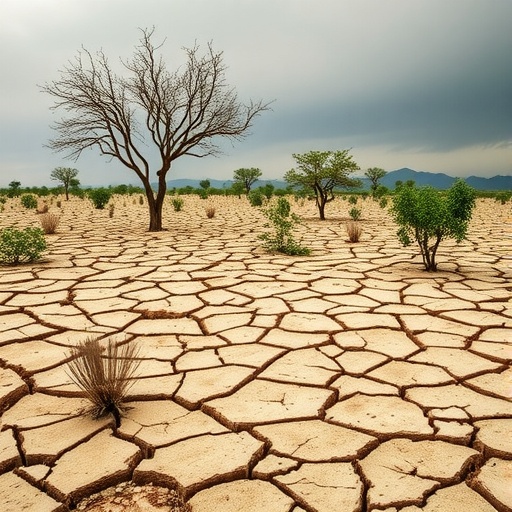
(Santa Barbara, Calif.) — The atmosphere’s capacity to hold moisture increases as it warms, a fundamental physical principle with profound implications for our planet’s climate systems. This capacity is why warm air can rapidly absorb water from surfaces, drying out landscapes even without a decrease in rainfall. A groundbreaking study recently published in Nature reveals how this atmospheric characteristic is intensifying drought conditions worldwide, independent of changes in precipitation patterns. The research uncovers that over the past 40 years, drought severity has risen by a staggering 40%, driven largely by a surge in atmospheric evaporative demand (AED) as global temperatures climb.
Traditionally, droughts have been perceived mainly as consequences of diminished rainfall. However, the new findings indicate that this paradigm misses a crucial driver of water scarcity: the ever-increasing “thirst” of the atmosphere itself. Atmospheric evaporative demand, a measure of the environment’s pull on water, effectively acts like a relentless sponge, drawing moisture not just from rainfall but from soils, vegetation, and surface water bodies at an unprecedented rate. As AED amplifies due to warming, ecosystems and human water supplies experience greater stress irrespective of how much rain actually falls.
At the core of this research lies a sophisticated approach to quantifying AED on a global scale—one that moves beyond simplistic temperature-based estimates. Lead author Solomon Gebrechorkos, a hydro-climatologist from the University of Oxford, and an international cohort of scientists deployed a suite of high-resolution data spanning over a century. They incorporated advanced climate models that integrate multiple climatic variables—beyond mere temperature—to capture the complex interplay governing atmospheric moisture demand. This holistic methodology allowed the team to assess AED’s evolution in a way that reflects the multi-faceted realities of climate systems.
The study’s co-author Chris Funk, director of UC Santa Barbara’s Climate Hazards Center, underscores the significance of accounting for AED when evaluating drought. “Drought assessment has historically fixated on water supply,” Funk explains, “but the growing evaporative demand of the atmosphere fundamentally alters the balance, often tipping conditions toward drought even when precipitation has not declined.” Their results suggest that in many regions, the atmosphere’s drying power has outpaced rainfall increases, exacerbating drought severity and challenging existing drought preparedness frameworks.
Quantifying AED entails analyzing several climatic drivers, including solar radiation, air temperature, wind speed, and relative humidity—all factors that modulate the rate at which moisture evaporates and transpires from surfaces. By leveraging comprehensive global datasets and applying rigorous climate models, the researchers created a standardized framework to compare wet and dry regions worldwide. This allowed them to isolate statistically significant trends that reveal a consistent and alarming global increase in atmospheric moisture demand throughout recent decades.
One of the study’s most striking revelations is the disparity between precipitation trends and AED escalation. While some areas have experienced stable or slightly increased rainfall, their drought severity has nonetheless intensified, a phenomenon directly attributed to the atmosphere’s enhanced evaporative pull. This supports the notion that temperature-driven increases in AED pose a hidden yet potent force in drying out soils and vegetation, threatening agricultural productivity and natural ecosystems beyond what rainfall records alone would predict.
Understanding the mechanics of AED growth is critical for anticipating future drought risks in a warming world. As temperatures rise, air that maintains constant relative humidity can hold exponentially more water vapor, intensifying evaporation rates. However, whether precipitation will increase sufficiently to offset the atmospheric demand remains uncertain. The study cautions that the rapid amplification of AED may outstrip any gains in precipitation, leading to more frequent, severe, and prolonged drought episodes globally.
The findings hold major implications for food security, water resource management, and ecosystem stability. Increased AED contributes to soil desiccation and heightened plant water stress, thereby reducing crop yields and stressing natural vegetation. Additionally, drier conditions fuel the frequency and intensity of wildfires as arid plants become more combustible. These compounded effects pose profound questions for how societies can sustainably manage water and land resources under evolving climate pressures.
To mitigate the growing threat, the study advocates for enhanced drought monitoring systems that incorporate atmospheric demand metrics alongside traditional precipitation measurements. Such integrated early warning systems would enable more precise risk assessments and prompt adaptive responses. For farmers, strategies like micro-irrigation and soil moisture retention techniques could become vital tools in counteracting rising AED and safeguarding agriculture against accelerating drought stress.
Moreover, the research signals the urgency of renewed scientific inquiry into the complex feedback loops involving evaporation, atmospheric moisture demand, and terrestrial water availability. Understanding these interconnections will be crucial for designing resilient agricultural practices, urban water management, and ecosystem conservation efforts. The dynamic between a warming atmosphere and hydrological cycles presents a multi-dimensional challenge that transcends simple rainfall forecasting.
Ultimately, this study reframes drought not as a mere absence of rain but as a nuanced climate phenomenon governed by the accelerating thirst of the atmosphere itself. It calls on the scientific community, policymakers, and the public to recognize that as global temperatures rise, the atmosphere’s growing evaporative demand will deeply reshape water availability patterns, exacerbating drought risks in ways previously underappreciated. Effective adaptation requires embracing this expanded perspective and developing tools to anticipate and manage the urgent realities ahead.
Cite Scienmag News
Russell Cooper. (June 4, 2025). Rising Atmospheric Thirst Intensifies Droughts, Even in Rainy Regions. Scienmag. https://scienmag.com/rising-atmospheric-thirst-intensifies-droughts-even-in-rainy-regions/
Russell Cooper. "Rising Atmospheric Thirst Intensifies Droughts, Even in Rainy Regions." Scienmag, 4 June 2025, https://scienmag.com/rising-atmospheric-thirst-intensifies-droughts-even-in-rainy-regions/. Accessed 4 September 2026.
Russell Cooper. "Rising Atmospheric Thirst Intensifies Droughts, Even in Rainy Regions." Scienmag. June 4, 2025. https://scienmag.com/rising-atmospheric-thirst-intensifies-droughts-even-in-rainy-regions/


