


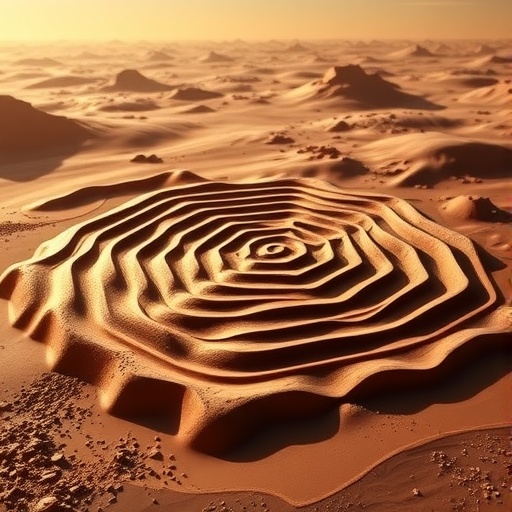
In a remarkable leap forward for planetary science and atmospheric physics, a new study delves into the complex interactions between wind-driven sediment transport and surface roughness across Earth and Mars-like conditions. The research conducted by Alvarez, Lapôtre, Swann, and colleagues unveils intricate details about the aerodynamic roughness of rippled sediment beds under varying atmospheric pressures, revolutionizing our understanding of aeolian processes that sculpt planetary landscapes. This breakthrough not only advances theoretical models but also paves the way for interpreting surface features observed on Mars with unprecedented accuracy.
The fundamental premise behind this research rests on active saltation—the process wherein sand and dust grains are lifted by wind and subsequently hop or bounce along the surface, influencing both wind flow and sediment behavior. Whereas saltation under Earth’s atmosphere has been extensively studied, the challenge has been to extrapolate these mechanisms to Mars, where the atmosphere is thinner and pressures are a fraction of Earth’s. By simulating a continuum of atmospheric pressures spanning Earth-like conditions down to Mars analogs, this study illuminates how these vastly different environments affect the aerodynamic roughness of rippled beds, a crucial factor determining wind-surface interactions.
Aerodynamic roughness length is a parameter that encapsulates how surface features impede airflow, thereby regulating the momentum transfer between the atmosphere and the planetary surface. It directly influences wind speed profiles, sediment entrainment thresholds, and the formation of surface features such as dunes and ripples. Knowing how aerodynamic roughness varies across different atmospheric pressures holds the key to accurate predictions in geomorphology and climatology—especially in the context of understanding Mars’ dynamic surface processes and its past and present sediment mobility.
Through a series of carefully designed experiments using wind tunnels capable of replicating Earth-to-Mars atmospheric pressures, the authors produced controlled conditions whereby saltating particles formed rippled bedforms on horizontal sediment beds. The research leveraged sophisticated measurement tools, including high-speed imaging, particle tracking velocimetry, and surface profilometry, to dissect the interplay between saltating grains, wind velocity, and emergent surface roughness. This meticulous methodology allowed for the first time a quantification of aerodynamic roughness dynamics under pressures as low as a few millibars, mimicking Martian atmospherics.
One of the cornerstone revelations from the study is that aerodynamic roughness is not a static property of sediment beds but dynamically modulated by active saltation. Contrary to previous assumptions that roughness length is primarily dictated by static bedform geometry, this work demonstrates that the momentum exchange process involving saltating grains elevates roughness to values substantially higher than those derived from mere surface topography. This effect intensifies as atmospheric pressure decreases, highlighting the complex feedbacks operating in the thin Martian atmosphere.
The researchers found that at Earth-like pressures, aerodynamic roughness values align closely with classical empirical formulations, validating existing models. However, as the pressure declines to Mars-relevant magnitudes, the roughness length paradoxically increases or remains elevated despite the expectation that thinner air should minimize such effects. This counterintuitive finding is explained by the enhanced relative influence of saltating grains on momentum transfer in a low-density atmosphere, which amplifies the wind-surface interaction beyond static bed contributions alone.
Understanding these mechanisms has profound implications for interpreting remote sensing data of Mars’ surface. Many rippled bedforms and dune features captured by orbiters and rovers have been challenging to reconcile with atmospheric models due to uncertainties in saltation thresholds and surface roughness parameters. The dynamic roughness values reported here provide critical benchmarks that can refine models predicting sediment mobilization, dust storms, and even seasonal changes in Martian surface morphology.
Moreover, this research bridges the gap between terrestrial and extraterrestrial geomorphology by illuminating universal principles underlying aeolian processes. It underscores that while atmospheric density imposes constraints on particle motion, the interaction between moving grains and airflow remains a dominant driver shaping the landscape. This insight enhances the predictive capability of climate-geomorphology coupling models and enriches our understanding of sedimentary processes in diverse planetary environments.
From a technical standpoint, the study meticulously quantifies the roughness Reynolds number and dimensionless saltation parameters across the tested pressure range. By systematically varying wind velocity and grain size distribution, the researchers constructed a comprehensive experimental framework. Their results reveal scaling laws that describe how roughness length scales with pressure-adjusted flow parameters, enabling extrapolation to other planetary bodies with thin or rarefied atmospheres beyond just Mars.
The findings also highlight that grain collisions, splash effects, and mid-air momentum transfers contribute significantly to aerodynamic roughness under saltating conditions. These microphysical processes, largely ignored in static bed roughness assessments, emerge as vital factors in shaping boundary layer characteristics and sediment transport rates. This nuanced understanding challenges classical roughness parameterizations employed in many planetary atmospheric models, calling for revised approaches incorporating dynamic feedbacks revealed here.
Implications extend to future planetary exploration missions, where accurate knowledge of wind-blown sediment transport informs rover navigation and site selection. By anticipating the behavior of ripples and dunes under varying atmospheric conditions, mission planners can better predict terrain hazards and dust exposure affecting instruments and operational lifespan. Insights from aerodynamic roughness dynamics also enrich the interpretation of atmospheric dust cycles, which impact both climate and potential bio-signatures on Mars.
Furthermore, the study’s methodology—combining controlled laboratory experiments with state-of-the-art flow diagnostics—sets a new standard for simulating extraterrestrial surface-atmosphere interactions. It exemplifies the synergy between experimental fluid mechanics and planetary science, highlighting how cross-disciplinary approaches yield transformative advances in understanding planetary environments. Future work inspired by these results can extend to variable gravity conditions, complex sediment compositions, and transient atmospheric phenomena.
In essence, Alvarez and colleagues have unveiled a critical piece of the aeolian puzzle, revealing that the complexity of rippled bed aerodynamic roughness transcends simplistic static models. Their work charts the intricate dance between grain-scale motions and wind flow across atmospheric regimes, bridging terrestrial insights with Martian enigmas. As researchers continue to unravel the mysteries of sediment transfer beyond Earth, these findings will undoubtedly serve as a foundational reference, enabling more precise simulations and interpretations of planetary surface evolution.
Ultimately, this research underscores that Martian environmental dynamics are far more active and complicated than previously thought. The interplay between saltating grains and atmosphere shapes the red planet’s surface features in ways that defy simple extrapolation from Earth-based models. Such revelations fuel excitement about exploring other worlds and understanding how fundamental physical processes manifest uniquely under alien skies. For planetary scientists and engineers alike, this work represents a milestone in decoding the atmospheric sculpting of planetary surfaces.
The broader impact of these findings also touches on climate modeling for Mars, atmospheric dust lifting mechanisms, and the potential for sediment transport to contribute to nutrient cycling on planetary surfaces. As we aim to design sustainable exploration outposts and potential habitats on Mars, grasping the environmental processes governing surface dust activity becomes crucial. The aerodynamic roughness of rippled beds under active saltation, as elucidated by this study, forms a cornerstone in building that environmental picture.
In conclusion, the research by Alvarez, Lapôtre, Swann, and their team embodies a masterful integration of experimental rigor and planetary insight. It enriches our understanding of how wind-sculpted sedimentary structures form and evolve under a spectrum of atmospheric pressures ranging from Earth-like toMartian extremes. Their findings represent a seminal contribution to planetary geomorphology, atmospheric physics, and the ongoing quest to comprehend the dynamic interfaces between planetary surfaces and their atmospheres.
Cite Scienmag News
Violet Maxwell. (June 2, 2025). Rippled Bed Aerodynamics from Earth to Mars. Scienmag. https://scienmag.com/rippled-bed-aerodynamics-from-earth-to-mars/
Violet Maxwell. "Rippled Bed Aerodynamics from Earth to Mars." Scienmag, 2 June 2025, https://scienmag.com/rippled-bed-aerodynamics-from-earth-to-mars/. Accessed 4 September 2026.
Violet Maxwell. "Rippled Bed Aerodynamics from Earth to Mars." Scienmag. June 2, 2025. https://scienmag.com/rippled-bed-aerodynamics-from-earth-to-mars/


