Thursday, October 29, 2026
Science
No Result
View All Result
  • Login
  • HOME
  • SCIENCE NEWS
  • CONTACT US
  • HOME
  • SCIENCE NEWS
  • CONTACT US
No Result
View All Result
Scienmag
No Result
View All Result
Home Science News Medicine

Ring-type semiconductor SPECT shows promise for dynamic imaging in phantom tests

October 28, 2026
in Medicine, Technology and Engineering
Denise Maddox
By Denise Maddox Scienmag Editorial Profile - Mechanical Engineering
Reading Time: 3 mins read
0
Ring-type semiconductor SPECT shows promise for dynamic imaging in phantom tests

Ring-type semiconductor SPECT shows promise for dynamic imaging in phantom tests

65
SHARES
587
VIEWS
Share on FacebookShare on Twitter
ADVERTISEMENT

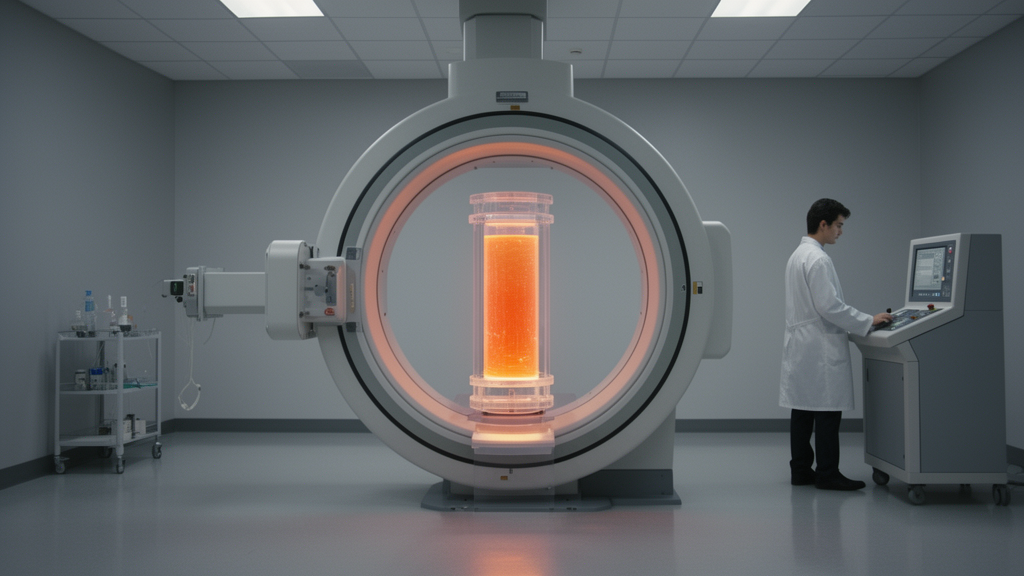
Dynamic single-photon emission computed tomography (SPECT), which tracks how radioactivity distributes and changes in the body over time, has drawn renewed interest since ring-type semiconductor SPECT/CT systems entered clinical use. Yet the clinical value of dynamic SPECT has not been firmly established. A new phantom study published in EJNMMI Physics set out to measure how well a ring-type semiconductor system performs in dynamic imaging, and to identify the reconstruction settings and calibration factors that give the most reliable quantitative results.

The researchers built a controlled model of changing radioactivity: two 40-millilitre balloon tubes, one at the centre and one at the periphery of a cylindrical phantom, were filled with a Tc-99m solution infused at a constant rate by a syringe pump. The team then acquired dynamic SPECT images with the ring-type system and, for comparison, dynamic planar images with a conventional Anger-type camera. Radioactivity concentrations in the balloons were measured during imaging to generate time–activity curves, the basic quantitative output of any dynamic study.

Reconstruction conditions mattered greatly. Dynamic SPECT data were reconstructed using acquisition times of 5 and 15 seconds and eight different values of beta, the noise-suppression parameter in a Bayesian penalty likelihood method, ranging from 0.005 to 0.2. The team also examined whether specific conversion factors were needed to translate reconstructed image values into true radioactivity concentrations, and compared the time–activity curves from the two systems to find the optimal settings.

The results revealed a clear trade-off. Time–activity curves from planar imaging showed better linearity than those from SPECT, and the SPECT curves fluctuated considerably, especially at short acquisition times. However, the two modalities behaved very differently when geometry got crowded: when the two adjacent balloons overlapped, planar imaging merged them into a single combined curve, while SPECT resolved and measured them separately.

The beta parameter proved critical. Under low-count-rate conditions, high beta values between 0.12 and 0.2 suppressed noise so aggressively that signal was lost. The Becquerel calibration factor, used to convert reconstructed image values into radioactivity concentration, was highly dependent on both acquisition and reconstruction conditions. The values closest to theoretical expectations were obtained with a beta of 0.02, identifying that setting as the most appropriate of those tested for dynamic SPECT on this system.

The authors conclude that time–activity curves from the ring-type system showed reduced linearity and greater fluctuations than those from the Anger-type system, but that dynamic SPECT accurately separated and measured adjacent targets even when they overlapped in planar images, and that suitable reconstruction parameters and calibration factors were identified. As a phantom study, the work defines the operating conditions for future clinical evaluation rather than demonstrating patient benefit; the authors themselves note that the efficacy of dynamic SPECT in clinical practice has not yet been sufficiently demonstrated.

Subject of Research: Phantom evaluation of dynamic SPECT imaging performance and reconstruction parameters on a ring-type semiconductor SPECT/CT system compared with an Anger-type system

Article Title: Phantom evaluation of dynamic SPECT imaging with a ring-type semiconductor SPECT/CT system: comparison with an anger-type system

Article References: Tanaka, Y., Hebiguchi, H., Odagiri, H., Hatano, A., Miyoshi, A., Ooura, K., Jimbo, H., Takeuchi, T., Kodama, H., Takanami, K., Usui, A., & Kaneta, T. (2026). Phantom evaluation of dynamic SPECT imaging with a ring-type semiconductor SPECT/CT system: comparison with an anger-type system. EJNMMI Physics. https://doi.org/10.1186/s40658-026-00953-6

Image Credits: AI Generated

DOI: 10.1186/s40658-026-00953-6

Keywords: dynamic SPECT, SPECT/CT, ring-type semiconductor detector, Anger camera, phantom study, Tc-99m, time–activity curves, image reconstruction, Bayesian penalty likelihood, Becquerel calibration factor, EJNMMI Physics, quantitative imaging

Cite Scienmag News

Denise Maddox. (October 28, 2026). Ring-type semiconductor SPECT shows promise for dynamic imaging in phantom tests. Scienmag. https://scienmag.com/ring-type-semiconductor-spect-shows-promise-for-dynamic-imaging-in-phantom-tests/


Denise Maddox. "Ring-type semiconductor SPECT shows promise for dynamic imaging in phantom tests." Scienmag, 28 October 2026, https://scienmag.com/ring-type-semiconductor-spect-shows-promise-for-dynamic-imaging-in-phantom-tests/. Accessed 29 October 2026.

Denise Maddox. "Ring-type semiconductor SPECT shows promise for dynamic imaging in phantom tests." Scienmag. October 28, 2026. https://scienmag.com/ring-type-semiconductor-spect-shows-promise-for-dynamic-imaging-in-phantom-tests/

Tags: Anger cameraBayesian penalty likelihoodBayesian reconstruction methods in SPECTBecquerel calibration factorcalibration factors in dynamic SPECTclinical applications of dynamic SPECTcontrolled phantom models for imagingdynamic imaging in nuclear medicinedynamic SPECTEJNMMI Physicsimage reconstructionnoise suppression in SPECT reconstructionphantom studies in SPECT imagingphantom studyquantitative imagingquantitative SPECT imagingring-type semiconductor detectorring-type semiconductor SPECTSPECT/CTSPECT/CT system performanceTc-99mTc-99m radioactivity monitoringtime-activity curves in nuclear imagingtime–activity curves
Share26Tweet16
Previous Post

Reaching the disease-activity target is not the same as feeling well in axial spondyloarthritis

Next Post

Ancient Ice Age Water Still Flows Beneath an Italian Plain, New Survey Finds

Related Posts

GANs fight back: review maps how adversarial networks still shape text-to-image synthesis
Technology and Engineering

GANs fight back: review maps how adversarial networks still shape text-to-image synthesis

October 29, 2026
Circadian Syndrome Linked to Higher Risk of Multisite Pain in Chinese Adults
Medicine

Circadian Syndrome Linked to Higher Risk of Multisite Pain in Chinese Adults

October 29, 2026
Digital exclusion linked to worsening depression and health trajectories in older adults
Medicine

Digital exclusion linked to worsening depression and health trajectories in older adults

October 29, 2026
Sleep quality, not sleep length, carries the strongest link between work stress and depression
Medicine

Sleep quality, not sleep length, carries the strongest link between work stress and depression

October 29, 2026
Qualitative study documents resilience and discrimination among sexual and gender minorities in Guyana
Medicine

Qualitative study documents resilience and discrimination among sexual and gender minorities in Guyana

October 29, 2026
Governments Still Lack the Policy Blueprint for Integrated Primary Care
Medicine

Governments Still Lack the Policy Blueprint for Integrated Primary Care

October 29, 2026
Next Post
Ancient Ice Age Water Still Flows Beneath an Italian Plain, New Survey Finds

Ancient Ice Age Water Still Flows Beneath an Italian Plain, New Survey Finds

  • Mothers who receive childcare support from maternal grandparents show more optimized

    Mothers who receive childcare support from maternal grandparents show more parental warmth, finds NTU Singapore study

    27656 shares
    Share 11059 Tweet 6912
  • University of Seville Breaks 120-Year-Old Mystery, Revises a Key Einstein Concept

    1061 shares
    Share 424 Tweet 265
  • Bee body mass, pathogens and local climate influence heat tolerance

    682 shares
    Share 273 Tweet 171
  • Researchers record first-ever images and data of a shark experiencing a boat strike

    546 shares
    Share 218 Tweet 137
  • Groundbreaking Clinical Trial Reveals Lubiprostone Enhances Kidney Function

    531 shares
    Share 212 Tweet 133
Science

Embark on a thrilling journey of discovery with Scienmag.com—your ultimate source for cutting-edge breakthroughs. Immerse yourself in a world where curiosity knows no limits and tomorrow’s possibilities become today’s reality!

RECENT NEWS

  • Financial inclusion boosts Uganda’s growth short term, but slows it in the long run
  • GANs fight back: review maps how adversarial networks still shape text-to-image synthesis
  • Circadian Syndrome Linked to Higher Risk of Multisite Pain in Chinese Adults
  • Digital exclusion linked to worsening depression and health trajectories in older adults

Categories

  • Agriculture
  • Anthropology
  • Archaeology
  • Athmospheric
  • Biology
  • Biotechnology
  • Blog
  • Bussines
  • Cancer
  • Chemistry
  • Climate
  • Earth Science
  • Editorial Policy
  • Marine
  • Mathematics
  • Medicine
  • Pediatry
  • Policy
  • Psychology & Psychiatry
  • Science Education
  • Science News
  • Social Science
  • Space
  • Technology and Engineering

Subscribe to Blog via Email

Enter your email address to subscribe to this blog and receive notifications of new posts by email.

Join 5,150 other subscribers

© 2025 Scienmag - Science Magazine

Welcome Back!

Login to your account below

Forgotten Password?

Retrieve your password

Please enter your username or email address to reset your password.

Log In
No Result
View All Result
  • HOME
  • SCIENCE NEWS
  • CONTACT US

© 2025 Scienmag - Science Magazine

Discover more from Science

Subscribe now to keep reading and get access to the full archive.

Continue reading