


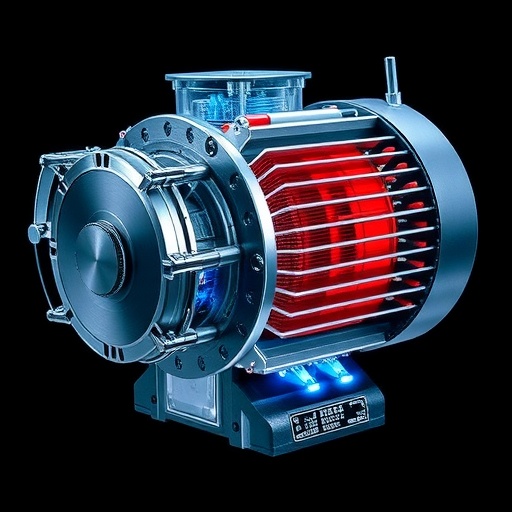
In the quest for more efficient and effective motor control systems, researchers have made groundbreaking strides in the development of a Dual Three-Phase Open-Winding Permanent Magnet Synchronous Motor (DTP-OW-PMSM) drive, aimed at achieving high power ratings while minimizing current harmonics. The current landscape of electric motor drives is one that constantly seeks innovations to tackle issues related to performance, energy efficiency, and system longevity. Consequently, this study presents a revolutionary approach by leveraging a unique configuration of two sets of three-phase windings, positioned with a spatial phase shift of 30 electric degrees, coupled with a sophisticated modulation strategy.
The DTP-OW-PMSM drive is distinguished by its intricate topology, which consists of four inverters powered by three distinct direct current (DC) sources, exhibiting a voltage ratio of 2:1:1. This configuration is not only unique but also holds significant potential for improving overall drive performance through what is known as the four-level effect. The combination of multiple DC sources and a well-structured winding configuration allows for a more versatile and efficient operation, making it ideal for applications in sectors such as electric vehicles, aerospace, and industrial automation.
One of the critical innovations introduced in this research is the DTP-FL Space Vector Pulse Width Modulation (SVPWM) strategy. This method provides a systematic approach to manage the voltage levels while ensuring that the modulation precision remains high. This is achieved by first constructing two identical three-phase four-level space vector diagrams. The division of these diagrams allows for a targeted selection of three adjacent vectors closest to the reference vector within each diagram. Careful vector synthesis is then conducted to ensure that the modulation maintains optimum precision while simultaneously reducing the switching frequency, a feature that is critical for enhancing the lifespan of inverter components.
A notable aspect of this new algorithm is its ability to counteract modulation error that may arise from voltage deviations. Recognizing this challenge, the researchers have optimized the DTP-FL SVPWM strategy through the implementation of a technique known as Unified Duty Ratio Compensation (UDRC). This enhancement further elevates the performance of the motor drive by allowing it to maintain stability and accuracy even during instances of voltage inconsistencies. Experimentation has demonstrated the robustness and effectiveness of this optimized strategy, reinforcing the innovative capacity of the research team.
To quantify the advancements brought about by the DTP-FL SVPWM strategy, extensive simulation and experimental evaluations were performed. The findings revealed a staggering reduction in average current Total Harmonic Distortion (THD)—cutting down by over 29% when compared to traditional modulation strategies across the entire modulation range. This significant reduction in current harmonics is pivotal, as it directly correlates with enhanced efficiency and minimized energy losses during operation. Moreover, the average switching frequencies of high-voltage and low-voltage side inverters displayed considerable decreases, with reductions of 90% and 32%, respectively. Such monumental improvements not only contribute to effective energy management but also bolster the reliability and longevity of the drive systems.
As electric vehicles continue to surge in popularity, and with the increasing reliance on renewable energy systems, the implications of this research resonate beyond conventional applications. The advancements in modulation technology facilitated by this DTP-OW-PMSM drive and the DTP-FL SVPWM strategy could serve as a game changer, significantly enhancing the efficiency and reliability of next-generation motor drives. Particularly in performance-critical applications like electric vehicle propulsion systems and aerospace actuators, the ability to achieve precise and efficient motor control is instrumental in ensuring safety, operational efficacy, and sustainability.
The future holds promise as the research team plans to extend their work into areas such as fault diagnosis and fault-tolerant control methodologies. This forward-looking approach aims to allow the DTP-OW-PMSM drive to sustain stable operations even amidst inverter failures or disturbances in the DC-link. By developing safeguards against potential system failures, the researchers contribute significantly to enhancing safety and dependability in critical motor applications.
Considering the rapid advancements made within this field, it is reasonable to anticipate that the findings will spur further research initiatives aimed at refining motor drive technologies and exploring their scalability. The innovative structures and methodologies established in this work lay down the groundwork for new explorations in energy-efficient motor controls.
Moreover, as the demand for sustainable technologies continues to elevate the importance of improving the efficiency and effectiveness of electric drives, this research encapsulates a significant step towards realizing a future where high-precision and reliable motor drives become the norm rather than the exception. The implications of this work extend far beyond mere technical enhancements; they represent a stride toward a more energy-efficient and sustainable future across various industries.
The complete study, which encompasses exhaustive experimentation and theoretical elucidations, is available for those interested in delving deeper into the findings. The researchers have made their contributions accessible through the DOI link provided, encouraging a broader dissemination of knowledge within the scientific community and industry stakeholders alike.
In conclusion, the research on the DTP-OW-PMSM drive marks an influential progression in motor drive technology. With its twin focus on performance enhancement and harmonics reduction, it presents a compelling model for forthcoming innovations in the field. The confluence of sophisticated design and advanced modulation approaches opens new avenues for efficiency improvements and reliability in dynamic applications, establishing a promising pathway for future explorations.
Keywords
DTP-OW-PMSM drive, SVPWM strategy, electric vehicles, motor control, harmonics reduction, energy efficiency, fault tolerance, electric propulsion systems, renewable energy, efficiency improvement, inverter technology.
Cite Scienmag News
Grant Pearson. (October 20, 2025). Revolutionary Motor Design and Control Techniques Boost Efficiency and Accuracy in High-Power Drive Systems. Scienmag. https://scienmag.com/revolutionary-motor-design-and-control-techniques-boost-efficiency-and-accuracy-in-high-power-drive-systems/
Grant Pearson. "Revolutionary Motor Design and Control Techniques Boost Efficiency and Accuracy in High-Power Drive Systems." Scienmag, 20 October 2025, https://scienmag.com/revolutionary-motor-design-and-control-techniques-boost-efficiency-and-accuracy-in-high-power-drive-systems/. Accessed 4 September 2026.
Grant Pearson. "Revolutionary Motor Design and Control Techniques Boost Efficiency and Accuracy in High-Power Drive Systems." Scienmag. October 20, 2025. https://scienmag.com/revolutionary-motor-design-and-control-techniques-boost-efficiency-and-accuracy-in-high-power-drive-systems/


