


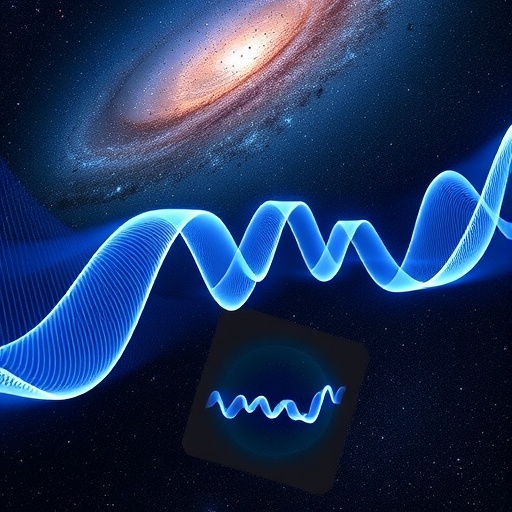
In a groundbreaking development in astrophysics, researchers from the Universities of Birmingham and Sussex have introduced an innovative method for detecting gravitational waves in the milli-Hertz frequency range. This promising new approach aims to unveil cosmic phenomena that have eluded detection by current technological means. Gravitational waves, the ripples in spacetime first predicted by Einstein, have been subject to meticulous observation at higher frequencies through advanced ground-based interferometers like LIGO and Virgo, as well as at ultra-low frequencies via pulsar timing arrays. However, the mid-band frequency range has remained largely unexplored, dubbed a scientific blind spot until now.
The pioneering work presented by scientists through their extensive research focuses on employing cutting-edge technologies related to optical cavities and atomic clocks to detect gravitational waves in the milli-Hertz band, which ranges from 10⁻⁵ to 1 Hz. The scientists have posited a novel detector design that leverages advancements in optical resonators—technologies originally conceived for the purposes of optical atomic clocks—enabling it to measure exceptionally minute phase shifts in laser light instigated by the passing of gravitational waves.
Officially published on October 3rd in the prestigious journal Classical and Quantum Gravity, the researchers revealed their proposal amid growing anticipation in the scientific community. The proposed optical cavity detectors stand out due to their compact size and relative immunity to seismic interferences and Newtonian noise, which have historically posed significant obstacles to gravitational wave detection. This transformative technology promises to fulfill a crucial gap in gravitational wave astronomy by providing tools capable of sensing signals from previously inaccessible cosmic events.
Dr. Vera Guarrera, a co-author of the study from the University of Birmingham, emphasized the significance of this endeavor, articulating that utilizing technologies refined in the realm of optical atomic clocks allows for an expanded frontier in gravitational wave detection capabilities. By employing apparatuses that can comfortably fit on a laboratory table, researchers can envisage establishing a global network of these detectors. This ambitious network could initiate the search for gravitational wave signals that have remained concealed from scientific inquiry for an extended period.
The milli-Hertz frequency range, often referred to as the ‘mid-band,’ is anticipated to host significant signals stemming from a variety of astrophysical and cosmological sources. These sources include the merging of compact binaries comprising white dwarfs and black holes, phenomena that are crucial to our understanding of the universe. While ambitious space missions such as the Laser Interferometer Space Antenna (LISA) are poised to target this frequency band, their deployment is projected for the 2030s. In contrast, the optical resonator detectors proposed in this research possess the advantage of immediate deployment, enabling scientific exploration of this territory right now.
Professor Xavier Calmet from the University of Sussex acknowledged the broader scientific implications of the proposed detectors. He highlighted that this novel approach allows for a detailed examination of astrophysical models related to binary systems within our galaxy, the investigation of mergers involving massive black holes, and even the potential to probe stochastic gravitational wave backgrounds originating from the early universe. The methodologies established in this research provide researchers with the necessary tools to begin examining these signals from terrestrial laboratories while concurrently paving the way for future endeavors in space exploration.
While it is well-recognized that upcoming space-based missions like LISA will present superior sensitivity in detecting gravitational waves, they carry the drawback of long timelines before operational readiness. The optical cavity detectors present researchers with a viable and efficient alternative for immediate exploration of the milli-Hertz range and serve as a crucial companion to current high-frequency observatories such as LIGO.
The structural design of these innovative units involves the integration of pairs of orthogonal ultrastable optical cavities complemented by an atomic frequency reference, allowing for the simultaneous multi-channel detection of gravitational wave signals. This sophisticated configuration significantly enhances the overall sensitivity of the detector while also permitting the differentiation of gravitational wave polarization and identification of the direction from which these waves emanate.
The research team’s proposal opens the door to a new landscape in gravitational wave detection methodologies, providing substantial opportunities for scientific engagement and exploration of the cosmos. Furthermore, integrating these optical resonator detectors with existing atomic clock networks has the potential to extend the reach of gravitational wave detection into even lower frequencies, thus enriching the academic pursuit of high-frequency observatories.
As the realm of gravitational wave astronomy continues to evolve, the work conducted by this inclusive team at the Universities of Birmingham and Sussex exemplifies the transformative impact cutting-edge technology can have on our understanding of the universe. They have ushered in an era characterized by the prospect of uncharted astronomical phenomena coming to light, once relegated to the shadows of scientific inquiry. With the research community eagerly watching, these findings set the stage for unprecedented advancements in both terrestrial laboratories and beyond.
In conclusion, as we stand on the threshold of exploring the mysteries of gravitational waves in the milli-Hertz frequency range, it’s clear that the contributions from researchers in this field will play a pivotal role in shaping our understanding of the universe. The development of these compact, highly sensitive detectors not only provides avenues for immediate discovery but also lays the groundwork for future explorations that could profoundly alter our comprehension of cosmic phenomena. The excitement surrounding this innovative detection strategy is palpable, promising a deeper look into the intertwining dance of time and space, as we endeavor to unravel the universe’s most profound secrets.
Keywords
Gravitational waves, milli-Hertz frequency, optical resonators, astrophysics, Einstein, spacetime, LIGO, Virgo, black holes, atomic clocks, cosmic phenomena, gravitational wave astronomy.
Cite Scienmag News
Grant Pearson. (October 2, 2025). Revolutionary Method for Gravitational Wave Detection Unlocks the Milli-Hertz Frontier. Scienmag. https://scienmag.com/revolutionary-method-for-gravitational-wave-detection-unlocks-the-milli-hertz-frontier/
Grant Pearson. "Revolutionary Method for Gravitational Wave Detection Unlocks the Milli-Hertz Frontier." Scienmag, 2 October 2025, https://scienmag.com/revolutionary-method-for-gravitational-wave-detection-unlocks-the-milli-hertz-frontier/. Accessed 3 September 2026.
Grant Pearson. "Revolutionary Method for Gravitational Wave Detection Unlocks the Milli-Hertz Frontier." Scienmag. October 2, 2025. https://scienmag.com/revolutionary-method-for-gravitational-wave-detection-unlocks-the-milli-hertz-frontier/


