


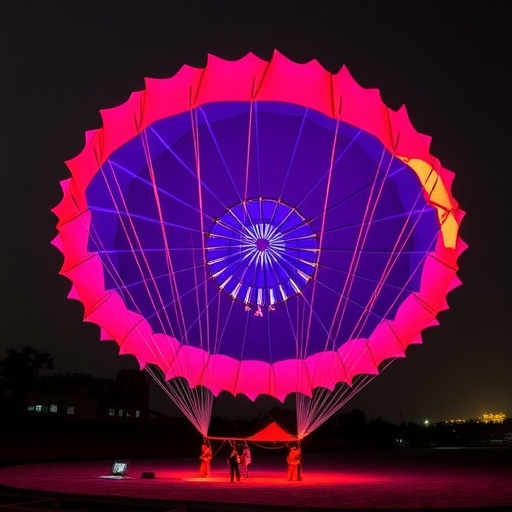
In a remarkable advancement in aerospace engineering, researchers at Polytechnique Montréal have leveraged the ancient art of kirigami—a traditional Japanese paper-cutting technique—to develop an innovative parachute design that promises to revolutionize aerial delivery systems. This groundbreaking work, led by professors David Mélançon and Frédérick Gosselin from the Mechanical Engineering Department, explores the potential of applying kirigami principles to create a new class of parachutes, allowing for programmable reconfiguration and improved functionality, a feature that conventional parachutes cannot offer.
The fundamental principle of kirigami is to manipulate the mechanical properties of planar materials through a combination of strategic cuts and folds. This technique, popular among children crafting paper snowflakes, has traditionally found applications in various engineering fields. These include the development of flexible medical devices, deployable structures for space exploration, and extendable architectures. However, until now, kirigami has never been harnessed for parachute technology.
The newly developed parachute consists of a plastic sheet intricately cut into a closed-loop kirigami pattern. Remarkably, this unique configuration allows the parachute to transform into an inverted bell shape during free fall, regardless of the release angle. This characteristic is crucial, as it ensures quick stabilization and a predictable ballistic descent trajectory, distinguishing it from traditional parachute designs which often lack this degree of control.
Professor Mélançon highlights the significance of this advancement by emphasizing the parachute’s consistent performance, which does not waver even when subjected to varied sizes in the device. Such stability is essential for applications that demand precision and reliability, particularly in sensitive operations like humanitarian aid delivery. The seamless design of the parachute, coupled with a single suspension line connecting it to the payload, enhances usability and simplifies deployment.
The research team has conducted extensive testing to validate the effectiveness of their kirigami parachute concept. Utilizing numerical simulations, wind-tunnel experiments, and live drops from drones, they have gathered significant data supporting the parachute’s promising capabilities. The preliminary results suggest a considerable potential for this technology, not just in delivering essential supplies in remote areas but also in more ambitious missions, such as exploring extraterrestrial terrains on Mars.
One of the most appealing aspects of the kirigami parachute is its low production cost. The team employs laser cutting techniques to fabricate these innovative devices, but they also indicate that a straightforward die-cutting process could suffice for production. This affordability opens the door for widespread adoption in various fields, especially in emergency response scenarios where efficient and cost-effective delivery systems are crucial.
The implications for humanitarian aid are particularly noteworthy. In areas struck by natural disasters or during conflicts, traditional supply routes may become compromised, making aerial delivery of crucial supplies paramount. The kirigami parachute’s ability to deliver food, water, and medical supplies efficiently could transform the way assistance is rendered in crisis situations, ultimately saving lives by ensuring that help reaches those in need in a timely manner.
In addition to humanitarian applications, the researchers envision the parachute’s use in delivering scientific instruments or experiments to remote parts of the world or even other planets. With a reliable means of descent, payloads could be precisely delivered to designated locations, minimizing the risk of losing valuable equipment. The potential for scaling up this technology adds to its versatility; larger versions of the parachute could facilitate the transport of heavier cargo or multiple packages at once.
Looking ahead, the Polytechnique Montréal research team is not content to stop with a single design. Their ongoing research aims to explore various cutting patterns to endow the parachutes with additional functionalities. For instance, future iterations could be designed to spiral down to the ground or glide before release, optimizing delivery for specific payloads or conditions.
As they venture into this new design endeavor, the team recognizes the myriad possibilities that lie ahead. By varying the descent trajectory based on the cargo, they envision systems where delivered items could be sorted mid-air before reaching the ground. This level of control could open up entirely new avenues for logistical operations, significantly enhancing the efficiency of supply chains in a variety of industries.
In conclusion, the integration of kirigami principles into parachute design marks a significant leap forward in engineering and materials science. By marrying art with technology, the researchers at Polytechnique Montréal are not only opening the door to novel applications of kirigami but also addressing pressing global challenges with innovative solutions. As this research evolves, the possibilities for its impact on fields ranging from humanitarian aid to extraterrestrial exploration become increasingly exciting.
The kirigami-inspired parachutes represent a fusion of creativity and practicality that has the potential to redefine how we approach aerial logistics in the modern world, turning imaginative concepts into life-saving realities.
Keywords
Kirigami, parachute technology, aerospace engineering, humanitarian aid, Polytechnique Montréal, mechanical properties, programmable reconfiguration, aerial logistics, innovation, design, flexible structures.
Cite Scienmag News
Grant Pearson. (October 1, 2025). Revolutionary Kirigami Parachute Designed for Humanitarian Aid Unveiled. Scienmag. https://scienmag.com/revolutionary-kirigami-parachute-designed-for-humanitarian-aid-unveiled/
Grant Pearson. "Revolutionary Kirigami Parachute Designed for Humanitarian Aid Unveiled." Scienmag, 1 October 2025, https://scienmag.com/revolutionary-kirigami-parachute-designed-for-humanitarian-aid-unveiled/. Accessed 3 September 2026.
Grant Pearson. "Revolutionary Kirigami Parachute Designed for Humanitarian Aid Unveiled." Scienmag. October 1, 2025. https://scienmag.com/revolutionary-kirigami-parachute-designed-for-humanitarian-aid-unveiled/


