


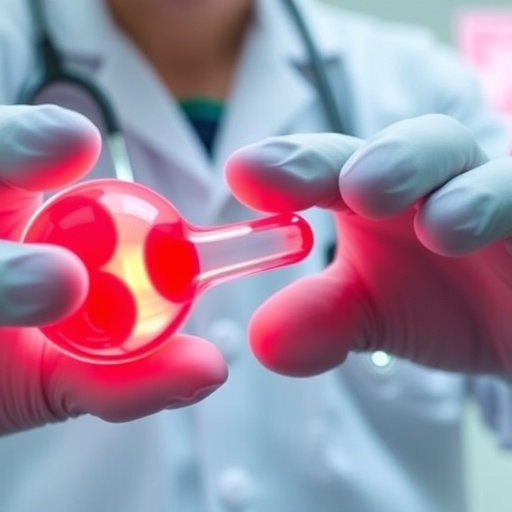
Blood clotting is a fundamental biological mechanism that has been safeguarding life for millions of years by preventing excessive bleeding. However, in traumatic instances such as severe injuries or hemorrhages, the body’s natural clotting processes can be insufficiently swift or robust to prevent life-threatening blood loss. In a groundbreaking collaborative effort, researchers are pioneering a revolutionary engineered blood clot that outperforms its natural counterpart in speed and durability, potentially redefining emergency and surgical care.
A team from the Paul M. Rady Department of Mechanical Engineering at the University of Colorado Boulder, along with collaborators from McGill University, the University of British Columbia, the University of Toronto, and the Versiti Blood Research Institutes, have worked together to create a new biomaterial—a strengthened blood clot fabricated from the body’s own red blood cells. Their findings, detailed in the prestigious journal Nature, reveal a clotting system that is not only faster to form but is also significantly tougher than any natural clot documented.
Traditionally, blood clots form through the interaction of platelets and fibrin proteins, which create a mesh that stops bleeding by sealing wounds. While this natural system is effective under moderate circumstances, it may prove too brittle or slow for critical injuries like gunshot wounds or catastrophic internal bleeding. The natural clots, although intricate, have limitations in mechanical strength and formation speed, which can prove fatal in high-stress scenarios.
The innovation at the heart of this breakthrough involves a process known as “click clotting,” a chemical technique that rapidly links red blood cells into a cohesive, gel-like matrix. This engineered network acts in concert with the body’s natural platelet-fibrin mesh, reinforcing the clot’s structure without disrupting normal blood chemistry. Remarkably, this dual-layer clot formation occurs within approximately five seconds, a fraction of the time natural clots typically take, which is crucial in emergency settings.
Extensive mechanical testing combined with computational models, led by CU Boulder’s Nonlinear Mechanics Laboratory, demonstrated that these engineered clots exhibit thirteen times greater toughness and four times stronger adhesion than native clots. The robust network resists rupture under pressure, promising a significant advancement in managing severe bleeding. The research capitalized on the innate properties of red blood cells—the body’s own biochemical constituents—bestowing the clots with unparalleled biocompatibility.
One of the most striking facets of the engineered clots is their transience. Built from red blood cells, which naturally degrade over time, these clots offer a self-limiting advantage. Unlike synthetic alternatives comprised of polymers or foreign substances, these cytogel clots dissolve naturally, mitigating the risks of thrombosis or embolism associated with persistent clots. The engineered clots reconcile the need for immediate, vigorous defense against blood loss with the requirement for safety and biocompatibility in the long term.
Beyond their mechanical attributes, these reinforced clots also exhibit biological benefits. Laboratory and in vivo rodent models revealed that they not only staunch bleeding effectively but also promote tissue repair and reduce inflammatory responses. This dual function enhances their potential use not only in trauma care but also in controlled surgical environments, where wound healing and inflammation management are critical.
The collaborative team envisions far-reaching implications for this technology, extending beyond immediate hemostasis. Future applications may include targeted drug delivery systems, localized tissue repair, and specialized biomaterials for regenerative medicine. The success of linking red blood cells into a mechanically and biologically functional material could represent a paradigm shift in how cells are engineered to serve structural and therapeutic functions in the human body.
This pioneering research was conceived through the multidisciplinary synergy of biophysical engineering, chemistry, and medical science, highlighting the power of integrating expertise to solve complex clinical challenges. Associate Professor Jianyu Li of McGill University, spearheading the Laboratory of Biomaterials Mechanics, alongside CU Boulder Associate Professor Rong Long, played pivotal roles in elucidating the mechanical underpinnings that enable these engineered clots to outperform their natural analogs.
The cytogel clots’ ability to rapidly dissipate energy while maintaining structural integrity addresses one of the most vexing challenges in hemostasis: preventing clot rupture during the turbulent and dynamic conditions following severe injury. This mechanical resilience can drastically reduce hemorrhagic mortality by providing a stable, localized barrier to blood loss while also supporting subsequent healing processes.
In conclusion, the advent of click-clotted red blood cell networks marks a significant milestone in trauma medicine and biomaterial science. By harnessing and enhancing natural cellular components through precise chemical engineering, this novel biomaterial transcends the limitations of native blood clots. As research progresses, it promises to unlock new horizons for life-saving interventions and biomaterial innovations that capitalize on the inherent potential of the human body’s own building blocks.
- Paul M. Rady Department of Mechanical Engineering: https://www.colorado.edu/mechanical
- Laboratory of Biomaterials Mechanics: https://sites.google.com/view/libiomater/home
- Nonlinear Mechanics Laboratory: http://spot.colorado.edu/~rolo5514/
- Nature Journal Article DOI: http://dx.doi.org/10.1038/s41586-026-10412-y
- News Release by McGill University: https://www.mcgill.ca/newsroom/channels/news/mcgill-researchers-engineer-faster-more-effective-blood-clots-372695
References:
Li, J., Jiang, S., Long, R., et al. (2026). Engineering rapid and tough red blood cell-based clots via click chemistry. Nature, https://doi.org/10.1038/s41586-026-10412-y
Keywords
Blood clotting, engineered biomaterials, red blood cells, hemostasis, click chemistry, trauma care, biocompatibility, cytogel, fibrin, platelet network, mechanical toughness, regenerative medicine
Cite Scienmag News
Denise Maddox. (June 15, 2026). Revolutionary Blood Clot Technology Set to Transform Emergency Medicine. Scienmag. https://scienmag.com/revolutionary-blood-clot-technology-set-to-transform-emergency-medicine/
Denise Maddox. "Revolutionary Blood Clot Technology Set to Transform Emergency Medicine." Scienmag, 15 June 2026, https://scienmag.com/revolutionary-blood-clot-technology-set-to-transform-emergency-medicine/. Accessed 3 September 2026.
Denise Maddox. "Revolutionary Blood Clot Technology Set to Transform Emergency Medicine." Scienmag. June 15, 2026. https://scienmag.com/revolutionary-blood-clot-technology-set-to-transform-emergency-medicine/


