


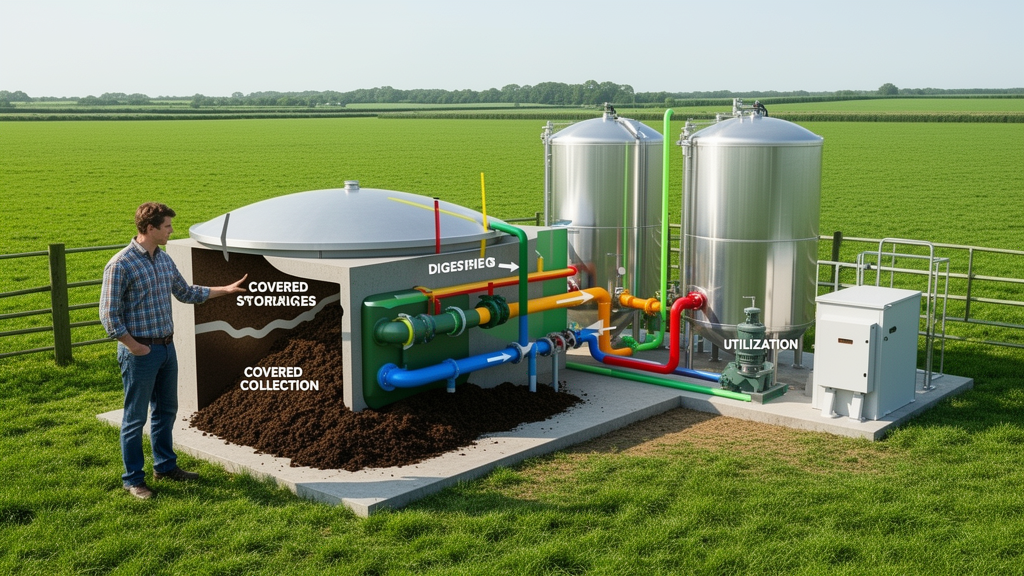
A systematic review comparing biogas production from chicken manure, piggery waste and cow dung found that co-digestion and feedstock-specific pretreatment generally improved methane output and process stability, but large gaps remained between theoretical biomethane potential and experimentally achieved yields. The analysis, which examined studies published from 2013 to 2023, identified piggery waste as the strongest-performing substrate, chicken manure as an energy-rich but inhibition-prone feed, and cow dung as a comparatively stable material limited by slow lignocellulosic hydrolysis. Wide differences in operating conditions, reactor design, microbial adaptation and system scale prevented direct conversion of laboratory results into a single performance estimate.
The review focused on anaerobic digestion, in which microbial communities decompose organic matter without oxygen and produce methane-rich gas. The process proceeds through four sequential stages—hydrolysis, acidogenesis, acetogenesis and methanogenesis—each involving specialized microbial groups. Temperature, pH, substrate composition and moisture content can affect overall digestion, alongside operational factors such as hydraulic retention time and mixing. Livestock manure is attractive as a feedstock because it contains substantial organic matter and is continuously available in agricultural settings, but its chemical and physical properties strongly influence gas yield, degradation rate and process stability.
Chicken manure typically has a carbon-to-nitrogen ratio near 10:1 and releases substantial ammonia as uric acid is converted to ammonium. This nitrogen excess can raise total and free ammonia, inhibit methanogenic microorganisms and contribute to volatile fatty acid accumulation. Laboratory studies reviewed by the authors reported methane yields commonly between 275 and 350 litres of methane per kilogram of volatile solids under mesophilic conditions, although short or poorly controlled systems often performed worse. One early experiment recorded a peak of 90 cubic centimetres per kilogram per day by day 14, while another produced as much as 321 litres of biogas over 30 days with methane concentration of 45.71%.
Water extraction improved the manure’s nutrient balance without adding chemical reagents. Cold- and hot-water extraction increased the carbon-to-nitrogen ratio from 10:1 to 20:1 and 27:1, respectively, and were associated with biogas yields of 500–600 and 527–800 millilitres per gram of volatile solids, compared with 362–500 millilitres for untreated manure. The corresponding methane increases were reported as 18% and 39%. Co-digestion with carbon-rich plant material can also improve methane concentration and stability, although the outcome may involve a trade-off: a chicken-manure mixture with lemon grass reached 66.20% methane, yet essential oils in the plant may inhibit microbial activity and reduce total gas production. Microbial acclimation, trace-element supplementation and lower digester temperatures are additional controls that have improved performance, but they can raise operating complexity and cost.
Piggery waste displayed the highest methane potential among the three feedstocks because it is highly biodegradable and has a comparatively favourable nutrient balance. Reviewed studies often reported yields of 350 to more than 400 normal litres of methane per kilogram of volatile solids when pig manure was co-digested with carbon-rich agro-industrial residues. Co-digestion of Iberian pig manure with tomato pulp, grape pomace or olive residues produced a maximum reported yield of 404 normal litres of methane per kilogram of volatile solids at a manure-to-by-product ratio of 2:1. Maintaining a carbon-to-nitrogen ratio between 20 and 30 was identified as important for efficient methane production and for limiting ammonia inhibition. These values came from particular mixtures and operating conditions, so they do not establish a universal yield for all piggery-waste digesters.
Small field installations offer additional evidence for the waste-management potential of pig manure, although they also show why short trials do not necessarily predict stable long-term output. Two 1,600-litre digesters installed at pig farms in Abidjan produced 22.63 and 16.31 cubic metres of biogas over 56 days. Methane content reached 80%–82% after purification, while chemical oxygen demand fell by about 68% and biochemical oxygen demand by 48%–51%. Most measured pathogens were eliminated, although spore-forming organisms persisted. Gas production rose rapidly during the first two to four weeks and then declined, reaching almost zero in one system by day 49. The observations indicate that feedstock availability and process stability remain important constraints rather than demonstrating sustained production throughout the monitoring period.
Cow dung supplied the most stable digestion environment of the three reviewed wastes, aided by its high moisture content, buffering capacity and naturally occurring anaerobic inoculum. Its performance was nevertheless limited by lignocellulosic fibres that resist hydrolysis. Thermophilic digestion at 53 degrees Celsius produced cumulative biogas of about 0.15 litres per kilogram of volatile solids, with average methane concentration of 47%. Ultrasonic pretreatment was investigated as a way to disrupt those structures; laboratory optimization identified 15 minutes of sonication, a slurry ratio of 2.31 and an 18-day retention time, yielding 21.339 millilitres of biogas in the reported test. Co-digestion proved more competitive than mono-digestion in several studies, including a 75% poultry-manure and 25% cow-dung mixture that produced 15,796 millilitres of biogas with 60.7% methane. A separate 75% cow-dung mixture produced the highest methane concentration in that comparison, 63.6%, but with a lower total gas yield, illustrating the distinction between gas quantity and quality.
The review identifies pretreatment as a way to make livestock residues more accessible to microbes. Milling and extrusion reduce particle size and cellulose crystallinity, while microwave irradiation and liquid hot water improve the breakdown of lignocellulosic material. Steam explosion, commonly operated at 160–200 degrees Celsius and 0.69–4.83 megapascals, uses saturated steam, sudden depressurization and mechanical shear to open the biomass structure. Alkaline agents such as sodium hydroxide or calcium hydroxide solubilise lignin, whereas acids enhance hemicellulose solubilisation but require corrosion-resistant equipment and chemical recovery. Biological pretreatment with white- and brown-rot fungi, microbial consortia or enzymes is comparatively mild, but it is slower and requires controlled space. The appropriate method and operating conditions depend on substrate properties, including moisture and lignin content, so the reviewed techniques cannot be applied interchangeably.
Comparisons across the literature remain difficult because studies use inconsistent units such as total solids, volatile solids and chemical oxygen demand, as well as different digestion times, inocula and gas-measurement methods. Laboratory batch assays also tend to outperform pilot and full-scale reactors, where heat transfer, hydrodynamics, heterogeneous feedstock and operational disturbances can reduce conversion efficiency. The review reports that a full-scale chicken-manure digester may eventually approach 90% of laboratory biomethane potential after a prolonged acclimation phase, a performance that short experiments may fail to capture. Theoretical values calculated from elemental composition should therefore be treated as upper bounds rather than guaranteed operating results, especially for nitrogen-rich manure and fibrous cow dung. Scale-dependent losses and inhibition mean that high theoretical potential does not by itself demonstrate commercially efficient production.
Several research priorities follow from the synthesis. Long-term microbial responses to ammonia require direct investigation in continuous digesters, and 16S rRNA or metagenomic analyses should be paired with gas-production measurements. Advanced pretreatments also need techno-economic and life-cycle evaluation to determine whether their gains survive after energy, chemical recovery and equipment costs are included. Digestate quality needs closer scrutiny, particularly concerning heavy metals, antibiotic residues and long-term soil effects. Sensor-based monitoring, machine-learning optimisation and real-time control show promise, but the review notes that they have rarely been validated at full scale with variable feeds and climates. Overall, the evidence supports livestock biogas as a viable waste-management and renewable-energy pathway, while also showing that stable methane production depends on optimised feedstocks, controlled digestion, appropriate pretreatment and co-digestion rather than on a universally superior manure type.
Subject of Research: Anaerobic digestion and methane production from chicken manure, piggery waste and cow dung
Article Title: Review sustainable energy from livestock waste: a review of biogas production pathways
Article References: Baloyi, M. E., & Modise, S. J. (2026). Review sustainable energy from livestock waste: a review of biogas production pathways. Frontiers in Energy Research, 14, Article 1940650. https://doi.org/10.3389/fenrg.2026.1940650
Image Credits: AI Generated
DOI: 10.3389/fenrg.2026.1940650
Keywords: livestock waste, biogas, anaerobic digestion, methane yield, co-digestion, feedstock pretreatment, ammonia inhibition, lignocellulosic hydrolysis, waste-to-energy, circular bioenergy, Review, sustainable
Cite Scienmag News
William Thompson. (October 22, 2026). Review maps livestock-waste biogas pathways and performance gaps. Scienmag. https://scienmag.com/review-maps-livestock-waste-biogas-pathways-and-performance-gaps/
William Thompson. "Review maps livestock-waste biogas pathways and performance gaps." Scienmag, 22 October 2026, https://scienmag.com/review-maps-livestock-waste-biogas-pathways-and-performance-gaps/. Accessed 22 October 2026.
William Thompson. "Review maps livestock-waste biogas pathways and performance gaps." Scienmag. October 22, 2026. https://scienmag.com/review-maps-livestock-waste-biogas-pathways-and-performance-gaps/


