

Thursday, October 22, 2026
Science
No Result
View All Result
  • Login
  • HOME
  • SCIENCE NEWS
  • CONTACT US
  • HOME
  • SCIENCE NEWS
  • CONTACT US
No Result
View All Result
Scienmag
No Result
View All Result
Home Science News

Computational Modeling Links Damping to Beam–Foundation Regime Shifts

October 22, 2026
in Science News
Denise Maddox
By Denise Maddox Scienmag Editorial Profile - Mechanical Engineering
Reading Time: 2 mins read
0
Computational Modeling Links Damping to Beam–Foundation Regime Shifts

Computational Modeling Links Damping to Beam–Foundation Regime Shifts

65
SHARES
587
VIEWS
Share on FacebookShare on Twitter
ADVERTISEMENT

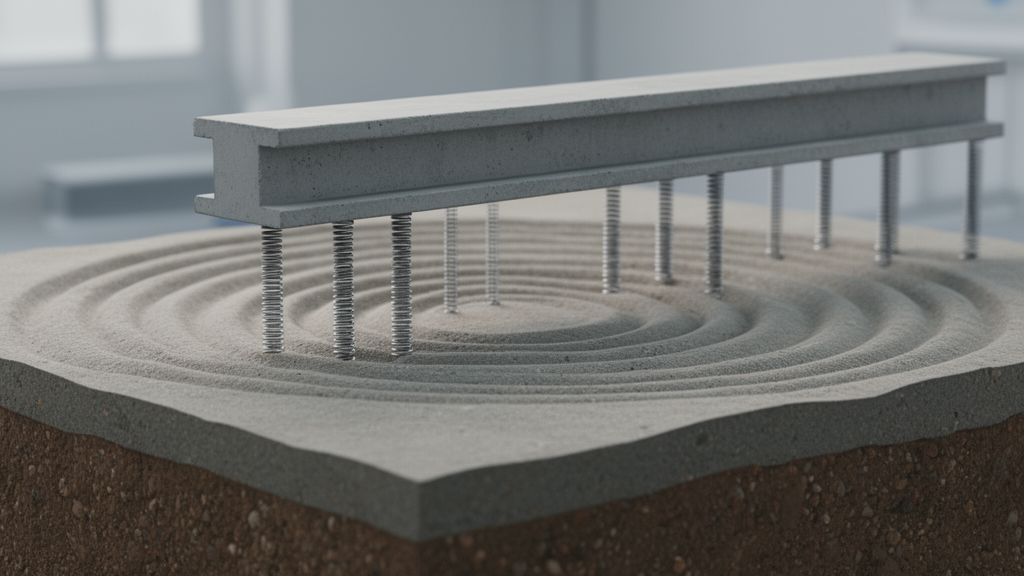
A computational study finds that increasing damping shifts elastically constrained beam–foundation systems from undamped motion through underdamped oscillations toward overdamped behavior and complete vibration suppression. The analysis also shows that greater foundation stiffness raises natural frequencies and supports more effective control of vibration across the modeled systems. The researchers examined Timoshenko, shear, Rayleigh and Euler–Bernoulli beam models resting on viscoelastic Filonenko-Borodich and Hetényi foundations.

Their scope included the effects of damping, foundation stiffness, shear deformation and rotary inertia on dynamic transitions among undamped, underdamped and overdamped regimes. The work is a mathematical and computational study of beam dynamics rather than an investigation of a specific structure or population. To analyze the systems, the team used separation of variables to obtain an analytical solution and the Galerkin finite element method for numerical calculations.

The formulation incorporated non-classical boundary conditions. Together, the two approaches were used to examine frequency characteristics, oscillation amplitudes and stability behavior, as well as to compare analytical predictions with numerical results. The results indicate that foundation stiffness and damping influence distinct aspects of the modeled response.

Increasing foundation stiffness was associated with higher natural frequencies and more effective vibration control. Increasing damping, by contrast, produced a gradual transition from sustained oscillations to a regime in which vibrations were suppressed, rather than simply lowering the amplitude while preserving the original type of dynamic behavior. Good agreement between the analytical and numerical findings supports the robustness of the proposed formulation.

The authors say the findings offer insights for advanced structural-system design, while identifying non-uniform geometries, heterogeneous materials and environmental effects as possible extensions for further study.

Subject of Research: Computational modeling of damping-driven vibration transitions in viscoelastically supported beam–foundation systems.

Article Title: A computational dynamics and damping–induced transitions in beam–foundation systems with viscoelastic constraints

Article References: Elsadig, M., Kanwal, S., Nawaz, R., & Zia, Q. M. Z. (2026). A computational dynamics and damping–induced transitions in beam–foundation systems with viscoelastic constraints. PLOS One, 21(10), e0359573. https://doi.org/10.1371/journal.pone.0359573

Image Credits: AI Generated

DOI: 10.1371/journal.pone.0359573

Keywords: beam dynamics, vibration damping, viscoelastic foundations, natural frequencies, Timoshenko beams, finite element method, Filonenko-Borodich foundation, Hetényi foundation, underdamped motion, overdamped response, computational, dynamics

Cite Scienmag News

Denise Maddox. (October 22, 2026). Computational Modeling Links Damping to Beam–Foundation Regime Shifts. Scienmag. https://scienmag.com/computational-modeling-links-damping-to-beam-foundation-regime-shifts/

Denise Maddox. "Computational Modeling Links Damping to Beam–Foundation Regime Shifts." Scienmag, 22 October 2026, https://scienmag.com/computational-modeling-links-damping-to-beam-foundation-regime-shifts/. Accessed 22 October 2026.

Denise Maddox. "Computational Modeling Links Damping to Beam–Foundation Regime Shifts." Scienmag. October 22, 2026. https://scienmag.com/computational-modeling-links-damping-to-beam-foundation-regime-shifts/


Tags: beam dynamicsbeam–foundation dynamic regime shiftsbeam–foundation system damping effectsboundary conditions in computational beam modelscomputationalcomputational modeling of vibration regimescontrol of vibrations in structural engineeringdamping and foundation stiffness interactiondynamicsFilonenko-Borodich foundationfinite element methodfinite element method in beam vibration analysisHetényi foundationinfluence of foundation stiffness on natural frequenciesnatural frequenciesoscillation amplitude and stability in beam systemsoverdamped responseTimoshenko and Euler–Bernoulli beam analysisTimoshenko beamstransition from underdamped to overdamped vibrationsunderdamped motionvibration dampingviscoelastic foundation models in beam dynamicsviscoelastic foundations
Share26Tweet16
Previous Post

Review maps livestock-waste biogas pathways and performance gaps

Next Post

Mouse study links stress to shortened astrocyte cilia in amygdala

Related Posts

Mouse study links stress to shortened astrocyte cilia in amygdala
Social Science

Mouse study links stress to shortened astrocyte cilia in amygdala

October 22, 2026
Review maps livestock-waste biogas pathways and performance gaps
Science News

Review maps livestock-waste biogas pathways and performance gaps

October 22, 2026
Fuzzy game theory balances cost and speed in automated electric vehicle logistics
Science News

Fuzzy game theory balances cost and speed in automated electric vehicle logistics

October 22, 2026
Review assesses miRNA nanocarriers for osteosarcoma
Biology

Review assesses miRNA nanocarriers for osteosarcoma

October 22, 2026
Disordered substrates promote tumor cell escape in simplified models
Biology

Disordered substrates promote tumor cell escape in simplified models

October 22, 2026
Sierra Leone suspected typhoid notifications exceed regional blood-culture benchmark
Medicine

Sierra Leone suspected typhoid notifications exceed regional blood-culture benchmark

October 22, 2026
Next Post
Mouse study links stress to shortened astrocyte cilia in amygdala

Mouse study links stress to shortened astrocyte cilia in amygdala

  • Mothers who receive childcare support from maternal grandparents show more optimized

    Mothers who receive childcare support from maternal grandparents show more parental warmth, finds NTU Singapore study

    27656 shares
    Share 11059 Tweet 6912
  • University of Seville Breaks 120-Year-Old Mystery, Revises a Key Einstein Concept

    1061 shares
    Share 424 Tweet 265
  • Bee body mass, pathogens and local climate influence heat tolerance

    682 shares
    Share 273 Tweet 171
  • Researchers record first-ever images and data of a shark experiencing a boat strike

    546 shares
    Share 218 Tweet 137
  • Groundbreaking Clinical Trial Reveals Lubiprostone Enhances Kidney Function

    531 shares
    Share 212 Tweet 133
Science

Embark on a thrilling journey of discovery with Scienmag.com—your ultimate source for cutting-edge breakthroughs. Immerse yourself in a world where curiosity knows no limits and tomorrow’s possibilities become today’s reality!

RECENT NEWS

  • Mouse study links stress to shortened astrocyte cilia in amygdala
  • Computational Modeling Links Damping to Beam–Foundation Regime Shifts
  • Review maps livestock-waste biogas pathways and performance gaps
  • Fuzzy game theory balances cost and speed in automated electric vehicle logistics

Categories

  • Agriculture
  • Anthropology
  • Archaeology
  • Athmospheric
  • Biology
  • Biotechnology
  • Blog
  • Bussines
  • Cancer
  • Chemistry
  • Climate
  • Earth Science
  • Editorial Policy
  • Marine
  • Mathematics
  • Medicine
  • Pediatry
  • Policy
  • Psychology & Psychiatry
  • Science Education
  • Science News
  • Social Science
  • Space
  • Technology and Engineering

Subscribe to Blog via Email

Enter your email address to subscribe to this blog and receive notifications of new posts by email.

Join 5,151 other subscribers

© 2025 Scienmag - Science Magazine

Welcome Back!

Login to your account below

Forgotten Password?

Retrieve your password

Please enter your username or email address to reset your password.

Log In
No Result
View All Result
  • HOME
  • SCIENCE NEWS
  • CONTACT US

© 2025 Scienmag - Science Magazine

Discover more from Science

Subscribe now to keep reading and get access to the full archive.

Continue reading