


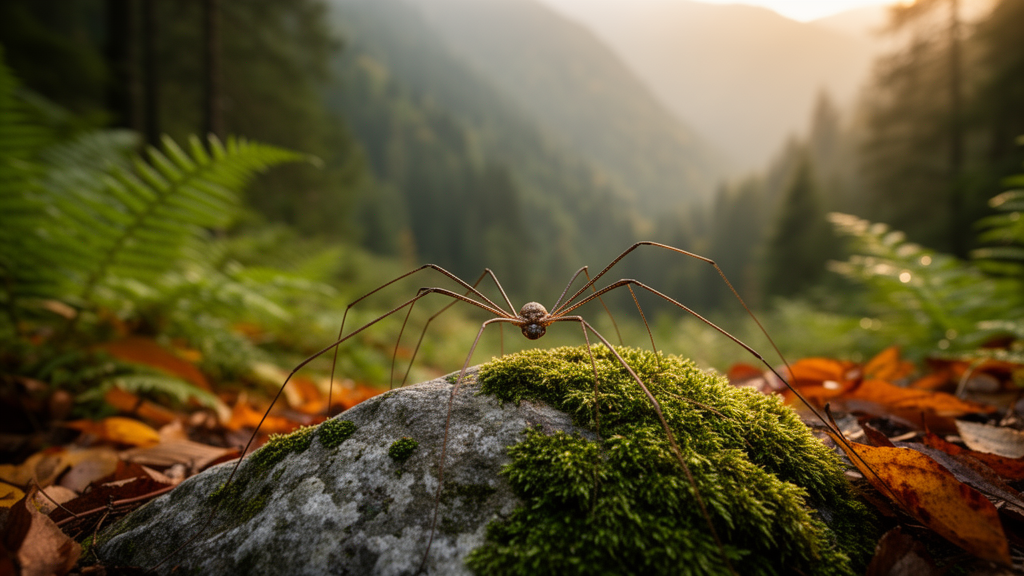
A literature and collection-based review records about 48 harvestman species, or Opiliones, in Georgia, with the greatest representation from the families Phalangiidae and Nemastomatidae. The study synthesizes published records and unpublished collection data to document species distributions, type localities, habitats and elevation ranges, while also flagging uncertain identifications and taxonomic questions that require further examination.
This was a regional faonomic review rather than a new field survey or experimental study. The authors critically assessed literature on Georgian and Caucasian harvestmen and added records from the private collection of coauthor Jochen Martens. These collection records supplied information on habitat and elevation that was often absent from older publications. A map of collection localities was produced in QGIS 3.30.3 using locality names, although many historical records lacked coordinates and could not be georeferenced precisely.
The resulting inventory covers species from several families and genera, including Parasiro, Dicranolasma, Calathocratus, Trogulus, Giljarovia, Histricostoma, Mitostoma, Nemaspela, Paranemastoma, Vestiferum, Nelima, Lacinius, Mitopus, Odiellus, Opilio, Phalangium, Rilaena, Metaplatybunus and Zacheus. The list distinguishes between original descriptions, redescriptions, new locality records and taxonomic changes. It also revives Paranemastoma bacurianum as a species, makes Metaplatybunus hypanicus a junior synonym of M. georgicus, and removes Paranemastoma umbo from the Georgian and Caucasian lists because its original locality label is considered probably incorrect.
The review shows that many recorded Georgian harvestmen are restricted to the Caucasus or to Georgia. Examples include Nemaspela birsteini, Nemaspela gagrica, Nemaspela melouri, Nemaspela prometheus and Nemaspela kotia, all of which are listed as Georgian cave endemics. Nemaspela abchasica is described as endemic to caves of the western Caucasus in Georgia and the Russian Caucasus. These cave records are species-level distribution statements rather than evidence of a continuing trend in either species abundance or discovery.
Elevation and habitat data were available for several common or widely distributed species. Histricostoma caucasicum, described in the review as Georgia’s most common small litter-inhabiting nemastomatid, has documented Georgian records from 280 m to 2,100 m above sea level. Paranemastoma kalischevskyi has been recorded from 290 m to 2,190 m in forest habitats and open patches. Odiellus zecariensis, considered common and widespread in Georgia, has records from 600 m to 1,600 m. By contrast, Giljarovia triangula has only two Georgian localities, both in the Mtskheta-Mtianeti region at 1,750 m and 2,000 m above sea level.
Several taxa remain in need of clearer species boundaries. The authors note that Georgian populations assigned to Dicranolasma giljarovi require genitalic and genetic investigation to determine whether all belong to that species or to D. ponticum. Differences in body size and proportions among populations of Calathocratus caucasicus may likewise indicate more than one locally restricted species. For Giljarovia tenebricosa, variation in the male cheliceral apophysis raises questions about whether differently sized populations are conspecific, while genetic analysis is needed to assess possible cryptic species in Paranemastoma kalischevskyi and P. superbum.
The review also identifies records that require verification rather than treating them as secure occurrences. Mitopus morio has numerous historical Georgian localities, including records around Tbilisi, but no recent finds were recorded despite examination of museum material and the availability of a large harvestman collection. The authors state that the Georgian data should be checked through further research. A single Georgian record of Nelima doriae may represent a human-mediated introduction because the species has also been introduced to Australia, New Zealand and Argentina. A cave record for Nemaspela femorecurvata was considered likely erroneous, and specimens attributed to Parasiro remained undetermined to species because they had not received taxonomic treatment.
The review concludes that Georgia’s harvestman fauna is not fully explored, but it cautions that its composition cannot yet be reconstructed with uniform precision. Missing or imprecise locality data, historical museum material, uncertain generic placements and unverified determinations all limit interpretation. The authors present the inventory as a reference point for more intensive study, particularly in undersampled habitats and for species whose known distributions consist of isolated localities.
Subject of Research: Review of Georgia’s harvestman diversity, distributions, habitats and taxonomic uncertainties
Article Title: An annotated list of the Georgian harvestmen ( Arachnida , Opiliones )
Article References: Modebadze, N., Martens, J., Snegovaya, N., & Barjadze, S. (2023). An annotated list of the Georgian harvestmen (Arachnida, Opiliones). Caucasiana, 2, 211-230. https://doi.org/10.3897/caucasiana.2.e106544
Image Credits: AI Generated
DOI: 10.3897/caucasiana.2.e106544
Keywords: harvestmen, Opiliones, Georgia, Caucasus, faunal inventory, taxonomy, cave fauna, species distribution, elevational records, collection data, annotated, list
Cite Scienmag News
Margaret Porter. (October 20, 2026). Review documents about 48 harvestman species in Georgia and identifies taxonomic gaps. Scienmag. https://scienmag.com/review-documents-about-48-harvestman-species-in-georgia-and-identifies-taxonomic-gaps/
Margaret Porter. "Review documents about 48 harvestman species in Georgia and identifies taxonomic gaps." Scienmag, 20 October 2026, https://scienmag.com/review-documents-about-48-harvestman-species-in-georgia-and-identifies-taxonomic-gaps/. Accessed 20 October 2026.
Margaret Porter. "Review documents about 48 harvestman species in Georgia and identifies taxonomic gaps." Scienmag. October 20, 2026. https://scienmag.com/review-documents-about-48-harvestman-species-in-georgia-and-identifies-taxonomic-gaps/


