


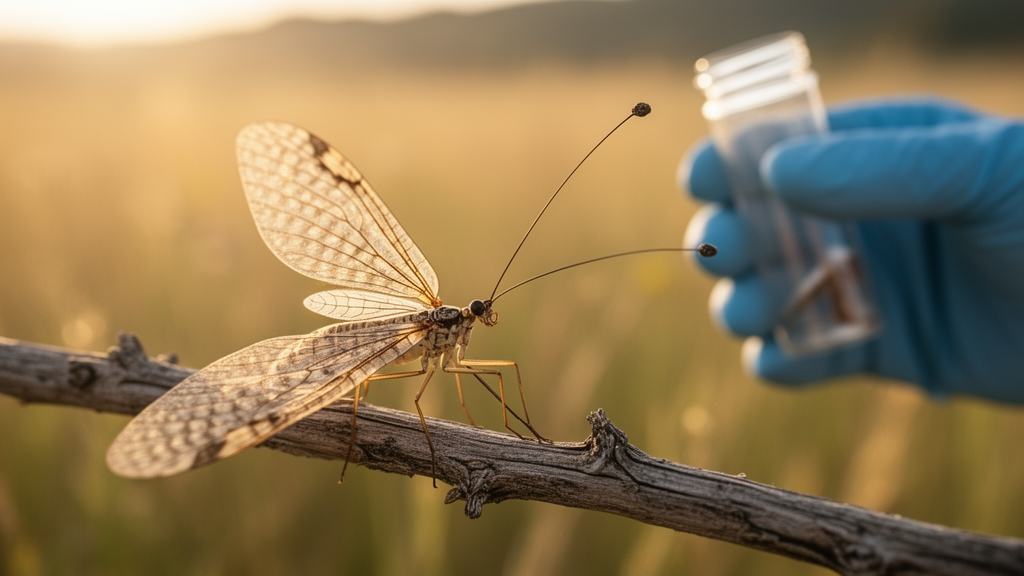
A barcode-assisted, annotated inventory of Georgian owlflies documents the first recorded occurrence of the genus Deleproctophylla in Georgia. The faunistic and molecular study compiled 128 specimens representing four species in three genera and obtained five quality cytochrome oxidase subunit I (COI) barcodes, each 658 base pairs long and free of stop codons, indels and deletions, for all four species. The new country record is based on one female of Deleproctophylla australis , collected near Lisi Lake in Tbilisi on 2 July 2023.
The specimen was found on a dry slope with xerophytic vegetation at 677 metres above sea level. Before this work, Georgia’s owlfly fauna comprised two genera and three species, while D. australis had not been reliably documented in the country. The checklist combines newly collected specimens with museum material and records from iNaturalist, the Georgian Biodiversity Database and a specialized Georgian wildlife Facebook group.
Most of the new material was gathered in 2021–2023 through the Caucasus Barcode of Life project using entomological nets during daytime, collection by hand and light traps. Collected specimens were preserved in 96% ethanol and stored at −22 °C in the scientific collections of Ilia State University, while some were kept dry in a private collection. Species were identified with the key published by Aspöck and colleagues, and sampling localities were mapped in QGIS 3.22.10.
For the molecular analysis, DNA was extracted from whole specimens with the Quick-DNA Magbead Plus Kit. Partial COI sequences were amplified by polymerase chain reaction using the LCOI490-JJ and HCO2198-JJ primers. The protocol comprised an initial 15-cycle set with annealing temperatures decreasing by 1 °C per cycle, followed by 25 cycles at 45 °C.
Amplicons were visualized on 1% agarose gels and sequenced in both directions at the Beijing Genomics Institute in Hong Kong. Sequence analysis was conducted in Geneious Prime 2022.1.1, and the resulting sequences were submitted to the Barcode of Life Data System. The molecular comparisons revealed taxonomic complications rather than an entirely straightforward correspondence between barcode matches and species identities.
For Libelloides ustulatus , the barcode was identical to a L. ustulatus sequence from Abastumani, Georgia. For L. macaronius , the closest BOLD match was L. coccajus from France at a p-distance of 1.07%, while L. macaronius from Cyprus ranked second at 1.22%. The D. australis barcode was separated from a D. variegata sequence from Azerbaijan’s Nakhchivan region by a p-distance of 0.16%.
No barcode from a properly identified D. australis had previously been available in BOLD or GenBank. The authors propose that the small genetic distance might reflect potential misidentification of the GenBank specimen used for comparison. They also note that the observed morphological differences could represent variation within a single species, an issue that requires individual assessment of the material concerned.
Identification of the two Deleproctophylla species relied partly on differences in body size and wing and body coloration. D. australis is generally larger than the similar D. variegata and has extensive brownish-red spots on both wings below the pterostigma. The corresponding spots in D. variegata are visibly darker brownish black.
Additional distinctions include patterns on the pronotum and thorax, although the forewing spot in D. australis can sometimes be absent, complicating identification from a standard key. The annotated list contains Bubopsis hamata , Deleproctophylla australis , Libelloides macaronius and L. ustulatus . The first has a reported range from northeastern Africa to West Asia and the Caucasus; L. macaronius has a broad Ponto-Mediterranean distribution and was the most widespread species represented in Georgia.
L. ustulatus has a Caucaso-Anatolian distribution and has historically been treated as a subspecies of L. hispanicus , although some authors have recognized it at species level. The records indicate contrasting habitat and seasonal patterns. B. hamata , D. australis and L. macaronius were primarily associated with arid habitats in central and southeastern Georgia, with recorded flight periods from May through August.
L. ustulatus was concentrated along the Meskheti Range and near Tbilisi, mainly in forest meadows at approximately 700–2,200 metres above sea level, with a flight period from May to June. The authors consider it likely that the species also inhabits the subalpine belt of Georgia’s northern mountains, but that distribution was not directly documented. This was a faunistic inventory and molecular barcoding study, not a controlled ecological experiment.
The authors state that further research is needed to clarify their distribution and ecology, while larval stages of B. hamata and L. ustulatus remain undescribed. The checklist retains Ascalaphidae as a family despite a published phylogenomic proposal to merge it with Myrmeleontidae, because that proposal is not unanimously supported.
Subject of Research: Barcode-assisted faunistic inventory of four owlfly species in Georgia
Article Title: First barcode-assisted annotated checklist of owlflies ( Neuroptera , Myrmeleontidae , Ascalaphidae ) of Georgia with the first record of genus Deleproctophylla Lefèbvre, 1842
Article References: Japaridze, L.-G., Makharadze, G., Rostiashvili, I., Datunashvili, A., & Dobosz, R. (2024). First barcode-assisted annotated checklist of owlflies (Neuroptera, Myrmeleontidae, Ascalaphidae) of Georgia with the first record of genus Deleproctophylla Lefèbvre, 1842. Caucasiana, 3, 5-18. https://doi.org/10.3897/caucasiana.3.e117039
Image Credits: AI Generated
DOI: 10.3897/caucasiana.3.e117039
Keywords: owlflies, Georgia, Deleproctophylla australis, DNA barcoding, COI sequencing, faunistic checklist, Neuroptera, Ascalaphidae, biodiversity records, First, barcode-assisted, annotated
Cite Scienmag News
Gavin Prescott. (October 20, 2026). Barcode-assisted inventory records Deleproctophylla owlfly in Georgia for the first time. Scienmag. https://scienmag.com/barcode-assisted-inventory-records-deleproctophylla-owlfly-in-georgia-for-the-first-time/
Gavin Prescott. "Barcode-assisted inventory records Deleproctophylla owlfly in Georgia for the first time." Scienmag, 20 October 2026, https://scienmag.com/barcode-assisted-inventory-records-deleproctophylla-owlfly-in-georgia-for-the-first-time/. Accessed 20 October 2026.
Gavin Prescott. "Barcode-assisted inventory records Deleproctophylla owlfly in Georgia for the first time." Scienmag. October 20, 2026. https://scienmag.com/barcode-assisted-inventory-records-deleproctophylla-owlfly-in-georgia-for-the-first-time/


