


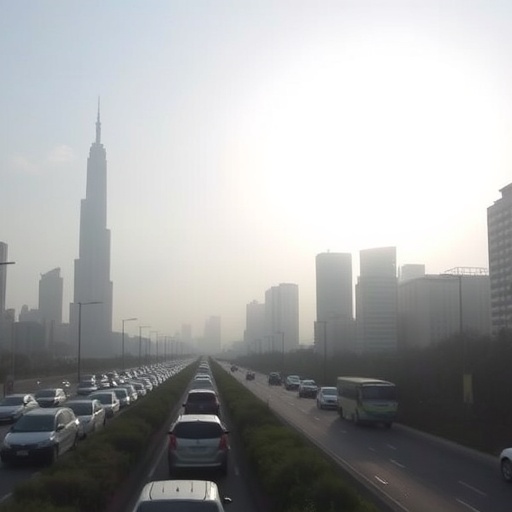
In a groundbreaking development that challenges decades of atmospheric science, researchers at Tampere University and the University of Helsinki have unveiled a novel chemical mechanism that impacts the formation of air pollution particles in urban settings. This discovery fundamentally alters our understanding of nitric oxide’s (NO) role—the pollutant predominantly emitted by vehicles, industrial plants, and combustion processes—in urban air chemistry. Contrary to the long-held belief that NO suppresses aerosol particle formation, the new findings reveal that for certain aromatic carbonyl compounds, NO can actually promote the creation of these harmful particles.
Air pollution aerosols are microscopic particles suspended in the air that exert significant detrimental effects on human health, visibility, and the broader climate system. From exacerbating respiratory diseases to influencing cloud formation and solar radiation, their presence in urban atmospheres inflicts multifaceted impacts. Consequently, elucidating the complex chemical pathways leading to aerosol generation is crucial for refining air quality models and formulating effective pollution mitigation strategies globally.
Historically, atmospheric chemists have maintained that nitric oxide acts chiefly as a suppressor of aerosol precursors by inhibiting the formation of low-volatility condensable vapors. These vapors aggregate to form the solid and liquid phases of particulate matter primarily responsible for smog and haze. The assumption was that NO’s presence would inhibit these vapors, thereby reducing particle formation rates. However, the latest research turns this assumption on its head, demonstrating that NO can actually accelerate the formation of secondary aerosol precursors, at least in the context of aromatic carbonyl compounds—an important class of volatile organic compounds (VOCs) abundant in urban atmospheres.
Lead doctoral researcher Shawon Barua of Tampere University elaborates, “Our experimental and computational analyses indicate that NO interacts with aromatic carbonyls through previously unrecognized reaction pathways. Instead of suppressing the evolution of aerosol precursors, NO facilitates their production by mediating complex sequential oxidation reactions.” This challenges the conventional paradigm, emphasizing that NO’s atmospheric chemistry is more intricate and context-dependent than previously understood.
To dissect this mechanism, the research team combined state-of-the-art laboratory experiments with advanced computational modeling techniques. They simulated atmospheric conditions typical of urban areas, where emissions from traffic, industry, and consumer products release aromatic carbonyl compounds into the environment. Their results unveiled a cascade of chemical transformations initiated by NO, which converts these aromatic carbonyls into highly reactive intermediates. These intermediates rapidly evolve into low-volatility species capable of nucleating new particles or condensing onto existing aerosols—crucial steps in secondary organic aerosol (SOA) formation.
Dr. Avinash Kumar from Tampere University underscores the broader implications, noting, “Urban air chemistry involves a labyrinth of interacting pollutants. The discovery of this NO-enhanced oxidation pathway complicates the existing models but also presents an opportunity. Accurate air quality predictions hinge on accounting for these previously overlooked chemical reactions.” With urban populations worldwide rising and vehicle emissions remaining a dominant pollution source, understanding these chemical intricacies assumes increasing urgency.
The study’s relevance extends beyond theoretical chemistry into tangible public health and climate policy arenas. Particulate matter, especially fine particles, penetrates deep into human lungs, contributing to cardiovascular and respiratory diseases. Moreover, aerosols influence atmospheric radiative balance, affecting climate warming trends. Recognizing that NO, a ubiquitous urban pollutant, can intensify aerosol precursor formation profoundly affects how city planners and environmental regulators address air quality.
Professor Matti Rissanen, also from Tampere University, emphasizes the gap this research fills. “Despite years of investigation, urban aerosol formation has remained somewhat enigmatic due to the complexity of chemical interactions. Our findings spotlight sequential oxidation reactions between pollutants that were absent from prior atmospheric models. Integrating these pathways could significantly enhance the fidelity of urban air quality simulations, enabling better human health risk assessments and climate impact forecasts.”
The research was meticulously peer-reviewed and culminated in an article entitled “Nitric oxide can enhance secondary aerosol precursor formation from aromatic carbonyls,” which was published in the prestigious journal Nature Communications on May 7, 2026. This publication reflects the robust scientific scrutiny and international recognition the study has garnered. It represents a pivotal step in atmospheric chemistry, promising to reshape how scientists and policymakers approach pollution control.
This newly identified chemical pathway highlights the complexity inherent in urban air pollution chemistry. As cities worldwide confront persistent smog and particulate pollution, it becomes ever more critical to unravel the multiple facets of pollutant interactions. The intricate interplay observed between nitric oxide and aromatic atmospheric compounds advocates for revisiting current air quality models to incorporate these nuanced mechanisms accurately.
Moving forward, the research team suggests that incorporating these newly discovered reactions into atmospheric chemistry models will be paramount. It is this integration that holds the key to unlocking more reliable predictions of aerosol concentrations under various urban emission scenarios. Enhanced models will ultimately aid in designing targeted strategies that can better protect urban populations from pollution-related health hazards and mitigate adverse climate effects.
The revelation that nitrogen oxides can have a dualistic role—both suppressing and enhancing aerosol formation depending on atmospheric context—opens new avenues for scientific inquiry. Understanding these dynamics at a molecular level underscores the need for continuous experimental innovation and computational advancements in atmospheric sciences.
As urbanization accelerates globally, and vehicular emissions continue to contribute significantly to atmospheric pollution, the implications of this study resonate beyond academia. It challenges conventional air pollution narratives and signals a compelling need for revisiting air quality management policies with updated scientific knowledge.
In conclusion, the collaborative research effort between Tampere University and the University of Helsinki not only redefines the atmospheric chemistry role of nitric oxide but also sets a precedent for future investigations into complex urban air pollution processes. By unveiling this hidden chemical pathway, the team has made a critical contribution toward more comprehensive environmental models, ultimately paving the way for healthier urban atmospheres and a deeper understanding of our impact on the planet.
News Publication Date: 7 May 2026
Web References:
https://www.nature.com/articles/s41467-026-72628-w
References:
Barua, S., Kumar, A., Rissanen, M., et al. (2026). Nitric oxide can enhance secondary aerosol precursor formation from aromatic carbonyls. Nature Communications.
Cite Scienmag News
Russell Cooper. (June 22, 2026). Researchers Uncover Key Hidden Factor Driving Urban Air Pollution. Scienmag. https://scienmag.com/researchers-uncover-key-hidden-factor-driving-urban-air-pollution/
Russell Cooper. "Researchers Uncover Key Hidden Factor Driving Urban Air Pollution." Scienmag, 22 June 2026, https://scienmag.com/researchers-uncover-key-hidden-factor-driving-urban-air-pollution/. Accessed 3 September 2026.
Russell Cooper. "Researchers Uncover Key Hidden Factor Driving Urban Air Pollution." Scienmag. June 22, 2026. https://scienmag.com/researchers-uncover-key-hidden-factor-driving-urban-air-pollution/


