

Friday, September 4, 2026
Science
No Result
View All Result
  • Login
  • HOME
  • SCIENCE NEWS
  • CONTACT US
  • HOME
  • SCIENCE NEWS
  • CONTACT US
No Result
View All Result
Scienmag
No Result
View All Result
Home Science News Chemistry

Researchers Say Solar Storm Risks May Be Underestimated

July 15, 2026
in Chemistry
Bethany Barker
By Bethany Barker Scienmag Editorial Profile - Catalysis
Reading Time: 2 mins read
0
Researchers Say Solar Storm Risks May Be Underestimated

Researchers Say Solar Storm Risks May Be Underestimated

65
SHARES
587
VIEWS
Share on FacebookShare on Twitter
ADVERTISEMENT

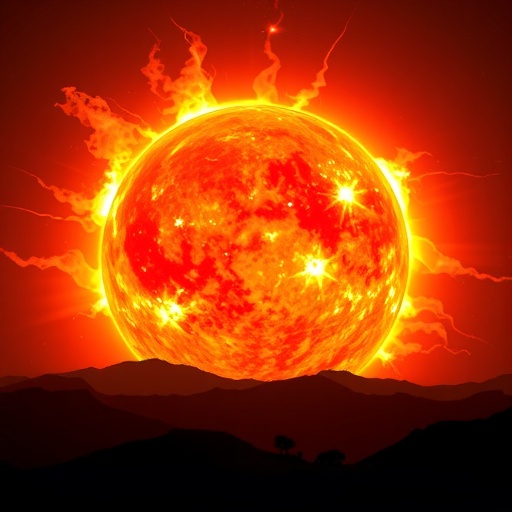
Extreme space weather may be more dangerous than researchers have long believed, according to new results published in Nature. The study revisits a puzzle: geomagnetic storms appear to “saturate” in their effects, as if Earth has an upper limit to how strongly it can respond to stronger solar activity.

The work centers on a specific process. Solar eruptions hurl a fast stream of charged particles—solar wind—toward Earth. When that wind interacts with our planet’s magnetic environment, it drives electric currents in the upper atmosphere and ionosphere. Those currents can scramble satellite communications, degrade navigation signals like GPS, and contribute to power-grid disruptions.

For decades, scientists assumed a ceiling existed because averages of storm measurements suggested that increasing solar-wind strength eventually produced no further increase in atmospheric currents. That interpretation fits intuitive “limit” models: beyond some point, the system would simply top out.

The new paper challenges that conclusion by showing how measurement bias can masquerade as physical saturation. Solar-wind intensity is often recorded by spacecraft located at the Lagrange point L1, roughly a million miles upstream of Earth. Even when instruments sample what looks like the strongest conditions, the plasma arriving at Earth is statistically pulled back toward more typical values—a phenomenon known as regression to the mean.

In practice, this means extreme solar-wind values are uncertain: the most intense measurements are partly overestimates, and the next stages of the flow—propagation through space and spatial variability—reduce the strength of what actually strikes Earth.

To test the idea, the team analyzed more than a million solar-wind measurements from NASA missions orbiting close to our planet. They found a clear, direct relationship between solar-wind strength and the resulting high-altitude currents, with no evidence of a true ceiling.

If correct, risk estimates for the most severe “once-in-a-thousand-year” events may have been too conservative. Modeling and engineering assumptions that bake in saturation could therefore underpredict the technological impacts of the rarest storms.

The authors stress that extremely large storms remain uncommon, which limits available data. But with better sampling and statistical treatment, the most extreme outcomes may scale upward rather than flatten—turning auroras and glitches into potentially larger systemic threats.

Keywords

Space weather, solar wind, geomagnetic storms, ionosphere, Lagrange point L1, regression to the mean, satellite communications, GPS disruption, extreme events, electric currents

Subject of Research: Space weather; solar wind; upper atmosphere currents (ionosphere)
Article Title: Regression to the mean can explain saturation of geomagnetic storms
News Publication Date: 15-Jul-2026
Web References: http://dx.doi.org/10.1038/s41586-026-10757-4
References: Nature (article by Nithin Sivadas and Maria Walach)
Image Credits: Nithin Sivadas, NASA Goddard Space Flight Center

Article Title: Researchers Say Solar Storm Risks May Be Underestimated

Article References: Original research article

Image Credits: AI Generated

DOI: Not provided

Keywords: extreme space weather effects, geomagnetic storm saturation, GPS signal degradation, importance of accurate solar wind measurement, ionospheric electric currents, limitations of current space weather models, power grid vulnerabilities during solar storms, satellite communication disruptions, solar eruption impacts on Earth, solar storm risk assessment, solar wind interactions with Earth's magnetic field, space weather measurement bias

Cite Scienmag News

Bethany Barker. (July 15, 2026). Researchers Say Solar Storm Risks May Be Underestimated. Scienmag. https://scienmag.com/researchers-say-solar-storm-risks-may-be-underestimated/

Bethany Barker. "Researchers Say Solar Storm Risks May Be Underestimated." Scienmag, 15 July 2026, https://scienmag.com/researchers-say-solar-storm-risks-may-be-underestimated/. Accessed 4 September 2026.

Bethany Barker. "Researchers Say Solar Storm Risks May Be Underestimated." Scienmag. July 15, 2026. https://scienmag.com/researchers-say-solar-storm-risks-may-be-underestimated/


Tags: extreme space weather effectsgeomagnetic storm saturationGPS signal degradationimportance of accurate solar wind measurementionospheric electric currentslimitations of current space weather modelspower grid vulnerabilities during solar stormssatellite communication disruptionssolar eruption impacts on Earthsolar storm risk assessmentsolar wind interactions with Earth's magnetic fieldspace weather measurement bias
Share26Tweet16
Previous Post

Day After Mass Shooting Sees Rise in Traffic Accidents

Next Post

New Drug Design Method Enhances Cancer Treatments with Increased Potency

Related Posts

Partially covalent desolvated cations boost electrochemical CO2 conversion
Chemistry

Partially covalent desolvated cations boost electrochemical CO2 conversion

September 4, 2026
Ferricyanide enables peptide hydrazide ligation in neutral water
Chemistry

Ferricyanide enables peptide hydrazide ligation in neutral water

September 4, 2026
How microplastics may weaken the human immune system
Chemistry

How microplastics may weaken the human immune system

September 4, 2026
New NiO–Cu3Mo2O9 Catalyst Boosts Hydrogen Production from Ammonia Borane
Chemistry

New NiO–Cu3Mo2O9 Catalyst Boosts Hydrogen Production from Ammonia Borane

September 4, 2026
Antimicrobial PVA silver nanoparticle zeolite nanofibers developed for wound dressings
Chemistry

Antimicrobial PVA silver nanoparticle zeolite nanofibers developed for wound dressings

September 4, 2026
Layered double hydroxides in sustained antibiotic delivery: a bibliometric review
Chemistry

Layered double hydroxides in sustained antibiotic delivery: a bibliometric review

September 3, 2026
Next Post
New Drug Design Method Enhances Cancer Treatments with Increased Potency

New Drug Design Method Enhances Cancer Treatments with Increased Potency

  • Mothers who receive childcare support from maternal grandparents show more optimized

    Mothers who receive childcare support from maternal grandparents show more parental warmth, finds NTU Singapore study

    27656 shares
    Share 11059 Tweet 6912
  • University of Seville Breaks 120-Year-Old Mystery, Revises a Key Einstein Concept

    1061 shares
    Share 424 Tweet 265
  • Bee body mass, pathogens and local climate influence heat tolerance

    682 shares
    Share 273 Tweet 171
  • Researchers record first-ever images and data of a shark experiencing a boat strike

    546 shares
    Share 218 Tweet 137
  • Groundbreaking Clinical Trial Reveals Lubiprostone Enhances Kidney Function

    531 shares
    Share 212 Tweet 133
Science

Embark on a thrilling journey of discovery with Scienmag.com—your ultimate source for cutting-edge breakthroughs. Immerse yourself in a world where curiosity knows no limits and tomorrow’s possibilities become today’s reality!

RECENT NEWS

  • Financial Knowledge Shapes How Investors Build Their Portfolios
  • Dynamic landslide susceptibility mapping using multi-temporal inventories in the Belluno Alps
  • Soil chemistry and microbes drive crop nutrient use efficiency
  • Riverbank erosion drives anxiety and PTSD in southwestern Bangladesh communities

Categories

  • Agriculture
  • Anthropology
  • Archaeology
  • Athmospheric
  • Biology
  • Biotechnology
  • Blog
  • Bussines
  • Cancer
  • Chemistry
  • Climate
  • Earth Science
  • Editorial Policy
  • Marine
  • Mathematics
  • Medicine
  • Pediatry
  • Policy
  • Psychology & Psychiatry
  • Science Education
  • Social Science
  • Space
  • Technology and Engineering

Subscribe to Blog via Email

Enter your email address to subscribe to this blog and receive notifications of new posts by email.

Join 5,151 other subscribers

© 2025 Scienmag - Science Magazine

Welcome Back!

Login to your account below

Forgotten Password?

Retrieve your password

Please enter your username or email address to reset your password.

Log In
No Result
View All Result
  • HOME
  • SCIENCE NEWS
  • CONTACT US

© 2025 Scienmag - Science Magazine

Discover more from Science

Subscribe now to keep reading and get access to the full archive.

Continue reading