


Direct utilization of water as a source of hydrogen atoms and molecules is fundamental to the evolution of the ecosystem and industry. However, liquid water is an unfavorable electron donor for forming these hydrogen species due to its redox inertness.

Credit: JACS
Direct utilization of water as a source of hydrogen atoms and molecules is fundamental to the evolution of the ecosystem and industry. However, liquid water is an unfavorable electron donor for forming these hydrogen species due to its redox inertness.
Recently, a research group led by Prof. WANG Feng and Assoc. Prof. JIA Xiuquan from the Dalian Institute of Chemical Physics (DICP) of the Chinese Academy of Sciences (CAS), in collaboration with Prof. Richard N. Zare’s group from Stanford University, has realized hydrogen formation by contact electrification at oil-water microdroplet interfaces and its regulation. This study was published in Journal of the American Chemical Society.
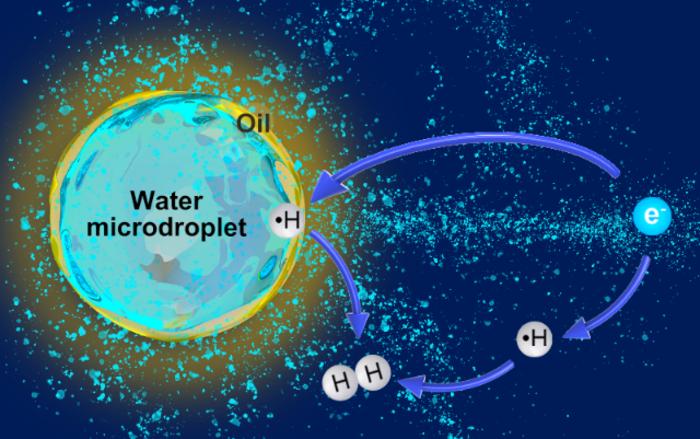
Water microdroplets have been shown to possess a high electric field at the interface of microdroplets, which is sufficient to ionize OH- to produce free electrons spontaneously. Subsequent charge transfer can lead to a variety of essential hydrogenation reactions.
In this study, the researchers found marked charge separation between oil-water microdroplets of different sizes through atomization. Compared with pure water microdroplets, the charge separation of oily aqueous microdroplets was improved due to the oil-mediated extraction of electrons from sprayed microdroplets, thus promoting the generation of hydrogen species. The hydrogen formation was proposed to proceed by contact electrification and charge neutralization at oil-water microdroplet interfaces.
This mechanism was verified by adding surfactants to disrupt the water-oil interfaces, which suppressed both charge separation and hydrogen evolution activity.
Besides, the researchers found that the reductive hydrogen species could further lead to an in-situ CO2 hydrogenation process run at normal temperature for selective CO formation using water as the hydrogen source.
Large amounts of water resources are subject to pollution caused by oil spills, oily wastewater discharge, etc. Traditional wastewater treatment technology always results in significant carbon emissions. This study indicated that it is possible to realize the upcycling of oil-containing wastewater by spraying an oil-water emulsion to generate H2 from water, which could transform the oily wastewater treatment process into a viable carbon sequestration pathway.
Journal
Journal of the American Chemical Society
Method of Research
Commentary/editorial
Subject of Research
Not applicable
Article Title
Sprayed Oil–Water Microdroplets as a Hydrogen Source
Article Publication Date
4-Apr-2024
Cite Scienmag News
Bethany Barker. (April 18, 2024). Researchers realize hydrogen formation by contact electrification of water microdroplets and its regulation. Scienmag. https://scienmag.com/researchers-realize-hydrogen-formation-by-contact-electrification-of-water-microdroplets-and-its-regulation/
Bethany Barker. "Researchers realize hydrogen formation by contact electrification of water microdroplets and its regulation." Scienmag, 18 April 2024, https://scienmag.com/researchers-realize-hydrogen-formation-by-contact-electrification-of-water-microdroplets-and-its-regulation/. Accessed 4 September 2026.
Bethany Barker. "Researchers realize hydrogen formation by contact electrification of water microdroplets and its regulation." Scienmag. April 18, 2024. https://scienmag.com/researchers-realize-hydrogen-formation-by-contact-electrification-of-water-microdroplets-and-its-regulation/

