


Scientists use tiny minerals called zircons as geologic timekeepers. Often no bigger than a grain of sand, these crystals record chemical signatures of the geological environment where they formed. In a new study led by scientists at The University of Texas at Austin, researchers used them to describe what could be an overlooked step in a fundamental tectonic process that raises seafloors into mountains.

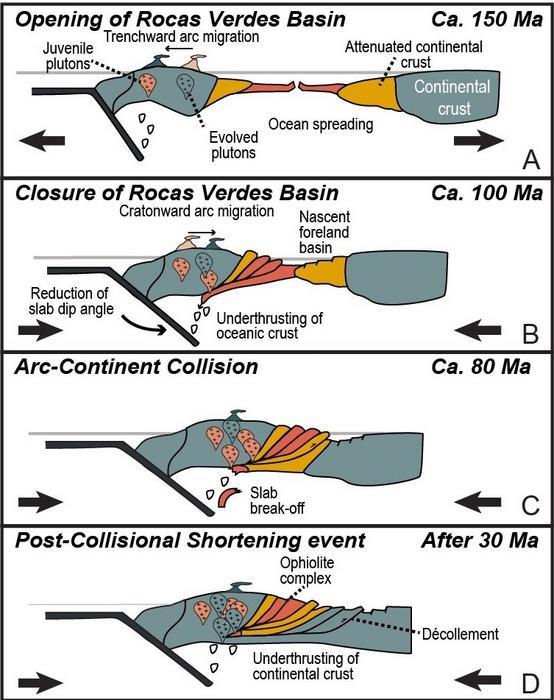
Credit: Fernando Rey et al
Scientists use tiny minerals called zircons as geologic timekeepers. Often no bigger than a grain of sand, these crystals record chemical signatures of the geological environment where they formed. In a new study led by scientists at The University of Texas at Austin, researchers used them to describe what could be an overlooked step in a fundamental tectonic process that raises seafloors into mountains.
In a study published in the journal Geology, the researchers describe zircons from the Andes mountains of Patagonia. Although the zircons formed when tectonic plates were colliding, they have a chemical signature associated with when the plates were moving apart.
The researchers think that the unexpected signature could be explained by the mechanics of underlying tectonic plates that hasn’t yet been described in other models. This missing step involves a sort of geologic juicing in a magma chamber where zircons form before they reach the surface, with oceanic crust entering the chamber ahead of continental crust.
“If you put some oceanic basin below this magma, you have a change in the composition of this magma as it’s incorporated,” said the study’s lead author Fernando Rey, a doctoral student at the UT Jackson School of Geosciences. “This is something that was not documented before this study.”
This theory of oceanic magma mixing is important because it could represent a transitional step in the formation of back arc basins – an important geological structure that shapes landscapes, geologic records and helps regulate the planet’s climate.
These basins form between oceanic and continental tectonic plates, opening up as the plates move apart and closing as they come back together. While the opening of the basin creates oceanic crust, its closing squeezes the crust into mountains – bringing a geologic record of Earth history to the surface where humans can more easily access it, said coauthor Matt Malkowski, an assistant professor at the Jackson School’s Department of Earth and Planetary Sciences. What’s more, the weathering of the ocean crust is a major driver of natural carbon dioxide storage.
“This is the Earth’s way of sequestering carbon. Very effective on its own, but it may take hundreds of thousands if not millions of years,” said Malkowski.
Malkowski collected the zircons examined in the study from rock and sediment samples at a field site in Patagonia. The samples captured the entire record of the back arc basin, called the Rocas Verdes Basin, from opening to closing.
When Rey started analyzing the chemical signatures of the zircons, nothing looked out of place at first. The zircons associated with an opening basin had the expected signature. However, when he started examining zircons associated with the closing of the basin, the signature didn’t undergo the expected chemical shift – known to scientists as a “pull down” because of the way data plotting the isotope ratios goes from steadily rising to falling down.
When that pull down signature didn’t show up until 200 million years later, appearing in zircons that formed 30 million years ago when the basin was already well into its closure phase, Rey and his collaborators hypothesized a scenario that could help explain the data.
In their paper, they propose a model where the same tectonic forces that squeeze the oceanic crust into mountains could be underthrusting parts of that crust and pushing it toward the magmatic chamber where the zircons are formed – influencing the chemical signatures recorded in the crystals during the early to middle stages of closure. As the continents continue to squeeze together, the oceanic crust is eventually replaced by continental crust, the source of the pulldown signal.
The researchers think this transitional phase where zircons are juiced by oceanic crust could be part of back arc basins around the world. But there’s a good reason why it hasn’t been observed before, said Rey. Most back arc basins close faster than Patagonia did – in a few million years rather than tens of millions of years – meaning a shorter window of time in which these zircons can form.
Now that scientists have discovered this zircon signal in Patagonia, they can start looking for signs of it in zircons from other places. Rey is currently analyzing zircons from the Sea of Japan – a modern back arc basin that’s in the early stages of closure – to see if there’s signs of oceanic crust influencing the zircon signature.
This research adds to a record of discovery about back arc basins at UT Austin, said Malkowski. Professor Ian Dalziel authored a well-known Nature paper in 1974 that first recognized the Andes of Patagonia as forming due to back arc basin closure.
“Here we are 50 years later, and we’re still learning new things about these rocks,” Malkowski said.
The research was funded by the National Science Foundation and UT Austin.
Journal
Geology
DOI
Article Title
Detrital isotopic record of a retreating accretionary orogen: An example from the Patagonian Andes
Article Publication Date
28-Feb-2024
Cite Scienmag News
Violet Maxwell. (April 4, 2024). Researchers propose new step in tectonic squeeze that turns seafloor into mountains. Scienmag. https://scienmag.com/researchers-propose-new-step-in-tectonic-squeeze-that-turns-seafloor-into-mountains/
Violet Maxwell. "Researchers propose new step in tectonic squeeze that turns seafloor into mountains." Scienmag, 4 April 2024, https://scienmag.com/researchers-propose-new-step-in-tectonic-squeeze-that-turns-seafloor-into-mountains/. Accessed 4 September 2026.
Violet Maxwell. "Researchers propose new step in tectonic squeeze that turns seafloor into mountains." Scienmag. April 4, 2024. https://scienmag.com/researchers-propose-new-step-in-tectonic-squeeze-that-turns-seafloor-into-mountains/

