


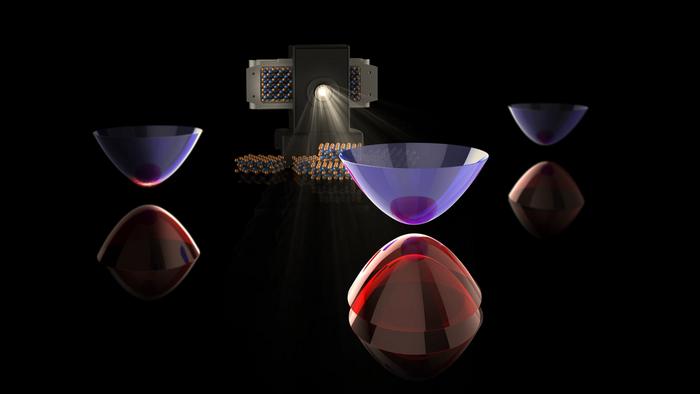
Solution-processed semiconductor nanocrystals are also called colloidal quantum dots (QDs). While the concept of size-dependent quantum effects had been long known to physicists, a sculpture of the theory into real nanodimensional objects remained impossible till the discovery of QDs. The size-dependent colors of QDs are essentially naked-eye, ambient-condition visualization of the quantum size effect. In recent years, researchers across the world have been searching for fascinating quantum effects or phenomena using the material platform of QDs, such as single-photon emission and quantum coherence manipulation.

Credit: DICP
Solution-processed semiconductor nanocrystals are also called colloidal quantum dots (QDs). While the concept of size-dependent quantum effects had been long known to physicists, a sculpture of the theory into real nanodimensional objects remained impossible till the discovery of QDs. The size-dependent colors of QDs are essentially naked-eye, ambient-condition visualization of the quantum size effect. In recent years, researchers across the world have been searching for fascinating quantum effects or phenomena using the material platform of QDs, such as single-photon emission and quantum coherence manipulation.
Floquet states (i.e., the photon-dressed states) are ubiquitously invoked to explain quantum phenomena in relation to coherent interaction between light field and matter. However, direct observation of these Floquet states has been an experimental challenge. For example, only until very recently did researchers report experimental signatures of Floquet-Bloch bands in black phosphorus (a narrow-gap model semiconductor) interacting with mid-infrared pulses by using complex time- and angle-resolved photoemission spectroscopy. In such studies, the samples were almost exclusively housed in low-temperature, high-vacuum environments, and the driving fields were tuned to the infrared, terahertz, or even microwave regions to avoid sample damage.
In a study published in Nature Photonics, Prof. WU Kaifeng and his colleagues from the Dalian Institute of Chemical Physics of the Chinese Academy of Sciences reported the first direct observation of Floquet states in semiconductors by using all-optical spectroscopy in the visible to near-infrared region under ambient conditions.
The researchers adopted the quasi-two-dimensional colloidal nanoplatelets developed in the past decade. The strong, atomically-precise quantum confinement in the thickness dimension results in interband and intersubband transitions in the visible and near-infrared regions, respectively. The levels involved in such transitions naturally form a three-level system. A sub-bandgap visible photon dresses a heavy-hole state (|hh1〉) to a Floquet state of the same parity as the first quantized electron state (|e1〉), allowing this Floquet state to be probed by a near-infrared photon through its transition to the second quantized electron state (|e2〉).
Moreover, while the transiently populated Floquet states were often assumed to fade away outside the temporal overlap of pump and probe pulses, the researchers directly observed dephasing of the Floquet state into real population of |e1〉 in hundreds of femtoseconds. All the experimental observations in this study are substantiated by quantum mechanical simulations.
“Not only does this study provide an all-optical direct observation of Floquet states in semiconductor materials, but it also uncovers the rich spectral and dynamic physics of Floquet states that can be harnessed to dynamically control the optical responses and coherent evolution in condensed-matter systems,” said Prof. WU.
Since the current demonstration is attained for colloidal materials under ambient conditions, it will expand the reach of Floquet engineering, which currently focuses on tailoring the quantum and topological properties of solid-state materials, to coherently controlling surface/interfacial chemical reactions through nonresonant light field.
Journal
Nature Photonics
Method of Research
Commentary/editorial
Subject of Research
Not applicable
Article Title
Observation of Floquet states and their dephasing in colloidal nanoplatelets driven by visible pulses
Article Publication Date
13-Aug-2024
Cite Scienmag News
Bethany Barker. (August 22, 2024). Researchers observe floquet states in colloidal nanoplatelets driven by visible pulses. Scienmag. https://scienmag.com/researchers-observe-floquet-states-in-colloidal-nanoplatelets-driven-by-visible-pulses/
Bethany Barker. "Researchers observe floquet states in colloidal nanoplatelets driven by visible pulses." Scienmag, 22 August 2024, https://scienmag.com/researchers-observe-floquet-states-in-colloidal-nanoplatelets-driven-by-visible-pulses/. Accessed 4 September 2026.
Bethany Barker. "Researchers observe floquet states in colloidal nanoplatelets driven by visible pulses." Scienmag. August 22, 2024. https://scienmag.com/researchers-observe-floquet-states-in-colloidal-nanoplatelets-driven-by-visible-pulses/

