


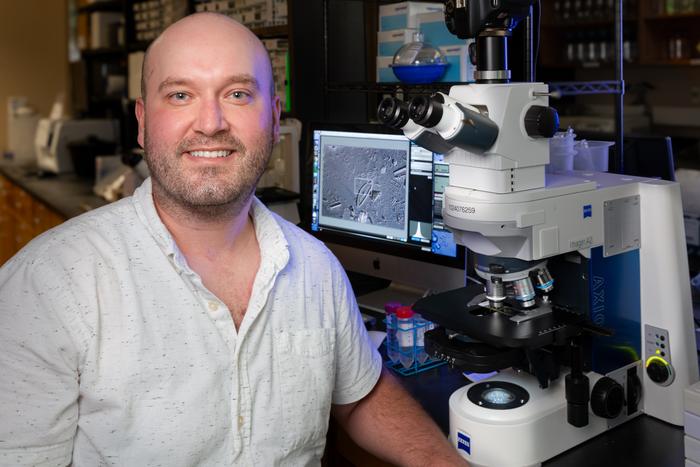
When it comes to predicting the abundance of a species, body size appears to be a fundamental and repeatable predictor, with smaller organisms occurring in greater numbers than larger ones. The caveat, known as Bermann’s Rule, is that in polar regions larger bodied organisms predominate. Other factors that influence species abundance include light availability, food availability, competition and predation.

Credit: University Relations
When it comes to predicting the abundance of a species, body size appears to be a fundamental and repeatable predictor, with smaller organisms occurring in greater numbers than larger ones. The caveat, known as Bermann’s Rule, is that in polar regions larger bodied organisms predominate. Other factors that influence species abundance include light availability, food availability, competition and predation.
New findings by a team of researchers in biological sciences at the U of A have now added a genetic component to our understanding of species abundance.
Genome size, the total amount of DNA contained within one copy of a single complete genome, can also be a strong predictor of species abundance. The paper examined diatoms, which are unicellular algae that play an important role in freshwater and marine food webs. They create long-chain fatty acids, like fish oil and other lipids, that serve as energy. The energy molecules that diatoms produce go up the food web from zooplankton to aquatic insects to fish to humans.
Diatoms also play a critical role in photosynthesis, the process by which carbon dioxide is converted to oxygen. It’s estimated that 20-25 percent of Earth’s oxygen comes from diatoms – more than rainforests and land plants.
The key finding was that temperature and genome size, not body size, had the greatest influence on the maximum population growth rate of the diatoms. Yet body size still mattered in colder latitudes, conserving Bermann’s Rule.
The paper, “Diatom abundance in the polar oceans is predicted by genome size,” was published in PLoS Biology by a trio of authors from the Department of Biological Sciences: Wade Roberts, a postdoctoral researcher in the Alverson Lab; Adam Siepielski, an associate professor; and Andrew Alverson, professor and director of the Alverson Lab.
Roberts noted that the genome size of a diatom is critical to cell function and its ability to adapt to a changing environment.
“In phytoplankton, cell size is highly correlated to genome size,” Roberts explained. “We’ve known that for a while. But we weren’t sure if cell size was driving genome size or vice versa. We were able to directly test this through a path analysis to determine the directionality. We found that an increase in genome size led to increased cell size. So, we confirmed that size of the genome is driving cell size.”
The genome size of diatoms can vary by 50-fold between species, but most of the difference in genetic material is made up of repeated DNA. DNA codes for the proteins that are the building blocks of life, but it’s unclear how this repetitive DNA is utilized by the cell. It’s estimated that only about 2 percent of the human genome codes for genes.
Overall, the paper’s results advance understanding of species abundance by showing that a single emergent trait fundamental to all life, the size of the genome, can predict species abundance at a global scale.
“Larger organisms are more abundant in polar regions,” Roberts said. “That’s true of mammals and other multi-cellular organisms. But we didn’t know if that was true of phytoplankton. Now we can make predictions about community composition based off temperature. This will help us predict whether larger diatoms will be able to persist in warming waters.”
On a warming planet, this could mean the reduction of larger-celled diatoms and a potential decrease in oxygen output.
Journal
PLoS Biology
Method of Research
Computational simulation/modeling
Subject of Research
Not applicable
Article Title
Diatom abundance in the polar oceans is predicted by genome size
Article Publication Date
8-Aug-2024
COI Statement
No conflicts reported.
Cite Scienmag News
Drew Townsend. (August 9, 2024). Researchers make breakthrough in understanding species abundance. Scienmag. https://scienmag.com/researchers-make-breakthrough-in-understanding-species-abundance/
Drew Townsend. "Researchers make breakthrough in understanding species abundance." Scienmag, 9 August 2024, https://scienmag.com/researchers-make-breakthrough-in-understanding-species-abundance/. Accessed 8 September 2026.
Drew Townsend. "Researchers make breakthrough in understanding species abundance." Scienmag. August 9, 2024. https://scienmag.com/researchers-make-breakthrough-in-understanding-species-abundance/

