


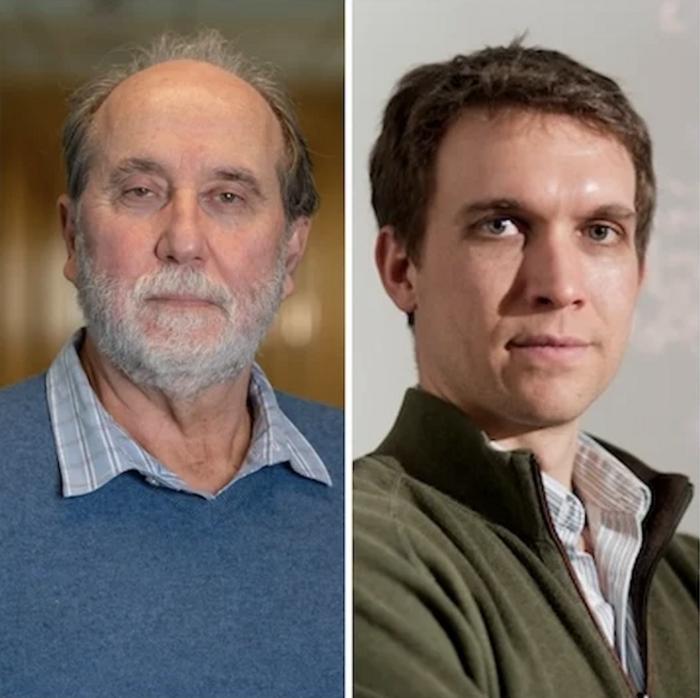
A team led by Jose Onuchic at Rice University and Paul Whitford at Northeastern University, both researchers at the National Science Foundation Physics Frontiers Center at the Center for Theoretical Biological Physics (CTBP) at Rice, has made a discovery in the fight against severe acute respiratory syndrome coronavirus-2 (SARS-CoV-2), the virus responsible for COVID-19.

Credit: Phot: Jose Onuchic by Gustavo Raskosky/Rice University and Paul Whitford by Brooks Canaday/Northeastern University
A team led by Jose Onuchic at Rice University and Paul Whitford at Northeastern University, both researchers at the National Science Foundation Physics Frontiers Center at the Center for Theoretical Biological Physics (CTBP) at Rice, has made a discovery in the fight against severe acute respiratory syndrome coronavirus-2 (SARS-CoV-2), the virus responsible for COVID-19.
The team, in partnership with an experimental effort led by Yale University researchers Walter Mothes and Wenwei Li, has uncovered new insights into how the virus infects human cells and how it can be neutralized. Their findings were published in the journal Science on Aug. 15.
SARS-CoV-2 uses its spike protein to attach to the angiotensin-converting enzyme 2 on human cells, initiating a process that allows it to enter the cell. The spike protein has two main parts: the S1 domain, which varies greatly among different strains of the virus, and the S2 domain, which is highly conserved across different coronaviruses. This similarity makes the S2 domain a promising target for vaccines and therapies that could work against many virus strains.
By combining simulations and theoretical predictions with structural information from their experimental collaborators, including initial and final configurations as well as intermediate states during the viral invasion, the researchers obtained a detailed picture of the infection process at an atomic level.
“Understanding these intermediate states of the spike protein creates new opportunities for treatment and prevention,” said Onuchic, the Harry C. and Olga K. Wiess Chair of Physics, professor of physics and astronomy, chemistry and biosciences and co-director of CTBP. “Our work demonstrates the importance of combining theoretical and experimental approaches to tackle complex problems such as viral infections.”
Using an advanced imaging technique called cryo-electron tomography, the experimental researchers at Yale captured detailed snapshots of the spike protein as it changes during the fusion process.
They discovered antibodies targeting a specific part of the S2 domain, called the stem-helix, which can bind to the spike protein and stop it from refolding into a shape necessary for fusion. This prevents the virus from entering human cells.
“Our study provides a detailed understanding of how the spike protein changes shape during infection and how antibodies can block this process,” Onuchic said. “This molecular insight opens up new possibilities for designing vaccines and therapies targeting a wide range of coronavirus strains.”
The researchers used a combination of theoretical modeling and experimental data to achieve their findings. By combining simulations of the spike protein with experimental images, they captured intermediate states of the protein that were previously unseen. This integrated approach allowed them to understand the infection process at an atomic level.
“The synergy between theoretical and experimental methods was crucial for our success,” said Whitford, a professor in the Department of Physics at Northeastern. “Our findings highlight new therapeutic targets and strategies for vaccine development that could be effective against most variants of the virus.”
The team’s discovery is significant in the ongoing efforts to combat COVID-19 and prepare for future outbreaks of related viruses. By targeting the conserved S2 domain, scientists can develop vaccines and therapies that remain effective even as the virus mutates.
“This research is a step forward in the fight against COVID-19 and other coronaviruses that may emerge in the future,” said Saul Gonzalez, director of the U.S. National Science Foundation’s Physics Division. “Understanding the fundamental physical workings within intricate biological mechanisms is essential for developing more effective and universal treatments that can protect our health and save lives.”
This work was supported by the National Science Foundation, National Institutes of Health, Canadian Institutes of Health Research, Canada Research Chairs and Welch Foundation.
Other researchers include Michael Grunst and Zhuan Qin at the Department of Microbial Pathogenesis and Shenping Wu at the Department of Pharmacology at Yale; Esteban Dodero-Rojas at CTPB; Shilei Ding, Jérémie Prévost and Andrés Finzi at the Centre de Recherche du CHUM; Yaozong Chen and Marzena Pazgier in the Infectious Disease Division in the F. Edward Hebert School of Medicine at Uniformed Services University of the Health Sciences; and Yanping Hu and Xuping Xie in the Department of Biochemistry and Molecular Biology at the University of Texas Medical Branch at Galveston.
Journal
Science
Article Title
Structure and inhibition of SARS-CoV-2 spike refolding in membranes
Article Publication Date
15-Aug-2024
Cite Scienmag News
Bethany Barker. (August 16, 2024). Researchers make breakthrough in fight against COVID-19. Scienmag. https://scienmag.com/researchers-make-breakthrough-in-fight-against-covid-19/
Bethany Barker. "Researchers make breakthrough in fight against COVID-19." Scienmag, 16 August 2024, https://scienmag.com/researchers-make-breakthrough-in-fight-against-covid-19/. Accessed 4 September 2026.
Bethany Barker. "Researchers make breakthrough in fight against COVID-19." Scienmag. August 16, 2024. https://scienmag.com/researchers-make-breakthrough-in-fight-against-covid-19/

