


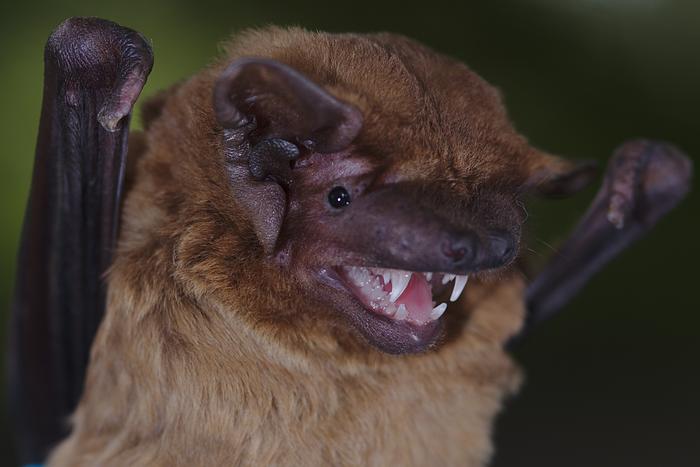
Researchers from Konstanz have measured the heart rate of bats over several days in the wild, including complete flights—the first time this has been done for a bat species. To record the heart rate of male common noctule bats during flight, the scientists attached heart rate transmitters weighing less than one gram to the animals, which they then accompanied in an airplane while the bats flew, sometimes for more than an hour, in search of food. Their results, published in Proceedings of the Royal Society B, show how much energy bats consume over the course of a day and what energy-saving strategies they use to survive.

Credit: Kamran Safi
Researchers from Konstanz have measured the heart rate of bats over several days in the wild, including complete flights—the first time this has been done for a bat species. To record the heart rate of male common noctule bats during flight, the scientists attached heart rate transmitters weighing less than one gram to the animals, which they then accompanied in an airplane while the bats flew, sometimes for more than an hour, in search of food. Their results, published in Proceedings of the Royal Society B, show how much energy bats consume over the course of a day and what energy-saving strategies they use to survive.
Researchers from the Max Planck Institute of Animal Behavior (MPI-AB) and the University of Konstanz used a special method to study male common noctule bats, which are found throughout Europe. Their aim was to understand exactly how much energy bats consume during the day and how this changes over the course of the year.
“Bats are fascinating animals that often share their habitat with us humans,” says Lara Keicher, the lead author of the study. “But bats are still shrouded in mystery. We don’t yet have a clear answer to simple questions such as: How much food do they need and can they find enough of it in different seasons to survive?” To predict how bats will fare in a changing climate, Keicher says it is crucial to know their energy requirements.
Bats with heart rate transmitters
To find out, the scientists fitted bats with small heart rate transmitters weighing just 0.8 grams. As with humans, heart rate can be used to determine energy consumption. The transmitters, which the bats only wore for a few days, send out an audio signal of the bats’ heartbeat, which is then recorded using a radio receiver. However, this only works if the receiver is within a few hundred meters from the bats.
“During the day, it was no problem to record the heart beats without major interruptions because bats were resting in tree caves or bat boxes,” says Keicher, who carried out the study as part of her doctoral thesis at the University of Konstanz and the MPI-AB. At night, however, bats fly out to hunt insects and can cover several kilometers in a short time. In order to accompany the bats around the clock, including during their nocturnal flight, the researchers flew in a small airplane to follow individuals for entire flights lasting more than an hour. “I know that we surprised Konstanz locals when our small plane flew in circles over the island of Mainau late at night,” recalls Keicher.
Awake during the day
The team, which also included members of the Swiss Institute for Snow and Avalanche Research and the University of Freiburg, found that the heart rate of bats reaches around 900 beats per minute during flight. According to Keicher, who analyzed the signal, “it sounded like a single high-pitched tone to our ears”.
Using the unique recordings of heart beats, the scientists discovered fascinating strategies that bats use to budget their energy consumption in different seasons. They found that male common noctule bats consume up to 42% more energy in summer compared to spring. This is mainly due to the fact that the bats in spring go into a kind of short daytime hibernation known as “torpor”—an energy-saving state in which heart rate can be reduced to six beats per minute. “We saw that bats in spring could ramp up their heart rates when they wake up, reaching the top speed of 900 beats per minute within only a few minutes,” says Keicher.
The team was surprised that male bats did not use torpor in summer at all. Keicher explains: “In the warmer months, when food is plentiful, males stay awake during the day to invest energy in sperm production in order to be ready for mating in the autumn.” To replenish the energy used up, the males hunt twice as long in summer as in spring and eat up to 33 June beetles or over 2500 mosquitoes in one night.
The results have provided insights into the energetic challenges of bats and their fascinating survival strategies. This understanding will allow better predictions of how increasingly extreme temperature fluctuations or changes in food availability will affect the animals’ lives and potentially threaten them.
The senior author of the study, MPI-AB scientist Dina Dechmann, says: “All bat species are protected in Germany and some are threatened with extinction. Basic research that investigates the behavior of the animals and their adaptations to the environment can help us develop protective measures so that, for example, common noctule bats can continue to be seen in the night sky over Konstanz.”
A YouTube video with audio of heart beats recorded from bats is here:
Journal
Proceedings of the Royal Society B Biological Sciences
Method of Research
Observational study
Subject of Research
Animals
Article Title
Heart rate monitoring reveals differential seasonal energetic trade-offs in male noctule bats.
Article Publication Date
10-Jul-2024
Cite Scienmag News
Drew Townsend. (July 9, 2024). Researchers listen to the hearts of bats in flight. Scienmag. https://scienmag.com/researchers-listen-to-the-hearts-of-bats-in-flight/
Drew Townsend. "Researchers listen to the hearts of bats in flight." Scienmag, 9 July 2024, https://scienmag.com/researchers-listen-to-the-hearts-of-bats-in-flight/. Accessed 5 September 2026.
Drew Townsend. "Researchers listen to the hearts of bats in flight." Scienmag. July 9, 2024. https://scienmag.com/researchers-listen-to-the-hearts-of-bats-in-flight/

