


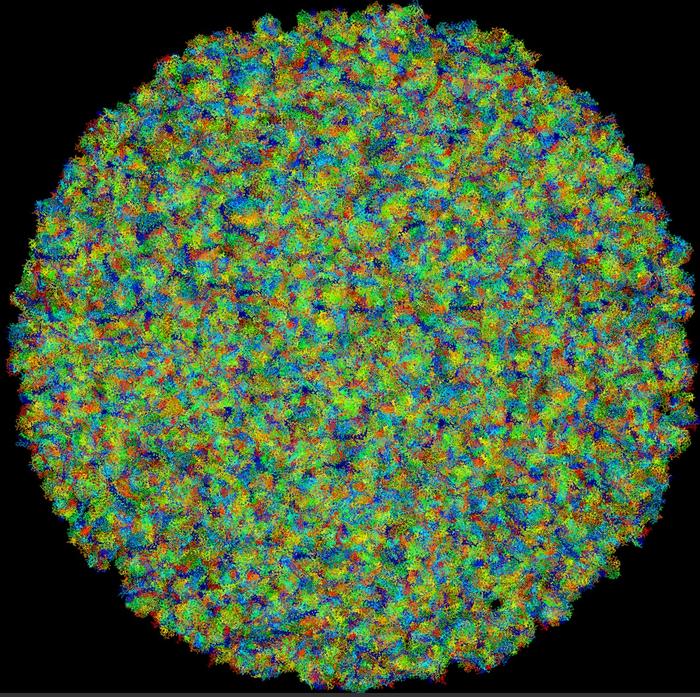
LAWRENCE — A partnership between scientists at the University of Kansas and collaborators in Europe, including war-torn Ukraine, will result in computer models of biological cells likely to hasten health breakthroughs by simulating molecular interactions inside cells with near experimental accuracy at vastly longer timescales than similar efforts.

Credit: Ilya Vakser
LAWRENCE — A partnership between scientists at the University of Kansas and collaborators in Europe, including war-torn Ukraine, will result in computer models of biological cells likely to hasten health breakthroughs by simulating molecular interactions inside cells with near experimental accuracy at vastly longer timescales than similar efforts.
The research is supported by the National Science Foundation’s IMPRESS-U (International Multilateral Partnerships for Resilient Education and Science System in Ukraine) program that aims to “support excellence in science and engineering research, education, and innovation through international collaboration and promote and catalyze integration of Ukrainian researchers in the global research community.”
The cell-modeling approach underpinning the research was pioneered in the lab of Ilya Vakser, professor of computational biology and molecular biosciences and director of the Center for Computational Biology at KU. Vakser’s group is one of the foremost in the world in modeling macromolecular interactions.
“Our extra-long simulation time scales will allow us to investigate macromolecular interactions in the environment that approximates the actual content of a cell,” said Vakser, the principal investigator. “The approach we put forward is about a million — and I mean a million — times faster than alternative approaches developed elsewhere.”
The method allows Vakser’s team to re-create physiological phenomena in cells that are much longer and more relevant to biology and medicine, with a wide range of applications to fundamental science and medicine.
“What we’re doing is a virtual cell,” Vakser said. “It’s a biological cell that exists in the computer. And it allows us to investigate all kinds of biological phenomena at atomic resolution, such as the effects of genetic mutations. For example, what changes if this part of the protein mutates? We can see potentially the consequence of that. Also, we will be able to drop a virtual drug into this model and see again how the cell reacts — what changes? So that’s a totally new opportunity for computer-aided drug design.”
The KU researcher’s key investigative collaborators are Ceslovas Venclovas of Vilnius University in Lithuania and Pavlo Kasyanov of the National Technical University of Ukraine Igor Sikorsky Kyiv Polytechnic Institute in Kyiv.
Vakser said Kasyanov’s team in Ukraine are leaders in massive parallel computing and artificial intelligence, boosting the computing power available to the cell-modeling technique honed at KU.
“We met with our colleagues in Ukraine through a common colleague, and they’re one of the leading groups in massive parallel computing and artificial intelligence,” Vakser said. “We started collaborating, and what they’re doing is adapting our approach for massive parallel computing and artificial intelligence, which would speed it up further by orders of magnitude, with implications that are hard to imagine now. It’s a breathtaking development, which we’re super excited about. It could be a huge thing for science and medicine in the relatively short term.”
Vakser said his Ukrainian collaborators highlighted the resilience of scientific pursuit.
“It’s remarkable how our colleagues, even in a war environment where bombs are falling, are able to do first-grade science, which is amazing for all of us,” he said.
In addition to providing educational training to KU students, the resulting computer simulation technology will be provided to the wider research community via an open-access web platform.
“We’re developing a public resource that will provide the opportunity for anybody in the world with a research interest in this to try this model and see how it works,” Vakser said. “It’s an entry point for them to do the modeling themselves.”
The grant and partnership underscore KU’s status as a leader in computer simulations of biological processes, according to Vakser.
“We are pioneering this research, and it’s on the radar around the world among the key figures in computational biology field,” he said.
Cite Scienmag News
Denise Maddox. (June 12, 2024). Researchers in US, Ukraine simulate cell activity at ‘breathtaking’ timescales. Scienmag. https://scienmag.com/researchers-in-us-ukraine-simulate-cell-activity-at-breathtaking-timescales/
Denise Maddox. "Researchers in US, Ukraine simulate cell activity at ‘breathtaking’ timescales." Scienmag, 12 June 2024, https://scienmag.com/researchers-in-us-ukraine-simulate-cell-activity-at-breathtaking-timescales/. Accessed 4 September 2026.
Denise Maddox. "Researchers in US, Ukraine simulate cell activity at ‘breathtaking’ timescales." Scienmag. June 12, 2024. https://scienmag.com/researchers-in-us-ukraine-simulate-cell-activity-at-breathtaking-timescales/

