


When Katey Walter Anthony heard rumors of methane, a potent greenhouse gas, ballooning under the lawns of fellow Fairbanks residents, she nearly didn’t believe it.

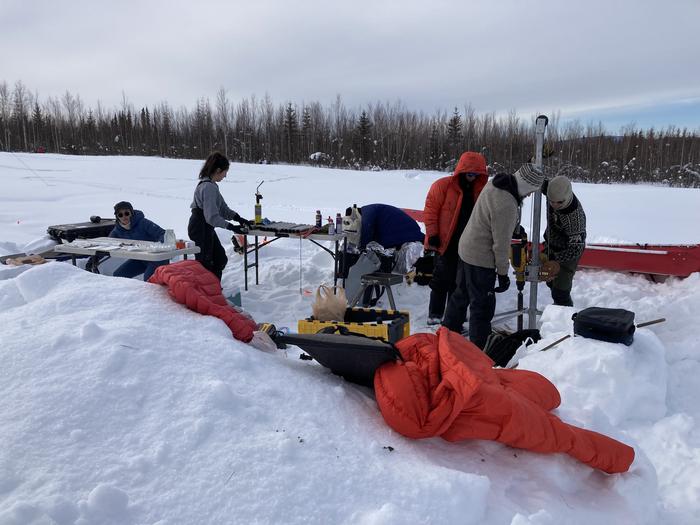
Credit: Photo by Katey Walter Anthony
When Katey Walter Anthony heard rumors of methane, a potent greenhouse gas, ballooning under the lawns of fellow Fairbanks residents, she nearly didn’t believe it.
“I ignored it for years because I thought ‘I am a limnologist, methane is in lakes,’” she said.
But when a local reporter contacted Walter Anthony, who is a research professor at the Institute of Northern Engineering at University of Alaska Fairbanks, to inspect the waterbed-like ground at a nearby golf course, she started to pay attention. Like others in Fairbanks, they lit “turf bubbles” on fire and confirmed the presence of methane gas.
Then, when Walter Anthony looked at nearby sites, she was shocked that methane wasn’t just coming out of a grassland. “I went through the forest, the birch trees and the spruce trees, and there was methane gas coming out of the ground in large, strong streams,” she said.
“We just had to study that more,” Walter Anthony said.
With funding from the National Science Foundation, she and her colleagues launched a comprehensive survey of dryland ecosystems in Interior and Arctic Alaska to determine whether it was a one-off oddity or unforeseen concern.
Their study, published in the journal Nature Communications this July, reported that upland landscapes were releasing some of the highest methane emissions yet documented among northern terrestrial ecosystems. Even more, the methane consisted of carbon thousands of years older than what researchers had previously seen from upland environments.
“It’s a totally different paradigm from the way anyone thinks about methane,” Walter Anthony said.
Because methane is 25 to 34 times more potent than carbon dioxide, the discovery brings new concerns to the potential for permafrost thaw to accelerate global climate change.
The findings challenge current climate models, which predict that these environments will be an insignificant source of methane or even a sink as the Arctic warms.
Typically, methane emissions are associated with wetlands, where low oxygen levels in water-saturated soils favor microbes that produce the gas. Yet methane emissions at the study’s well-drained, drier sites were in some cases higher than those measured in wetlands.
This was especially true for winter emissions, which were five times higher at some sites than emissions from northern wetlands.
Digging into the source
“I needed to prove to myself and everyone else that this is not a golf course thing,” Walter Anthony said.
She and colleagues identified 25 additional sites across Alaska’s dry upland forests, grasslands and tundra and measured methane flux at over 1,200 locations year-round across three years. The sites encompassed areas with high silt and ice content in their soils and signs of permafrost thaw known as thermokarst mounds, where thawing ground ice causes some parts of the land to sink. This leaves behind an “egg carton” like pattern of conical hills and sunken trenches.
The researchers found all but three sites were emitting methane.
The research team, which included scientists at UAF’s Institute of Arctic Biology and the Geophysical Institute, combined flux measurements with an array of research techniques, including radiocarbon dating, geophysical measurements, microbial genetics and directly drilling into soils.
They found that unique formations known as taliks, where deep, expansive pockets of buried soil remain unfrozen year-round, were likely responsible for the elevated methane releases.
These warm winter havens allow soil microbes to stay active, decomposing and respiring carbon during a season that they normally wouldn’t be contributing to carbon emissions.
Walter Anthony said that upland taliks have been an emerging concern for scientists because of their potential to increase permafrost carbon emissions. “But everyone’s been thinking about the associated carbon dioxide release, not methane,” she said.
The research team emphasized that methane emissions are especially high for sites with Pleistocene-era Yedoma deposits. These soils contain large stocks of carbon that extend tens of meters below the ground surface. Walter Anthony suspects that their high silt content prevents oxygen from reaching deeply thawed soils in taliks, which in turn favors microbes that produce methane.
Walter Anthony said it’s these carbon-rich deposits that make their new discovery a global concern. Even though Yedoma soils only cover 3% of the permafrost region, they contain over 25% of the total carbon stored in northern permafrost soils.
The study also found through remote sensing and numerical modeling that thermokarst mounds are developing across the pan-Arctic Yedoma domain. Their taliks are projected to be formed extensively by the 22nd century with continued Arctic warming.
“Everywhere you have upland Yedoma that forms a talik, we can expect a strong source of methane, especially in the winter,” Walter Anthony said.
“It means the permafrost carbon feedback is going to be a lot bigger this century than anybody thought,” she said.
Journal
Nature Communications
Article Title
Upland Yedoma taliks are an unpredicted source of atmospheric methane
Article Publication Date
18-Jul-2024
Cite Scienmag News
Sloane Callahan. (August 8, 2024). Researchers find unexpectedly large methane source in overlooked landscape. Scienmag. https://scienmag.com/researchers-find-unexpectedly-large-methane-source-in-overlooked-landscape/
Sloane Callahan. "Researchers find unexpectedly large methane source in overlooked landscape." Scienmag, 8 August 2024, https://scienmag.com/researchers-find-unexpectedly-large-methane-source-in-overlooked-landscape/. Accessed 4 September 2026.
Sloane Callahan. "Researchers find unexpectedly large methane source in overlooked landscape." Scienmag. August 8, 2024. https://scienmag.com/researchers-find-unexpectedly-large-methane-source-in-overlooked-landscape/

