


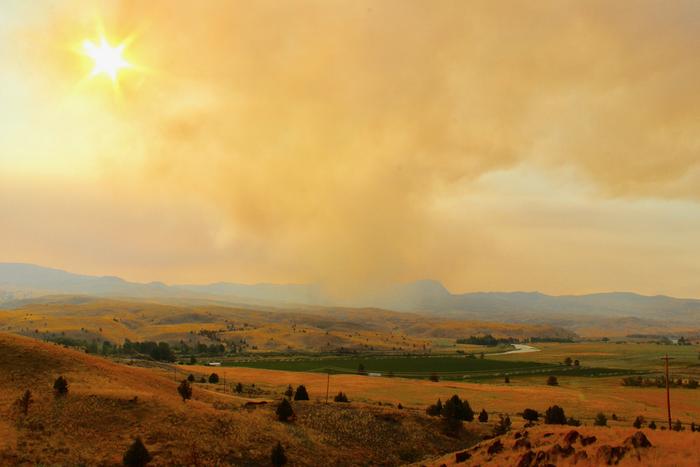
CORVALLIS, Ore. – A newly enhanced database is expected to help wildfire managers and scientists better predict where and when wildfires may occur by incorporating hundreds of additional factors that impact the ignition and spread of fire.

Credit: Emily Jane Davis, Oregon State University.
CORVALLIS, Ore. – A newly enhanced database is expected to help wildfire managers and scientists better predict where and when wildfires may occur by incorporating hundreds of additional factors that impact the ignition and spread of fire.
“There is a tremendous amount of interest in what enables wildfire ignitions and what can be done to prevent them,” said Erica Fleishman, an Oregon State University professor. “This database increases the ability to access relevant information and contribute to wildfire preparedness and prevention.”
The Fire Program Analysis Fire-Occurrence Database was developed in 2013 by the U.S. Forest Service and since been updated five times. It incorporates basic information such as ignition location, discovery date and final wildfire size.
The revised database now includes many new environmental and social factors, such as topography and vegetation, social vulnerability and economic justice metrics, and practical attributes such as the distance from the ignition to the nearest road.
In addition to aiding on-the-ground firefighters and managers, the database could also help power companies evaluate short-term risk when deciding whether to implement a public safety power shutoff or land management agencies determine whether to reduce access to public lands or restrict campfires during certain times of year, Fleishman said.
“There seem to be a lot of policies that are guided to some extent by intuition or emotions rather than by a large body of evidence,” she said. “These data present one way to increase the objective evidence to consider when making those decisions.”
The team, including Fleishman, and led by Yavar Pourmohamad, a doctoral student at Boise State University, and Mojtaba Sadegh, an associate professor at Boise State, added nearly 270 additional attributes. The database now includes information on 2.3 million fires in the United States from 1992 to 2020.
“This provides a considerably deeper understanding of the individual and compounded impact of these attributes on wildfire ignitions and size,” Pourmohamad said. “It also identifies the unequal effects of wildfires on distinct human populations and ecosystems, which can, in turn, inform efforts to reduce inequities.”
Information from the database can also be incorporated into artificial intelligence and machine learning models that explain drivers of past fires or project likelihoods or effects of future fires, said Fleishman, who is affiliated with OSU’s College of Earth, Ocean, and Atmospheric Sciences and also directs the Oregon Climate Change Research Institute.
“It’s amazing what you can infer when you have the computational capacity and this much information,” she said. “You can ask a lot of questions that inform different actions in different places and to understand what is associated with wildfire ignitions and fire effects.”
A paper outlining the database was recently published in the journal Earth System Science Data.
Other co-authors of the paper are Eric Henderson and Sawyer Ball of Boise State; John Abatzoglou, University of California, Merced; Erin Belval, Karen Short, Matthew Reeves and Julia Olszewski, USDA Forest Service Rocky Mountain Research Station; Nicholas Nauslar, National Weather Service Storm Prediction Center; Philip Higuera, University of Montana; Amir AghaKouchak, University of California, Irvine; and Jeffrey Prestemon, USDA Forest Service Southern Research Station.
The research was supported by the Joint Fire Science Program, a program of the U.S. Forest Service and U.S. Department of the Interior.
Journal
Earth System Science Data
Cite Scienmag News
Violet Maxwell. (July 22, 2024). Researchers enhance tool to better predict where and when wildfires will occur. Scienmag. https://scienmag.com/researchers-enhance-tool-to-better-predict-where-and-when-wildfires-will-occur/
Violet Maxwell. "Researchers enhance tool to better predict where and when wildfires will occur." Scienmag, 22 July 2024, https://scienmag.com/researchers-enhance-tool-to-better-predict-where-and-when-wildfires-will-occur/. Accessed 4 September 2026.
Violet Maxwell. "Researchers enhance tool to better predict where and when wildfires will occur." Scienmag. July 22, 2024. https://scienmag.com/researchers-enhance-tool-to-better-predict-where-and-when-wildfires-will-occur/

