


CHAPEL HILL, N.C. – Humans can sense five different tastes: sour, sweet, umami, bitter, and salty, using specialized sensors on our tongues called taste receptors. Other than allowing us to enjoy delicious foods, the sensation of taste allows us to determine the chemical makeup of food and prevents us from consuming toxic substances.

Credit: Kim et al (2024)
CHAPEL HILL, N.C. – Humans can sense five different tastes: sour, sweet, umami, bitter, and salty, using specialized sensors on our tongues called taste receptors. Other than allowing us to enjoy delicious foods, the sensation of taste allows us to determine the chemical makeup of food and prevents us from consuming toxic substances.
Researchers at the UNC School of Medicine, including Bryan Roth, MD, PhD, the Michael Hooker Distinguished Professor of Pharmacology, and Yoojoong Kim, PhD, a postdoctoral researcher in the Roth Lab, recently set out to address one very basic question: “How exactly do we perceive bitter taste?”
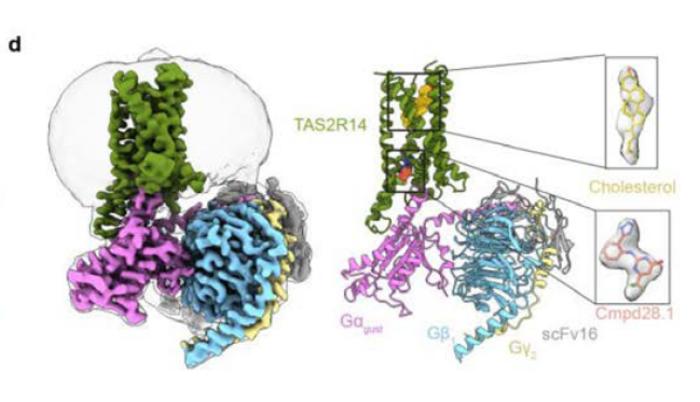
A new study, published in Nature, reveals the detailed protein structure of the TAS2R14 bitter taste receptor. In addition to solving the structure of this taste receptor, the researchers were also able to determine where bitter-tasting substances bind to TAS2R14 and how they activate them, allowing us to taste bitter substances.
“Scientists know very little about the structural make up of sweet, bitter, and umami taste receptors,” said Kim. “Using a combination of biochemical and computational methods, we now know the structure of the bitter taste receptor TAS2R14 and the mechanisms that initializes the sensation of bitter taste in our tongues.”
This detailed information is important for discovering and designing drug candidates that can directly regulate taste receptors, with the potential to treat metabolic diseases such as obesity and diabetes.
From Chemicals to Electricity to Sensation
TAS2R14s are members of the G protein-coupled receptor (GPCR) family of bitter taste receptors. The receptors are attached to a protein known as a G protein. TAS2R14 stands out from the others in its family because it can identify more than 100 distinct substances known as bitter tastants.
Researchers found that when bitter tastants come into contact with TAS2R14 receptors, the chemicals wedge themselves into to a specific spot on the receptor called an allosteric site, this causes the protein to change its shape, activating the attached G protein.
This triggers a series of biochemical reactions within the taste receptor cell, leading to activation of the receptor, which can then send signals to tiny nerve fibers – through the cranial nerves in the face – to an area of the brain called the gustatory cortex. It is here where the brain processes and perceives the signals as bitterness. And of course, this complex signaling system occurs almost instantaneously.
Cholesterol’s Role in Bitter Taste Reception
While working to define its structure, researchers found another unique feature of TAS2R14 – that cholesterol is giving it a helping hand in its activation.
“Cholesterol was residing in another binding site called the orthosteric pocket in TAS2R14, while the bitter tastant binds to the allosteric site,” said Kim. “Through molecular dynamics simulations, we also found that the cholesterol puts the receptor in a semi-active state, so it can be easily activated by the bitter tastant.”
Bile acids, which are created in the liver, have similar chemical structures with cholesterol. Previous studies have suggested that bile acids can bind and activate TAS2R14, but little is known about how and where they bind in the receptor.
Using their newfound structure, researchers found that bile acids might be binding to the same orthosteric pocket as cholesterol. While the exact role of bile acid or cholesterol in TAS2R14 remains unknown, it may play a role in the metabolism of these substances or in relation to metabolic disorders such as obesity or diabetes.
How This Can Help Drug Development
The discovery of this novel allosteric binding site for bitter tasting substances is unique.
The allosteric binding region is located between TAS2R14 and its coupled G protein is called G-protein alpha. This region is critical to form a signaling complex, which helps to transfer the signal from the taste receptor to the G-protein to the taste receptor cells.
“In the future, this structure will be key to discovering and designing drug candidates that can directly regulate G proteins through the allosteric sites,” said Kim. “We also have the ability to affect specific G-protein subtypes, like G-protein alpha or G-protein beta, rather than other G-protein pathways that we don’t want to cause any other side effects.”
Roth and Kim have made a number of new discoveries, but some leave more questions than answers. While running a genomics study, they found that the TAS2R14 protein in complex with the GI is expressed outside the tongue, especially in the cerebellum in the brain, the thyroid, and the pancreas. Researchers are planning future studies to elucidate the function these proteins may have outside of the mouth.
This work was supported by the NIH Illuminating the Druggable Genome Initiative.
About UNC School of Medicine
The UNC School of Medicine (SOM) is the state’s largest medical school, graduating more than 180 new physicians each year. It is consistently ranked among the top medical schools in the US, including 5th overall for primary care by US News & World Report, and 6th for research among public universities. More than half of the school’s 1,700 faculty members served as principal investigators on active research awards in 2021. Two UNC SOM faculty members have earned Nobel Prize awards.
# # # #
Journal
Nature
Article Title
Bitter taste receptor activation by cholesterol and an intracellular tastant
Article Publication Date
10-Apr-2024
Cite Scienmag News
Ophelia Keating. (April 10, 2024). Researchers discover how we perceive bitter taste. Scienmag. https://scienmag.com/researchers-discover-how-we-perceive-bitter-taste/
Ophelia Keating. "Researchers discover how we perceive bitter taste." Scienmag, 10 April 2024, https://scienmag.com/researchers-discover-how-we-perceive-bitter-taste/. Accessed 4 September 2026.
Ophelia Keating. "Researchers discover how we perceive bitter taste." Scienmag. April 10, 2024. https://scienmag.com/researchers-discover-how-we-perceive-bitter-taste/

