



image:
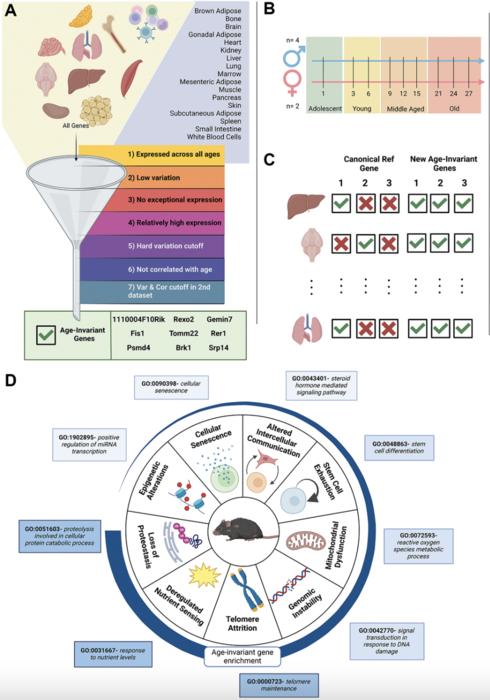
Figure 1. Visual diagram of article contents. (A) Bulk RNA-seq data from 17 murine tissues (GSE132040) were sequentially filtered through 7 criteria. The funnel is a visual depiction of the filtering process. Steps 1–4 are adapted from previous publications. We added criteria filters 5 and 6 to ensure low variation and no correlation with age. Criteria filter 7 was validation of low variation and no age correlation, performed in a second dataset for 11 of the 17 tissues. The filtering strategy resulted in 9 pan-tissue age-invariant genes (gene box). (B) Sample gender, age and life stage distributions of the samples in the dataset. A full table of samples can be found in Supplementary Table 10. (C) Classical reference genes are not applicable to all tissues in an aging context but age-invariant genes introduced here are. (D) Tissue aging-invariant genes are enriched to different extents for gene ontology terms associated with hallmarks of aging. Age-invariant genes have low enrichment in some (e.g. epigenetic alterations GO terms) and high enrichment in others (e.g. loss of proteostasis GO terms). Created with https://www.biorender.com/.
view more
Credit: Copyright: © 2025 González et al. This is an open access article distributed under the terms of the Creative Commons Attribution License (CC BY 4.0), which permits unrestricted use, distribution, and reproduction in any medium, provided the original author and source are credited.
“[…] we provide the aging field with lists of tissue-specific age-invariant genes as well as 9 pan-tissue age-invariant genes for use in normalization strategies in murine tissues, e.g., RT-qPCR.”
BUFFALO, NY — February 26, 2025 — A new research paper was published in Aging (Aging-US) on January 27, 2025, in Volume 17, Issue 1, titled “Age-invariant genes: multi-tissue identification and characterization of murine reference genes.”
Aging is a process driven by changes in gene activity, but researchers from Yale University School of Medicine and Altos Labs, led by first author John T. González and corresponding author Albert T. Higgins-Chen, have identified a set of genes that remain unchanged throughout the aging process. This discovery could improve the accuracy of aging research and provide insights into why some genes stay unchanged while others decline.
“Reference genes have mostly been identified and validated in young organisms, and no systematic investigation has been done across the lifespan.”
The study looked at gene activity in 17 different tissues in mice, from 1 month old to over 21 months old. Scientists used advanced bioinformatic analysis methods to analyze RNA sequencing data. They found nine genes that stayed the same across all tissues, as well as other genes that remained stable in specific tissues. These genes are usually shorter and have special DNA regions called CpG islands, which may help cells stay healthy and resist aging. Their stability throughout aging was confirmed by analyzing different datasets and using RT-qPCR.
One of the most significant findings is that these stable genes are linked to essential cellular functions, such as mitochondrial activity and protein maintenance. This challenges the common belief that all aspects of aging involve gene dysregulation. Instead, the findings suggest that some cellular processes may naturally resist aging, leading the way for new research on longevity and potential anti-aging therapies.
“Biological processes that change with age and those that resist age-related dysregulation are two sides of the same coin, and both will need to be investigated to fully understand aging.”
Another key finding is that commonly used reference genes, such as GAPDH and ACTB, fluctuate with age, making them unreliable for aging studies. No single classical reference gene was found to be stable across all tissues. Researchers often use these reference genes as a control to measure gene activity, but if their expression changes over time, it can lead to inaccurate results. By identifying new, stable reference genes, this study provides scientists with better tools for studying aging-related diseases, regenerative medicine, and longevity science.
Understanding how certain genes remain unchanged throughout life suggests that they may play a protective role in aging and could potentially be used to develop treatments that slow down age-related decline. While further research is needed, this discovery sets a new standard for measuring gene activity in aging studies and could have a significant impact on aging research and medicine.
Corresponding author: Albert T. Higgins-Chen – a.higginschen@yale.edu
Click here to sign up for free Altmetric alerts about this article.
About Aging:
The journal Aging aims to promote 1) treatment of age-related diseases by slowing down aging, 2) validation of anti-aging drugs by treating age-related diseases, and 3) prevention of cancer by inhibiting aging. (Cancer and COVID-19 are age-related diseases.)
Aging is indexed by PubMed/Medline (abbreviated as “Aging (Albany NY)”), PubMed Central, Web of Science: Science Citation Index Expanded (abbreviated as “Aging‐US” and listed in the Cell Biology and Geriatrics & Gerontology categories), Scopus (abbreviated as “Aging” and listed in the Cell Biology and Aging categories), Biological Abstracts, BIOSIS Previews, EMBASE, META (Chan Zuckerberg Initiative) (2018-2022), and Dimensions (Digital Science).
Please visit our website at www.Aging-US.com and connect with us:
- X
- YouTube
- Spotify, and available wherever you listen to podcasts
Click here to subscribe to Aging publication updates.
For media inquiries, please contact media@impactjournals.com.
Aging (Aging-US) Journal Office
6666 E. Quaker St., Suite 1
Orchard Park, NY 14127
Phone: 1-800-922-0957, option 1
Journal
Aging-US
Method of Research
News article
Subject of Research
Animals
Article Title
Age-invariant genes: multi-tissue identification and characterization of murine reference genes
Article Publication Date
27-Jan-2025
COI Statement
A.H.C. has received consulting fees from TruDiagnostic and FOXO Biosciences for work unrelated to this publication. All other authors report no biomedical financial interests or potential conflicts of interest.
Media Contact
Ryan Braithwaite
Impact Journals LLC
media@impactjournals.com
Journal
Aging-US
Method of Research
News article
Subject of Research
Animals
Article Title
Age-invariant genes: multi-tissue identification and characterization of murine reference genes
Article Publication Date
27-Jan-2025
COI Statement
A.H.C. has received consulting fees from TruDiagnostic and FOXO Biosciences for work unrelated to this publication. All other authors report no biomedical financial interests or potential conflicts of interest.
Keywords
Cite Scienmag News
Juliet Wilcox. (February 26, 2025). Researchers Discover Age-Invariant Genes That Could Revolutionize Aging Studies. Scienmag. https://scienmag.com/researchers-discover-age-invariant-genes-that-could-revolutionize-aging-studies/
Juliet Wilcox. "Researchers Discover Age-Invariant Genes That Could Revolutionize Aging Studies." Scienmag, 26 February 2025, https://scienmag.com/researchers-discover-age-invariant-genes-that-could-revolutionize-aging-studies/. Accessed 7 September 2026.
Juliet Wilcox. "Researchers Discover Age-Invariant Genes That Could Revolutionize Aging Studies." Scienmag. February 26, 2025. https://scienmag.com/researchers-discover-age-invariant-genes-that-could-revolutionize-aging-studies/

