

Sunday, July 19, 2026
Science
No Result
View All Result
  • Login
  • HOME
  • SCIENCE NEWS
  • CONTACT US
  • HOME
  • SCIENCE NEWS
  • CONTACT US
No Result
View All Result
Scienmag
No Result
View All Result
Home Science News Technology and Engineering

Researchers develop perovskite X-ray detector for medical imaging

May 21, 2024
in Technology and Engineering
Reading Time: 2 mins read
0
Researchers develop perovskite X-ray detector for medical imaging
67
SHARES
607
VIEWS
Share on FacebookShare on Twitter
ADVERTISEMENT

Technology (SIAT) of the Chinese Academy of Sciences, in collaboration with researchers at Central China Normal University, have developed a high-performance perovskite X-ray complementary metal-oxide-semiconductor (CMOS) detector for medical imaging.

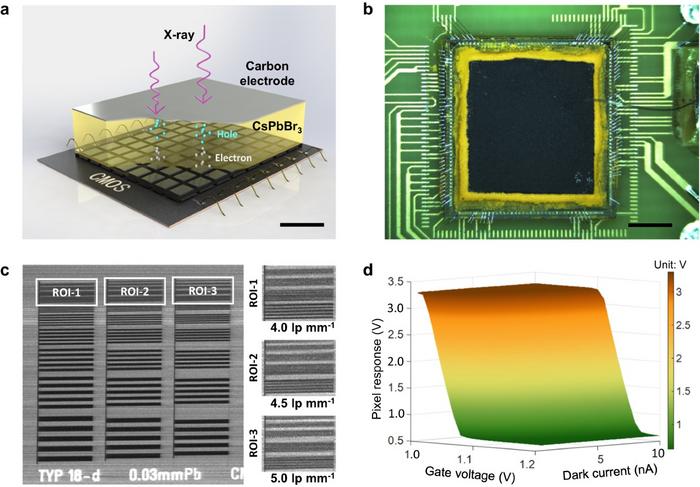
Inorganic CsPbBr3 based direct-conversion X-ray CMOS detector.

Credit: Yongshuai Ge

Technology (SIAT) of the Chinese Academy of Sciences, in collaboration with researchers at Central China Normal University, have developed a high-performance perovskite X-ray complementary metal-oxide-semiconductor (CMOS) detector for medical imaging.

The study was published in Nature Communications on Feb. 21.

X-ray imaging is vital for the diagnosis and treatment of cardiovascular and cancer diseases. Direct-conversion X-ray detectors made of semiconductor materials exhibit superior spatial and temporal resolution at lower radiation doses compared to indirect-conversion detectors made of scintillator materials. However, the currently available semiconductor materials, such as Si, a-Se, and CdZnTe/CdTe, are not ideal for general X-ray imaging due to their low X-ray absorption efficiency or high costs.

Perovskite is a promising alternative to conventional semiconductor materials. However, the feasibility of its combination with high-speed pixelated CMOS arrays is still unknown.

To address this issue, researchers developed a direct-conversion X-ray detector fabricated with a 300 μm thick inorganic CsPbBr3 perovskite film printed on a dedicated CMOS pixel array.

Researchers found that the screen-printed thick CsPbBr3 film has a high μτ product of 5.2×10⁻⁴ cm2 V–1, a high X-ray detection sensitivity of 15891 µC Gyair–1 cm–2, and a low dose detection limit of 321 nGyair s–1.

Experimental X-ray 2D imaging results showed that the proposed perovskite CMOS detector can achieve very high spatial resolution (5.0 lp mm-1, hardware limit is 6.0 lp mm-1) and low-dose (260 nGy) imaging performance.

Moreover, 3D CT imaging was also validated with the proposed detector at a fast signal readout speed of 300 fps.

“Our work shows the potential of lead halide perovskites in revolutionizing the development of state-of-the-art X-ray detectors with significantly enhanced spatial resolution, readout speed, and low-dose detection efficiency,” said Prof. GE. “This paves the road for medical X-ray imaging applications to become gentler and safer in the future.”


Journal

Nature Communications

Method of Research

Commentary/editorial

Subject of Research

Not applicable

Article Title

Dynamic X-ray imaging with screen-printed perovskite CMOS array

Article Publication Date

21-Feb-2024

Share27Tweet17
Previous Post

Monitoring the recovery process accurately with a medical needle and thread!

Next Post

Pancreatic cancer research receives $8m philanthropic funding boost

Related Posts

Topological Jackiw-Rebbi States in Photonic Van der Waals Heterostructures
Technology and Engineering

Topological Jackiw-Rebbi States in Photonic Van der Waals Heterostructures

July 19, 2026
Neonatal Monocyte Iron Handling Drives Immunometabolic Responses in Sepsis
Technology and Engineering

Neonatal Monocyte Iron Handling Drives Immunometabolic Responses in Sepsis

July 18, 2026
Carbonation-Empowered Offshore Deep Cement Mixing Enables Undredged Land Reclamation
Technology and Engineering

Carbonation-Empowered Offshore Deep Cement Mixing Enables Undredged Land Reclamation

July 18, 2026
Noninvasive Acoustic Assessment of Feeding Skills in Preterm Infants With BPD
Technology and Engineering

Noninvasive Acoustic Assessment of Feeding Skills in Preterm Infants With BPD

July 18, 2026
Journal Cyborg and Bionic Systems Impact Factor Hits 20.9, Ranks Top Four
Technology and Engineering

Journal Cyborg and Bionic Systems Impact Factor Hits 20.9, Ranks Top Four

July 18, 2026
Delayed vs Early Cord Clamping in Preterm Twins: Echocardiography Study
Technology and Engineering

Delayed vs Early Cord Clamping in Preterm Twins: Echocardiography Study

July 18, 2026
Next Post
Pancreatic cancer research receives $8m philanthropic funding boost

Pancreatic cancer research receives $8m philanthropic funding boost

  • Mothers who receive childcare support from maternal grandparents show more

    Mothers who receive childcare support from maternal grandparents show more parental warmth, finds NTU Singapore study

    27656 shares
    Share 11059 Tweet 6912
  • University of Seville Breaks 120-Year-Old Mystery, Revises a Key Einstein Concept

    1061 shares
    Share 424 Tweet 265
  • Bee body mass, pathogens and local climate influence heat tolerance

    682 shares
    Share 273 Tweet 171
  • Researchers record first-ever images and data of a shark experiencing a boat strike

    546 shares
    Share 218 Tweet 137
  • Groundbreaking Clinical Trial Reveals Lubiprostone Enhances Kidney Function

    531 shares
    Share 212 Tweet 133
Science

Embark on a thrilling journey of discovery with Scienmag.com—your ultimate source for cutting-edge breakthroughs. Immerse yourself in a world where curiosity knows no limits and tomorrow’s possibilities become today’s reality!

RECENT NEWS

  • Rannasangpei crocin-1 improves valproate-induced autism-like behaviors by reducing oxidative stress
  • Sleep Quality Links Synergistically with Frailty to Increase Cardiometabolic Multimorbidity in Elderly Chinese
  • Gut Microbiome Metabolites Shape Development of Stress-Related Mental Disorders
  • Cognitive reserve helps older adults resist frailty and recover better

Categories

  • Agriculture
  • Anthropology
  • Archaeology
  • Athmospheric
  • Biology
  • Biotechnology
  • Blog
  • Bussines
  • Cancer
  • Chemistry
  • Climate
  • Earth Science
  • Editorial Policy
  • Marine
  • Mathematics
  • Medicine
  • Pediatry
  • Policy
  • Psychology & Psychiatry
  • Science Education
  • Social Science
  • Space
  • Technology and Engineering

Subscribe to Blog via Email

Success! An email was just sent to confirm your subscription. Please find the email now and click 'Confirm Follow' to start subscribing.

Join 5,146 other subscribers

© 2025 Scienmag - Science Magazine

Welcome Back!

Login to your account below

Forgotten Password?

Retrieve your password

Please enter your username or email address to reset your password.

Log In
No Result
View All Result
  • HOME
  • SCIENCE NEWS
  • CONTACT US

© 2025 Scienmag - Science Magazine
