


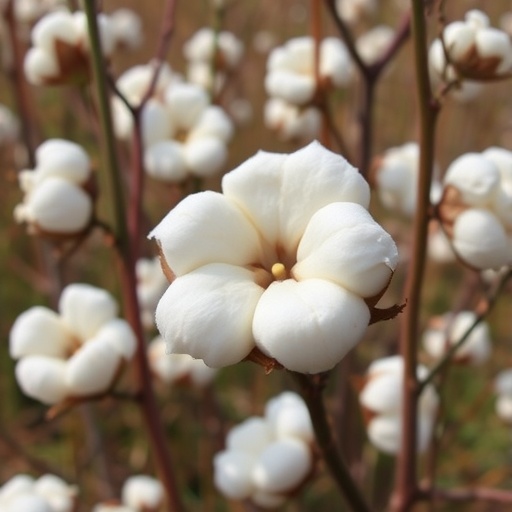
In a groundbreaking initiative poised to reshape our understanding of crop evolution, an international consortium of scientists has unveiled pivotal insights into the genomic origins and domestication journey of cotton (Gossypium hirsutum), the world’s foremost natural textile fiber. Spearheaded by Mississippi State University researchers, this comprehensive study harnessed advanced genomic sequencing technologies to trace cotton’s lineage back over five millennia to the Northwestern Yucatán Peninsula in Mexico. This revelation not only deepens our grasp of cotton’s historical cultivation but also lays the foundation for breeding innovation aimed at bolstering crop resilience amid escalating agricultural challenges.
Cotton’s domestication has long captivated geneticists and agriculturalists alike, as its diverse applications span textile manufacturing to bioengineering. Yet, the genomic intricacies governing its evolution have remained elusive until now. By sequencing the genomes of nearly 400 cotton plants, encompassing both wild variants and domesticated strains across Florida, the Caribbean, and Mexico, the researchers pieced together a genetic mosaic that illuminates the crop’s complex ancestry. This stratagem employed high-throughput sequencing techniques that captured extensive DNA fragments, enabling an unprecedented resolution in genome assembly and trait mapping.
Professor Dan Peterson, Chair of Biochemistry, Nutrition, and Health Promotion at Mississippi State University, emphasizes the significance of this work in confirming the long-held hypothesis that the wild upland cotton species found in the Northwestern Yucatán served as the primary genetic reservoir during early domestication. The researchers highlight the critical value of wild cotton populations whose genetic diversity harbors untapped traits, including disease resistance and environmental adaptability, which may have diminished as modern cultivars were selectively bred for desirable agronomic attributes.
The genetic bottleneck phenomenon, intrinsic to intensive breeding practices, inadvertently narrows the gene pool, thereby increasing vulnerability to emerging pathogens and environmental stressors. Through this study, the team underscores how conserving and integrating wild germplasm into breeding programs is vital for sustaining cotton’s productivity in the face of climate change and evolving pest populations. The rich allelic variation found in natural wild specimens acts as a dynamic inventory of evolutionary adaptations, continuously shaped by natural selection and offering breeders a robust toolkit to engineer hardier crops.
Technological advancements facilitated a genomic analysis far surpassing prior attempts, akin to transitioning from assembling a rudimentary 100-piece jigsaw puzzle to deciphering a million-piece masterpiece. Traditional short-read sequencing technologies fragmented DNA into minuscule segments, complicating sequence assembly and obscuring genomic regions critical for understanding adaptability. By contrast, the utilization of long-read sequencing platforms allowed researchers to reconstruct extensive contiguous DNA sequences, markedly refining genetic maps and enhancing the detection of structural variants pivotal to trait differentiation.
Tony Arick, interim director of the Mississippi State University Institute for Genomics, Biocomputing and Biotechnology (IGBB), highlights that these innovations have dramatically reduced the complexity and cost barriers of genomic projects. The ability to analyze longer DNA sequences yields more coherent genomic reconstructions, diminishing gaps and ambiguities that traditional methods struggled to resolve, thereby expediting the pathway to actionable genetic insights.
The collaborative project also involved esteemed scientists such as Corrinne Grover and Jonathan Wendel from Iowa State University, as well as contributions from Mexican institutions Universidad Nacional Autónoma de México and Universidad Autónoma de Yucatán. Partnering organizations expanded to include the University of Neuchâtel in Switzerland, the U.S. Department of Agriculture’s Agricultural Research Service, and the Chinese Academy of Agricultural Sciences—underscoring the global commitment to deciphering cotton’s genomic heritage.
Beyond academic prestige, the implications of this research are profound for cotton agriculture worldwide. By illuminating the genetic loci associated with domestication traits and environmental resilience, breeders can leverage this knowledge to engineer cultivars capable of thriving under adverse conditions such as drought, salinity, and pathogen pressure. This strategic infusion of wild genetic diversity back into cultivated lines promises to invigorate cotton production sustainability while securing livelihoods dependent on this indispensable fiber crop.
Historically, archaeological findings have complemented genetic data by confirming that ancient human societies in the Yucatán region harnessed cotton fibers, dating back thousands of years. The synergy of archaeological and genomic evidence crafts a compelling narrative that traces early agricultural innovation and ecological adaptation. These insights further provide a scaffold for exploring how anthropogenic selection shaped phenotypic traits central to cotton’s transformation from a wild plant to a globally cultivated crop.
For genetic and molecular biologists, cotton offers a fascinating model due to its complex polyploid genome, which comprises multiple sets of chromosomes merged through historical hybridization events. High-quality genome assemblies enabled by this study unravel the intricate genetic architecture and evolutionary events that forged upland cotton’s unique characteristics. Such knowledge is indispensable for pinpointing functional genes responsible for fiber quality, yield, and stress tolerance.
The research also embodies broader themes in plant science — emphasizing the necessity of conserving genetic resources amid accelerating environmental changes and agricultural demands. By documenting the genomic underpinnings of domestication, the team offers a blueprint for systematically harnessing natural genetic variation to future-proof crops. This approach aligns with global efforts to ensure food and fiber security through integrative biotechnological and breeding strategies tailored to dynamic ecological landscapes.
Looking forward, the integration of genomic, ecological, and phenotypic data sets is poised to catalyze precision breeding programs that can swiftly respond to emerging challenges in crop production. The availability of expansive genomic datasets exemplifies the transformative potential of collaborative international research networks that unite expertise and resources towards common sustainable agricultural goals.
In summary, this landmark investigation into cotton’s genomic diversity and domestication history not only resolves long-standing scientific queries but also charts a strategic path for harnessing genetic diversity to cultivate more resilient and productive cotton varieties. Mississippi State University’s leadership in this endeavor demonstrates the critical interface between fundamental genomic research and its real-world applications, promising to enhance the sustainability and robustness of one of humanity’s most vital natural fiber sources.
Cite Scienmag News
Juliet Wilcox. (June 23, 2026). Researchers Confirm the Origins of Cotton Domestication. Scienmag. https://scienmag.com/researchers-confirm-the-origins-of-cotton-domestication/
Juliet Wilcox. "Researchers Confirm the Origins of Cotton Domestication." Scienmag, 23 June 2026, https://scienmag.com/researchers-confirm-the-origins-of-cotton-domestication/. Accessed 4 September 2026.
Juliet Wilcox. "Researchers Confirm the Origins of Cotton Domestication." Scienmag. June 23, 2026. https://scienmag.com/researchers-confirm-the-origins-of-cotton-domestication/


