


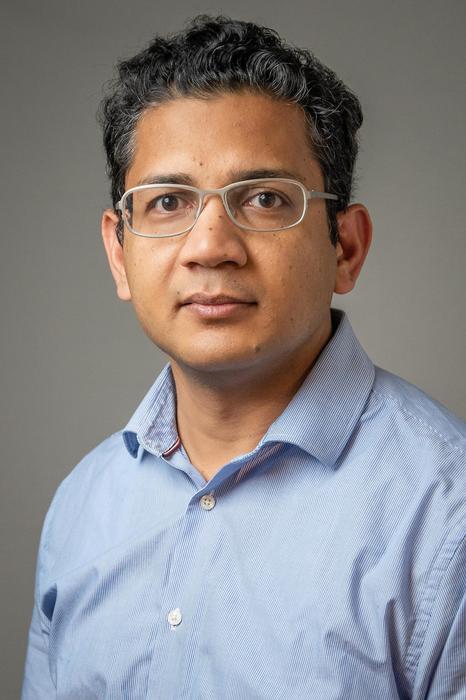
Mohammad Moshahid Khan, PhD, principal investigator and associate professor in the Department of Neurology in the College of Medicine at the University of Tennessee Health Science Center, was recently awarded a $308,000 grant from the Department of Defense for a study that will investigate the role of the gut microbiome in dystonia, a movement disorder of abnormal postures and involuntary twisting or repetitive movements, to improve neurobehavioral outcomes. Jianfeng Xiao, MD, PhD, associate professor in the Department of Neurology, is the co-investigator of the study.

Credit: UT Health Science Center
Mohammad Moshahid Khan, PhD, principal investigator and associate professor in the Department of Neurology in the College of Medicine at the University of Tennessee Health Science Center, was recently awarded a $308,000 grant from the Department of Defense for a study that will investigate the role of the gut microbiome in dystonia, a movement disorder of abnormal postures and involuntary twisting or repetitive movements, to improve neurobehavioral outcomes. Jianfeng Xiao, MD, PhD, associate professor in the Department of Neurology, is the co-investigator of the study.
Although the genetic and environmental causes of dystonia are difficult to determine, dystonia can be developed by factors including traumatic brain injuries, stroke, Parkinson’s disease, use of chronic antipsychotic therapy, and other conditions. The disorder impacts many Americans, and military personnel and veterans often develop dystonia.
Considering gut microbiomes can influence brain behavior and development, and microbiomes can be modified, this study seeks to give a new perspective into the cause of the disease and discover how the gut microbiome may be able to modulate neurobehavioral dysfunction.
“There is no cure for dystonia. Some treatments are available, but they have a lot of side effects. We need to develop disease-modifying therapies that would stop the progression of dystonia symptoms, treat it, or delay the disease’s progression,” Dr. Khan said. “Most of the dystonia research focuses on the genetic and neurological aspects, and we thought there may be another factor that is non-genetic and can be modified, and that’s how we came up with the gut microbiome.”
To conduct this study, the team will examine the gut microbiome in a rodent model of dystonia by identifying specific bacteria or fungi that causes gastrointestinal abnormalities in the model and test the potential use of probiotics in decreasing behavioral deficits. The team aims to find the effectiveness of probiotics in treating neurobehavioral dysfunction in the rodent, in hopes this will lead to developing microbiome-based therapies for humans.
“The major goal is to develop a microbiome-based therapy for the treatment and prevention of dystonia. The mouse model we are using has a mutation that is clinically relevant to a human with dystonia,” Dr. Khan said. “The study opens up an entirely new direction on dystonia research and will provide a significant positive impact by defining the role of gut microbiome in the dystonia pathobiology and testing the impact of the microbiome approach in mitigating the neurobehavioral function in the dystonia.”
Cite Scienmag News
Ophelia Keating. (July 2, 2024). Researchers awarded Department of Defense grant to study the role of gut microbiomes to improve outcomes in dystonia. Scienmag. https://scienmag.com/researchers-awarded-department-of-defense-grant-to-study-the-role-of-gut-microbiomes-to-improve-outcomes-in-dystonia/
Ophelia Keating. "Researchers awarded Department of Defense grant to study the role of gut microbiomes to improve outcomes in dystonia." Scienmag, 2 July 2024, https://scienmag.com/researchers-awarded-department-of-defense-grant-to-study-the-role-of-gut-microbiomes-to-improve-outcomes-in-dystonia/. Accessed 6 September 2026.
Ophelia Keating. "Researchers awarded Department of Defense grant to study the role of gut microbiomes to improve outcomes in dystonia." Scienmag. July 2, 2024. https://scienmag.com/researchers-awarded-department-of-defense-grant-to-study-the-role-of-gut-microbiomes-to-improve-outcomes-in-dystonia/

