


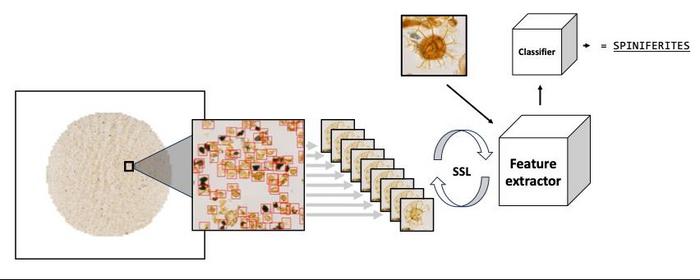
Microfossil analysis allows us to map the subsurface and understand past geological times. In research labs all over the world geologists spend countless hours looking through the microscope identifying and counting microfossils extracted from sedimentary rock below the seabed. The analysis is time-consuming but important, as the species distribution tell a great deal about the geological time period of sedimentary layers from the subsurface, as well as the climatic conditions at the earths surface at the time when these microfossils were formed.

Credit: Martinsen, Iver, et al.
Microfossil analysis allows us to map the subsurface and understand past geological times. In research labs all over the world geologists spend countless hours looking through the microscope identifying and counting microfossils extracted from sedimentary rock below the seabed. The analysis is time-consuming but important, as the species distribution tell a great deal about the geological time period of sedimentary layers from the subsurface, as well as the climatic conditions at the earths surface at the time when these microfossils were formed.
In a recent study published in the KeAI journal Artificial Intelligence in Geosciences, researchers at the machine learning group at University of Tromsø (UiT) The Arctic University of Norway created an advanced method for automatically detecting and analyzing microfossils from microscope images using AI. The team, in collaboration with industry partner Equinor, presented a method for automatic microfossil detection and analysis.
“This work shows that there is great potential in utilizing AI in this field,” says researcher Iver Martinsen, first and co-corresponding author of the study. “By using AI to automatically detect and recognize fossils, geologists might have a tool that can help them better utilize the enormous amount of information that wellbore samples provide”.
Microfossils are found in vast amounts everywhere, but the time and expertise required to analyze the data means that only a fraction of the available fossils are analyzed. The method the researchers used are based on state-of-the-art AI methodology — training an AI model completely without annotations, utilizing the large pool of raw data provided by the Norwegian Offshore Directorate.
“We used AI to detect fossils from one selected well on the Norwegian continental shelf, and in turn use 100,000 of the detected fossils to train a model for image recognition,” shares Martinsen.
To evaluate how well the model performs, the researchers tested the model by classifying several hundreds labeled fossils from the same well.
“We are very happy with our results. Our model exceeds previous benchmarks available out there. We hope that the present work will be beneficial for geologists both in industry and academia,” adds Martinsen.
###
Contact the author: Iver Martinsen, SFI Visual Intelligence/UiT – The Arctic University of Norway, Tromsø, Norway, iver.martinsen@uit.no
The publisher KeAi was established by Elsevier and China Science Publishing & Media Ltd to unfold quality research globally. In 2013, our focus shifted to open access publishing. We now proudly publish more than 100 world-class, open access, English language journals, spanning all scientific disciplines. Many of these are titles we publish in partnership with prestigious societies and academic institutions, such as the National Natural Science Foundation of China (NSFC).
Journal
Artificial Intelligence in Geosciences
Method of Research
Imaging analysis
Subject of Research
Not applicable
Article Title
The 3-billion fossil question: How to automate classification of microfossils
COI Statement
The authors declare that they have no known competing financial interests or personal relationships that could have appeared to influence the work reported in this paper.
Cite Scienmag News
Violet Maxwell. (June 23, 2024). Researchers at the University of Tromsø develop novel AI algorithm for analyzing microfossils. Scienmag. https://scienmag.com/researchers-at-the-university-of-tromso-develop-novel-ai-algorithm-for-analyzing-microfossils/
Violet Maxwell. "Researchers at the University of Tromsø develop novel AI algorithm for analyzing microfossils." Scienmag, 23 June 2024, https://scienmag.com/researchers-at-the-university-of-tromso-develop-novel-ai-algorithm-for-analyzing-microfossils/. Accessed 4 September 2026.
Violet Maxwell. "Researchers at the University of Tromsø develop novel AI algorithm for analyzing microfossils." Scienmag. June 23, 2024. https://scienmag.com/researchers-at-the-university-of-tromso-develop-novel-ai-algorithm-for-analyzing-microfossils/

