

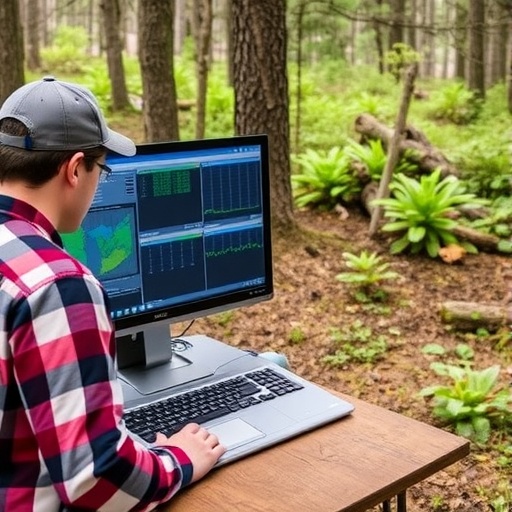
Mississippi State University researchers have unveiled an enhanced iteration of a cornerstone forestry decision-making software, significantly improving its accessibility and usability without compromising the sophisticated analytical framework that has made the tool indispensable for decades. Originally designed in 1999 to address the nuanced challenges of forest valuation and investment analysis, the software known as FORVAL has been a critical resource for foresters, land managers, and investors navigating complex forestry economics. The newly developed version, FORVAL-XL, updates this legacy by leveraging the versatility of Microsoft Excel to broaden its reach and operational ease.
The FORVAL program has long been acclaimed for its capability to quantify and evaluate multifaceted forest management scenarios, capturing the economic subtleties and long-term investment dynamics inherent to sustainable forestry. Steve Bullard, associate dean of the College of Forest Resources and associate director of the Forest and Wildlife Research Center, spearheaded the development of FORVAL-XL, emphasizing a user-centric overhaul. This version retains the software’s core strength in executing detailed discounted cash flow analyses, integrating variable costs and revenues over extended harvesting cycles, but introduces an array of new functionalities aimed at enhancing interpretability and interactivity for users.
This Excel-based upgrade is notable for its incorporation of modern analytic methods, including comprehensive sensitivity analyses that allow users to assess the impact of fluctuating market conditions and operational assumptions on forest investment outcomes. It features intuitive tables and graphical outputs that translate complex datasets into digestible, actionable insights. Furthermore, the capacity to export results into universally accessible PDF documents facilitates seamless communication among stakeholders, enhancing collaborative decision-making processes in forestry enterprises ranging from modest private woodland owners to large-scale timber operators.
The development process exemplified interdisciplinary collaboration and practical feedback integration. Jagadish Dosapati, a data science master’s candidate, contributed crucial coding expertise, ensuring that the software’s architecture supports both computational rigor and user-friendly interactions. Alongside, Thomas Straka, emeritus professor at Clemson University, and Robert Grala, George L. Switzer Professor of Forestry at Mississippi State, provided intellectual guidance and mentorship that shaped the tool’s evolution.
An integral aspect of this development was the involvement of forestry students enrolled in forest resource economics coursework under Professor Grala’s supervision. These students functioned as beta testers, furnishing real-time usability feedback. Their evaluations were instrumental in refining the application’s interface and functionality, ensuring it accommodates the practical needs and capabilities of future forest management professionals, consultants, and investment analysts. This educationally embedded testing loop not only enhanced software robustness but also bridged academic learning with applied forestry economics.
FORVAL-XL exemplifies how rigorous economic modeling and user-focused design can converge to produce tools that are both scientifically sound and practically viable. It supports detailed projections of timber sale values, management expenses, and opportunity costs, thus facilitating more informed land use decisions. The software’s structural framework accommodates various forest stand types, growth stages, and silvicultural treatments, enabling nuanced scenario planning that reflects real-world ecological and economic variability.
Looking beyond the immediate technological upgrade, FORVAL-XL symbolizes an embodiment of sustainable forestry principles, offering forest managers the analytical power to balance economic returns with ecological stewardship. Its capacity for scenario exploration aids in understanding the long-term repercussions of varied management strategies, thereby promoting decisions that can harmonize profitability with conservation goals. The model’s sensitivity analyses further provide a safeguard against uncertainty, guiding users through the volatility of timber markets and environmental factors affecting forest productivity.
The openness of FORVAL-XL, distributed freely alongside a comprehensive user manual, fosters widespread adoption and educational use. By dismantling barriers to access traditionally associated with specialized forestry software, Mississippi State University advances the democratization of advanced resource management tools. This initiative aligns with broader efforts to equip natural resource professionals with the analytical instruments necessary for adaptive, resilient forest economic planning amidst a shifting global environmental context.
Through FORVAL-XL, emerging foresters and experienced land managers alike gain a cutting-edge platform integrating spatial economic modeling, financial forecasting, and decision science. This fusion empowers stakeholders to evaluate investment viability with heightened precision, accounting for temporal dynamics and the multifarious factors influencing forest growth and market behavior. The platform’s enhanced transparency through its Excel interface invites customization and peer review, facilitating continuous refinement and contextual adaptation.
As the forestry sector grapples with increasing demands for sustainability, climate resilience, and economic efficiency, tools like FORVAL-XL stand at the forefront of technological innovation. They enable a more nuanced comprehension of forest ecosystems as economic assets, supporting strategies that optimize both environmental health and financial returns. Mississippi State University’s renewed commitment to evolving this software underscores the pivotal role of academia in bridging scientific advances and practical application in natural resource management.
In sum, FORVAL-XL represents more than an incremental software update; it is a transformative leap toward integrating complex economic analysis with accessible user experience. By employing modern computing frameworks and fostering collaborative development, this project revitalizes a critical decision-support tool, ensuring its relevance and efficacy for contemporary and future forestry challenges.
Subject of Research: Not applicable
Web References:
- https://www.fwrc.msstate.edu/software.php
- https://www.cfr.msstate.edu/
- https://www.fwrc.msstate.edu/
- https://www.msstate.edu/
Image Credits: Photo by MSU Agricultural Communications
Keywords: Software, Forestry, Land Management


