


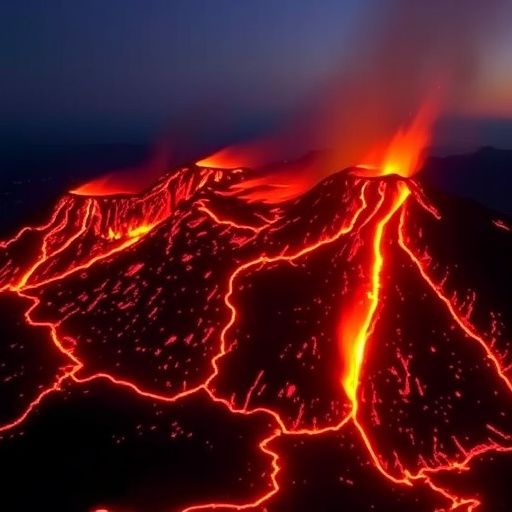
In 2012, an unprecedented wildfire swept across 42 square kilometers of alpine moorland in the Rwenzori Mountains, which straddle the border between Uganda and the Democratic Republic of Congo in Central Africa. The affected area was at an elevation exceeding 13,000 feet, a region historically considered too cold and moist to support fire propagation. This shocking event challenged longstanding assumptions about the fire resilience of Afroalpine ecosystems and raised urgent questions about the impacts of climate and anthropogenic change on these unique high-altitude environments.
The Rwenzori Mountains represent one of the globe’s most extraordinary montane ecosystems, renowned for their glaciated peaks, endemic flora, and fauna isolated by their “sky island” nature. To better understand the historical fire regime in this fragile alpine zone, a team of scientists from Brown University undertook extensive fieldwork to extract sediment cores from two remote mountain lakes: Lake Kopello, perched at approximately 13,000 feet in the alpine zone, and Lake Mahoma, situated on the lower slopes around 9,000 feet. These sediment cores serve as invaluable environmental archives, containing microscopic pollen, leaf wax biomarkers, fossil bacteria, and critically, charcoal particles—robust indicators of past wildfire activity.
Analysis of the sediment layers from Lake Kopello revealed a strikingly sparse charcoal record extending back 12,000 years, suggesting that large-scale fires were essentially absent from the highest reaches of the Rwenzori throughout the Holocene epoch. This geological archive was abruptly disrupted by the 2012 fire, yielding charcoal concentrations more than 100 times greater than at any prior time. Such an anomalous spike in charcoal unequivocally identifies the wildfire as a singular event in the last twelve millennia. The research team interpreted this as evidence that the alpine zone had no comparable fire history since the end of the last ice age.
In contrast, the lower elevation sediment core from Lake Mahoma disclosed a different fire history. Charcoal was notably scarce until approximately 2,000 years ago, after which a pronounced increase in charcoal abundance was detected. This rise in fire activity coincided closely with a rapid shift in the surrounding vegetation composition. Pollen records indicated a decline in deciduous tree species and a corresponding increase in bamboo and grass species adapted to fire-prone environments. This ecological transformation points towards a permanent alteration in forest structure likely driven by the new fire regime.
Determining the drivers behind this mid-Holocene fire emergence presents a complex challenge. However, the timing aligns with archaeological evidence indicating intensified human activity in the region around 2,000 years ago, including agriculture and settlement expansion. The inference is that anthropogenic land use changes, such as forest clearing and the use of fire as a land management tool, initiated the fire regime on the Rwenzori’s lower slopes. These human-induced landscape modifications, combined with local climatic variability, likely catalyzed the establishment of a recurring fire cycle.
At the highest elevations, the unprecedented nature of the 2012 fire suggests a convergence of novel factors. Increasing tourist visitation brings a heightened risk of ignition sources, while regional climate change trends towards warmer and drier conditions make the alpine zone more susceptible to fire spread. Where once moisture and cold temperatures limited fire potential, the altered climate and human presence have broken down these natural safeguards, opening a dangerous new chapter for Afroalpine ecosystems.
The ecological implications of this altered fire regime are profound. The Rwenzori Mountains, along with other iconic East African peaks like Mount Kenya and Mount Kilimanjaro, form UNESCO World Heritage Sites celebrated for their biodiversity and uniqueness. Fire disturbance transforms delicate alpine flora and fauna communities, many of which are endemic and specialized for stable cold environments. Repeated fires could trigger irreversible shifts in species composition, threatening biodiversity and ecosystem services.
Beyond ecological consequences, the 2012 wildfire had tangible impacts on human communities. The post-fire landscape’s reduced vegetation cover compromised the soil’s ability to retain rainfall, exacerbating runoff and leading to destructive floods in villages located downslope from burned areas. This vulnerability underscores the interconnected nature of mountain ecosystems and human livelihoods, emphasizing the broader socio-environmental stakes of changing fire regimes.
Given these findings, there is an urgent need to develop comprehensive fire management and prevention strategies tailored to these sensitive landscapes. Preserving Afroalpine ecosystems and mitigating wildfire risk will require coordinated efforts that address tourism impacts, climate adaptation, and community involvement. Research leaders underscore that if fire ignition sources continue unchecked under a warming climate, the permanence of these ecological transformations could become an irreversible reality.
For scientists involved in this work, the 2012 fire represents a poignant indicator of global environmental change. It embodies a moment in which the familiar landscape was irrevocably altered—what some term an “environmental change moment.” This event highlights the far-reaching consequences of anthropogenic influences combined with climate dynamics that are rewriting ecological histories, even in regions once deemed inhospitable to fire.
This transformative research, documented in a recent publication in the journal Nature, relied on interdisciplinary methods combining paleoecology, sedimentary geochemistry, and archaeological context. The utilization of charcoal as a fire proxy exemplifies how ancient environmental archives can inform our understanding of past disturbances and guide future conservation strategies in a changing world.
Studies like this augment our comprehension of fire ecology in tropical montane environments where data has traditionally been scarce. They reveal a complex interplay between natural climate variability, human land use, and emergent fire risk induced by global warming, ultimately broadening the scientific narrative around ecosystem vulnerability and resilience under rapid environmental change.
As these African sky islands face a future with more frequent fires, the role of early warning, monitoring, and targeted policy interventions will be critical. Protecting their unique biodiversity and safeguarding the communities dependent on these ecosystems demands immediate attention grounded in robust scientific evidence and adaptive management frameworks.
News Publication Date: 13-May-2026
Web References: DOI link
Cite Scienmag News
Russell Cooper. (May 13, 2026). Research Reveals: Fire That Scorched African Mountain Range Unprecedented in 12,000 Years. Scienmag. https://scienmag.com/research-reveals-fire-that-scorched-african-mountain-range-unprecedented-in-12000-years/
Russell Cooper. "Research Reveals: Fire That Scorched African Mountain Range Unprecedented in 12,000 Years." Scienmag, 13 May 2026, https://scienmag.com/research-reveals-fire-that-scorched-african-mountain-range-unprecedented-in-12000-years/. Accessed 4 September 2026.
Russell Cooper. "Research Reveals: Fire That Scorched African Mountain Range Unprecedented in 12,000 Years." Scienmag. May 13, 2026. https://scienmag.com/research-reveals-fire-that-scorched-african-mountain-range-unprecedented-in-12000-years/


