


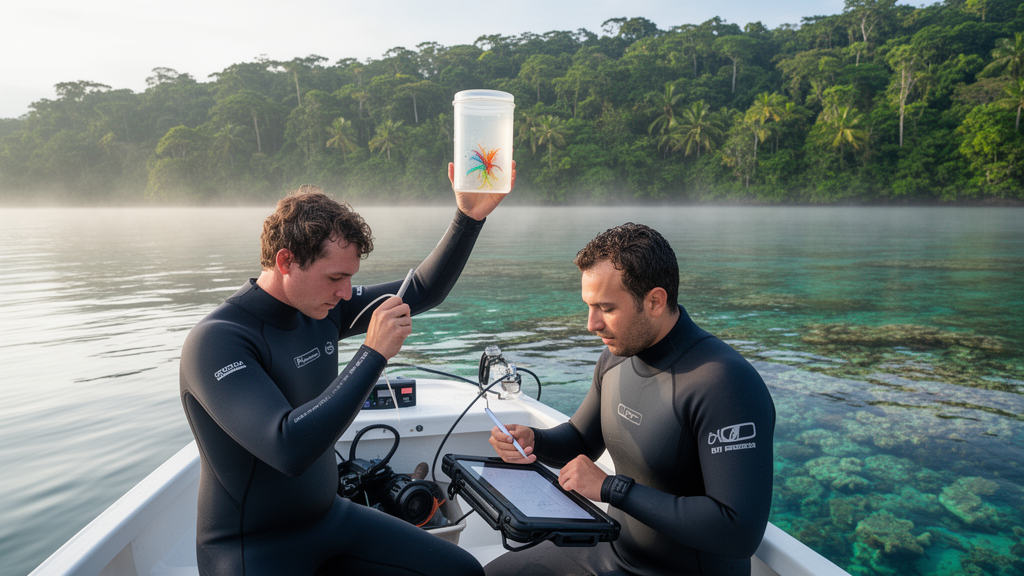
One of the wettest and least surveyed stretches of tropical coastline on Earth has just yielded a new trove of open-access biodiversity records. Between late July and mid-August 2024, a team of Colombian researchers and local community members carried out the Colombia BIO Juradó-Cupica Expedition, a fifteen-day sampling campaign along the northern Pacific coast of the Department of Chocó, between the municipalities of Juradó and Bahía de Cupica. The expedition, led by the Institute of Marine and Coastal Research (INVEMAR), the Universidad del Valle and the Universidad Tecnológica del Chocó, and funded by the Ministry of Science and Technology (Minciencias), was designed to fill one of the most conspicuous gaps in the marine knowledge of a region recognised as one of the world's 25 top biodiversity hotspots.
The study area stretches from Punta de Chicocora in the south of Bahía Cupica to Humboldt Bay, a coastal fringe that has long remained a blind spot in Colombian marine inventories. While the terrestrial biodiversity of the Chocó biogeographic region is comparatively well documented, marine knowledge there is fragmentary. Earlier research concentrated on sites such as Punta Cruces and Cabo Marzo, leaving the remote northern bays of Cupica and Juradó, near the Panamanian border, with scarce biological data.
The environments the team targeted are strikingly varied. Mangrove forests line parts of the coast, and Juradó hosts a large forest between Curiche and Partadó, medium-sized stands in Estero Cacique and Punta Ardita, and incipient mangroves elsewhere, totalling 2,237.1 hectares, about 5.4 percent of the mangrove of the Chocan Pacific. These forests provide habitats for reproduction, protection and feeding, and help prevent coastal erosion.
Rocky coastlines of unconsolidated soft rocks such as clays and siltstones, and hard massive rocks such as basalts and granite, appear regularly between Cupica and Juradó, with steep slopes, sessile endobenthic communities that erode sediments, zoned epibenthic organisms and tidal pools harbouring their own biological communities. Intertidal mudflats form another pillar of the region's coastal ecology. These gently sloping areas of fine sediment, found in low-to-moderate energy deltaic zones, are constantly reshaped by sediment deposition, erosion and currents.
They serve as resting and feeding grounds for migratory shorebirds, and in the gulfs of Tribugá and Cupica they support a rich invertebrate and demersal fish fauna. Rocky reefs, known locally as riscales, add a further dimension: submerged and emerged formations and small coastal islets of less than 60 hectares that are vital for migratory seabird colonies. Their submerged zones sustain fish, algae, sponges and invertebrates, including commercially important species such as snappers, groupers and tuna, and they act as aggregators of fish distributed along the coast, being more abundant where the coast protrudes, as at Cabo Marzo and Cabo Corrientes.
Beyond the shoreline lies the pelagic environment, the water column above the seabed, which includes the neritic zone of up to 200 metres depth over the continental shelf and the open oceanic zone beyond. Pelagic species are conventionally divided into nekton, organisms able to move independently of currents, and plankton, organisms that cannot overcome ocean currents. The scientific context of the expedition reaches back centuries.
The first European incursions into Colombia's Pacific, by Andagoya, Almagro and Pizarro in the sixteenth century, targeted coasts and rivers such as the San Juan and the Atrato, driven by Spanish expansion but hindered by geographical and logistical limitations. A milestone came with the visit of Alexander von Humboldt and Aimé Bonpland between 1799 and 1804, which helped launch systematic scientific exploration of the region and boosted knowledge of its terrestrial flora and fauna. International expeditions through the early and mid-nineteenth century added further samples from the Colombian Pacific.
A more sustained phase of local research began in the 1970s. Between the 1970s and 1990s, the Universidad del Valle and other institutions conducted biodiversity and fisheries studies focused on catchable and rocky areas of Gorgona Island, Utria Cove and Málaga Bay. Later, advances in maritime technology and strengthened national capacity enabled larger expeditions and more intensive studies of marine ecosystems, even in remote locations such as Malpelo Island and other offshore areas.
Data from these initiatives proved crucial for establishing protected areas and other conservation strategies, which is precisely the kind of application the new Juradó-Cupica baseline is intended to support. The expedition itself brought together fourteen researchers, six from INVEMAR, six from the Universidad del Valle and two from the Universidad Tecnológica del Chocó. Crucially, sixteen residents of the communities of Curiché-Coredó, Cabo Marzo, Punta Piñas and Cupica joined the daily sampling effort, contributing guidance, transport and logistics.
Members of the Los Delfines and Cupica Community Councils participated throughout the planning and execution of the expedition, an arrangement designed to strengthen local capacities, exchange traditional and scientific knowledge, and promote social appropriation of the research. This collaborative model reflects a contemporary understanding of scientific expeditions as interdisciplinary endeavours that involve local experts and residents in studying socio-ecosystems and the interactions that sustain them. The physical setting makes the region as challenging as it is valuable.
The area lies within a very humid tropical forest zone in the equatorial calm zone, and its climate is shaped by the Intertropical Convergence Zone, which generates local circulations and intense rainfall accentuated by orographic conditions. Temperatures average 25 to 26.8 degrees Celsius, and Chocó's North Pacific is among the rainiest places on the planet, exceeding 10,000 millimetres per year in spots, with an average of 6,000 millimetres and up to 250 rainy days per year. There is no true dry season, though precipitation is lower from December to April.
The main rivers under Juradó's jurisdiction, the Cupica, Octávida, Curiche, Putama, Partadó and Juradó, together with numerous mountain-slope watercourses that run directly to the sea, carry high water and sediment loads that shape the coastline and seabed. For a hotspot whose marine life has remained largely hidden behind logistical barriers and decades of research concentrated elsewhere, the expedition marks a first systematic look at the bays, reefs, mudflats, mangroves and open waters between Cupica and Juradó, and a demonstration of how community-led logistics and modern molecular tools can together open up one of the planet's most biologically rich and least documented coastlines.
Subject of Research: Marine and coastal biodiversity inventory of the Juradó-Cupica region, northern Colombian Pacific
Article Title: Open-access marine biodiversity records from the Colombia BIO Juradó-Cupica Expedition, Northern Colombian Pacific
Article References: Dorado-Roncancio, E., Montoya-Cadavid, E., Rodríguez-Toscano, A., López de Mesa, L., Chasqui, L., Londoño-Cruz, E., Bechara-Escudero, R., Cedeño-Posso, C., Barrios-Vásquez, E., Atencia-Galindo, M., Yepes-Narvaez, V., Rodríguez-Sánchez, A., Sánchez Muñoz, J., Lizarazo, N., Ossa-Hernandez, N., Gallego-Sánchez, D., Restrepo, V., Orozco Llanos, V., Gomez-Vanega, H., … Alonso Carvajal, D. (2026). Open-access marine biodiversity records from the Colombia BIO Juradó-Cupica Expedition, Northern Colombian Pacific. Biodiversity Data Journal, 14, Article e189764. https://doi.org/10.3897/bdj.14.e189764
Image Credits: AI Generated
Keywords: Colombia BIO, Juradó, Cupica, Chocó, marine biodiversity, mangroves, rocky reefs, mudflats, pelagic zone, INVEMAR, DNA barcoding, biodiversity hotspot
Cite Scienmag News
Margaret Porter. (October 27, 2026). Research report: Open-access marine biodiversity records from the Colombia BIO Juradó-Cupica Expedition, Northern Colombian Pacific. Scienmag. https://scienmag.com/research-report-open-access-marine-biodiversity-records-from-the-colombia-bio-jurado-cupica-expedition-northern-colombian-pacific/
Margaret Porter. "Research report: Open-access marine biodiversity records from the Colombia BIO Juradó-Cupica Expedition, Northern Colombian Pacific." Scienmag, 27 October 2026, https://scienmag.com/research-report-open-access-marine-biodiversity-records-from-the-colombia-bio-jurado-cupica-expedition-northern-colombian-pacific/. Accessed 27 October 2026.
Margaret Porter. "Research report: Open-access marine biodiversity records from the Colombia BIO Juradó-Cupica Expedition, Northern Colombian Pacific." Scienmag. October 27, 2026. https://scienmag.com/research-report-open-access-marine-biodiversity-records-from-the-colombia-bio-jurado-cupica-expedition-northern-colombian-pacific/


