


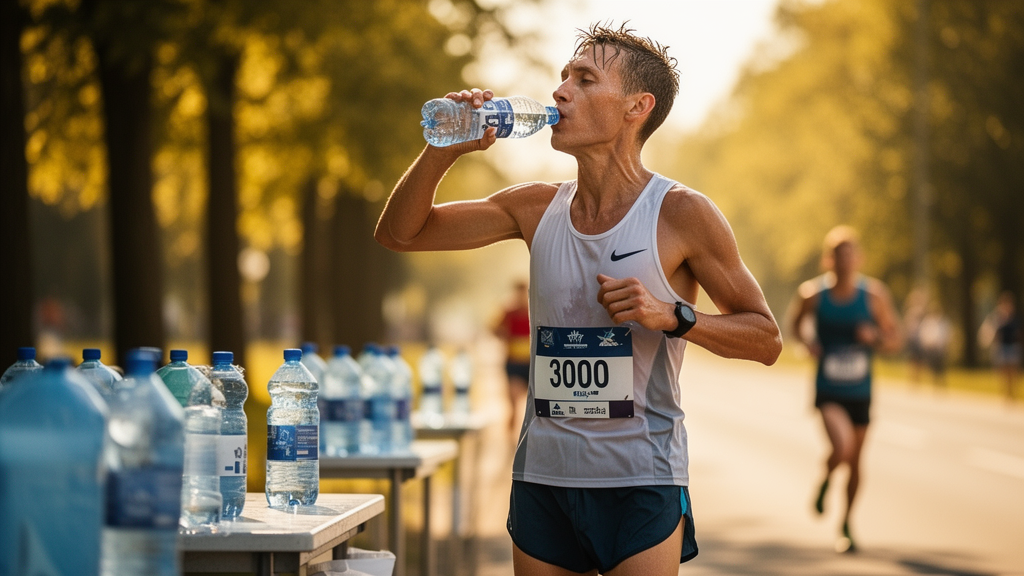
Drinking fluids during a long ride or run reliably lowers your heart rate and core temperature, but it may not make you any faster when the clock is what counts. That is the central message of a new systematic review and meta-analysis published in Frontiers in Nutrition, which pooled randomized crossover trials of during-exercise oral hydration in healthy adults. The review, led by Xiaojie Zhang of Hebei Sport University with colleagues from two other Chinese institutions, found that the answer to the question “should I drink during endurance exercise?” depends heavily on which outcome is measured, which performance test is used, and how much confidence the underlying evidence can actually support.
The research team searched six databases from their inception through 1 June 2026, looking for randomized trials in healthy adults who completed at least 60 minutes of continuous endurance exercise such as running or cycling. After screening 2,370 identified records and auditing 93 eligibility records, the reviewers retained 24 studies with a summed sample of 225 study-reported participants: 170 men, 20 women, and 35 whose sex was not reported. Twenty-one of those studies contributed to at least one pairwise meta-analysis. Every retained study used a randomized crossover design, and sample sizes ranged from just 6 to 20 participants, a scale that immediately signals how fragile the pooled conclusions must be treated.
The review’s most striking methodological choice was to keep different performance constructs strictly separate. Self-paced time trials and fixed-duration work tests, which most closely resemble real competition, were analyzed apart from open-ended time-to-exhaustion tests, which are more vulnerable to expectancy, motivation and discomfort effects. When the two constructs were combined in earlier syntheses, the reviewers argue, genuinely important differences could be obscured. In the new analysis, oral hydration versus no or minimal fluid showed essentially no clear benefit for time-trial or fixed-duration performance: a pooled estimate of minus 0.1 percent, with a 95 percent confidence interval spanning minus 3.6 to plus 3.5 percent across four studies and 30 participants.
Time-to-exhaustion tests told a different story. Across three studies involving 21 participants, drinking during exercise extended time to exhaustion by an average of 34.1 percent, with a confidence interval of 11.9 to 60.7 percent. But the authors are emphatic that this should not be read as an established benefit. The 95 percent prediction interval, which estimates where a future study’s effect would likely fall, stretched from minus 21.4 to plus 128.8 percent, meaning it included the possibility of no benefit at all. With only 21 participants, the evidence base represented just a fraction of the review’s own conservative information-size benchmark, and the certainty rating was downgraded to very low.
The physiological outcomes painted a picture of consistent average effects wrapped in substantial uncertainty. Core temperature was 0.38 degrees Celsius lower with hydration on average, based on nine studies and 80 participants, while heart rate was 6.82 beats per minute lower across 12 studies and 115 participants. Both averages favored drinking, but heterogeneity was high, with I-squared values of 87.3 and 83.3 percent respectively, and the prediction intervals for both outcomes crossed the null. Plasma volume change, a mechanism often invoked to explain hydration benefits, averaged 3.28 percentage points in favor of drinking, though again with a prediction interval that included no effect. Perceived exertion, plasma sodium concentration and osmolality all yielded intervals that crossed the null.
The reviewers also compared programmed or individualized drinking schedules against self-regulated, drink-to-thirst approaches. Here the headline finding concerns fluid balance rather than speed: programmed drinking reduced measured body-mass loss by 1.47 percentage points, a difference the authors stress is an expected consequence of simply consuming more fluid, not an independent physiological benefit. Performance itself showed no clear advantage, with a pooled time-trial estimate of plus 0.7 percent and a confidence interval from minus 4.4 to plus 6.2 percent across three studies. Core temperature and heart-rate comparisons in this domain also produced intervals crossing the null, and the two pooled symptom studies assessed unblinded abdominal discomfort, a design weakness that pushed those results to high risk of bias.
Questions about how much to drink and what to put in the bottle fared even worse. Higher versus lower fluid-replacement doses produced a time-trial estimate of 2.7 percent with a confidence interval spanning minus 8.8 to plus 15.6 percent and high heterogeneity. For sodium, the reviewers enforced a strict rule that comparisons had to match fluid volume and carbohydrate content between arms, which eliminated several otherwise eligible trials and left only two studies, by Sanders and colleagues and Wijering and colleagues, contributing to a pooled plasma-volume estimate of 1.78 percentage points with an interval from minus 5.24 to plus 8.81. No eligible pooled performance estimate supports an optimal sodium dose. Exploratory within-study dose-response analyses from two small trials yielded slopes of 0.3 and 6.6 percent per 10 percentage points of target replacement, but the authors declined to pool them because one measured a time trial and the other time to exhaustion.
The certainty machinery behind these conclusions is unusually transparent. All 40 estimable critical or important comparison-outcome pairs, including 18 single-study estimates, were rated very low certainty under review-specific GRADE rules. Objective physiological results predominantly carried some concerns for risk of bias, reflecting incomplete reporting of allocation and analysis plans, while subjective outcomes such as exertion and discomfort were rated high risk because participants inevitably knew which drinking strategy they were following. Sensitivity analyses showed the thermal estimate was sensitive to whether a carbohydrate-containing drink was counted as a pure water comparison: removing that contrast shifted the core-temperature estimate from minus 0.38 to minus 0.33 degrees Celsius and pushed the interval across the null.
The limitations the authors acknowledge are considerable. Women made up only 10.5 percent of participants with reported sex, no study recruited women exclusively, and menstrual-cycle phase was inconsistently documented, making generalization to female athletes uncertain. Original database search execution histories were not retained, a reproducible forward-citation log was unavailable, and one well-known four-dose experiment by Montain and Coyle was retained only narratively because its numerical results could not be verified. The team also deviated substantially from its original PROSPERO registration, abandoning a planned network meta-analysis in favor of direct pairwise synthesis because the sparse component contrasts could not support independent component effects or treatment rankings.
For athletes and coaches, the practical takeaway is one of calibrated expectations rather than a new prescription. Drinking during prolonged endurance exercise in the heat appears to blunt cardiovascular and thermal strain on average, and exhaustion-test results lean in its favor, but self-paced performance gains remain unproven and no evidence defines an ideal fluid volume or sodium concentration. The authors recommend individualized planning that weighs expected sweat losses, environmental heat, drink access, gastrointestinal tolerance and the real dangers of both underdrinking and overdrinking, the latter including exercise-associated hyponatremia. For researchers, the message is equally clear: larger trials with more women, better allocation reporting, paired precision data and cleanly separated performance constructs are needed before hydration science can move from averages to prescriptions.
Subject of Research: Effects of during-exercise oral hydration strategies on endurance performance and thermophysiological strain
Article Title: Effects of during-exercise oral hydration strategies on endurance performance and thermophysiological strain: a systematic review with meta-analysis
Article References: Zhang, X., Wang, L., & Liu, Z. (2026). Effects of during-exercise oral hydration strategies on endurance performance and thermophysiological strain: a systematic review with meta-analysis. Frontiers in Nutrition, 13, 1968824. https://doi.org/10.3389/fnut.2026.1968824
Image Credits: AI Generated
DOI: 10.3389/fnut.2026.1968824
Keywords: hydration, endurance performance, meta-analysis, systematic review, thermoregulation, core temperature, heart rate, sodium, fluid replacement, time trial, exercise physiology, sports nutrition
Cite Scienmag News
Daisy Hatcher. (October 27, 2026). Drinking During Endurance Exercise Cools the Body but May Not Speed You Up. Scienmag. https://scienmag.com/drinking-during-endurance-exercise-cools-the-body-but-may-not-speed-you-up/
Daisy Hatcher. "Drinking During Endurance Exercise Cools the Body but May Not Speed You Up." Scienmag, 27 October 2026, https://scienmag.com/drinking-during-endurance-exercise-cools-the-body-but-may-not-speed-you-up/. Accessed 27 October 2026.
Daisy Hatcher. "Drinking During Endurance Exercise Cools the Body but May Not Speed You Up." Scienmag. October 27, 2026. https://scienmag.com/drinking-during-endurance-exercise-cools-the-body-but-may-not-speed-you-up/


