


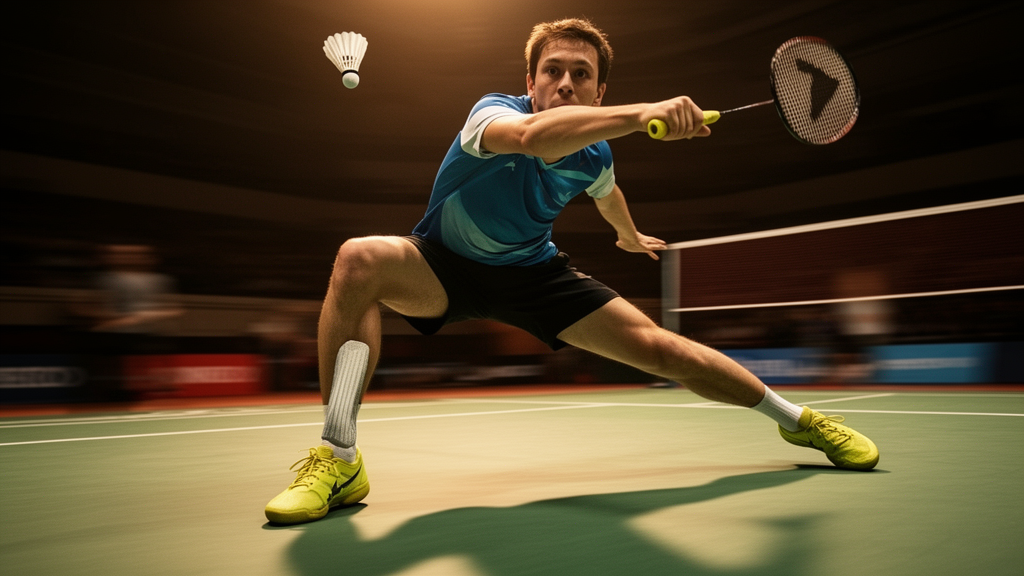
When badminton players tire, their lunges change in measurable ways. A new laboratory study of 24 highly trained male badminton athletes reports that exercise-induced fatigue shortens the braking phase of the racket-side forward lunge, compresses joint motion across several planes, and reduces the impulse and velocity gains needed to push the body back toward the court center. At the same time, the direction of the lunge matters on its own: backhand forward lunges produced harder secondary impacts, poorer dynamic postural stability scores, and greater ankle mechanical demands than forehand lunges.
The findings, published in Frontiers in Bioengineering and Biotechnology, offer a detailed, phase-by-phase picture of how the racket-side leg behaves when fatigue and lunge direction are manipulated under controlled conditions. The lunge is the signature movement of badminton. More than 15 percent of movements during match play are lunges, and the stance phase of each lunge divides into two mechanically distinct parts.
During braking, the player decelerates the body and absorbs impact before striking the shuttlecock; during recovery, the player generates force to regain velocity for repositioning. Ground reaction forces during lunging can reach roughly 2.5 times body weight, demanding substantial eccentric control as the lead leg accepts the load. Because lower-limb injuries account for approximately 52 percent of badminton-related injuries, understanding how fatigue reshapes this movement is a question of both performance and load management.
The research team, based at Guangzhou Sport University with collaborators in Seoul and Hong Kong, recruited 24 male athletes who held Chinese National Second-Class Athlete certification or higher, trained at least six hours per week, were right-handed, and had no lower-limb injury in the preceding six months. Under the Participant Classification Framework they were rated as Tier three, highly trained athletes, with an average age of about 23 years, roughly 11.6 years of badminton experience, and an average height of 1.76 meters. Each participant performed standardized three-step forehand and backhand forward lunges before and after a fatigue protocol, with lunge distance set at 1.5 times individual leg length and shuttlecocks delivered by a machine at fixed speed, trajectory, and frequency.
Measurement relied on an eight-camera Vicon motion-capture system recording three-dimensional marker trajectories at 200 hertz, paired with two AMTI force platforms sampling ground reaction forces at 1,000 hertz and embedded flush with a simulated badminton court. Forty-three reflective markers defined body segments and joint coordinate systems. The stance phase was segmented into braking, from initial contact to peak knee flexion, and recovery, from peak knee flexion to toe-off.
Outcomes included phase durations, anteroposterior center-of-mass velocity, joint angles and ranges of motion, ground reaction forces and impulses, peak net joint moments, phase-specific sagittal-plane joint quasi-stiffness, and dynamic postural stability indices computed during braking. The fatigue protocol was designed to mimic the intermittent, high-intensity character of badminton play. Each fatigue cycle comprised five consecutive maximal vertical jumps followed immediately by a maximal-effort 30-meter sprint, and the cycle repeated until three criteria were met: jump height below 70 percent of maximum for five consecutive jumps, a rating of perceived exertion of at least 17 on the Borg 6-to-20 scale, and heart rate at or above 80 percent of estimated maximum.
The protocol lasted 14.38 plus-or-minus 2.82 minutes on average, ending at a heart rate of about 184 beats per minute and a mean RPE of 19. Post-fatigue lunges began within roughly 10 seconds, and heart rate and RPE remained elevated even at the end of the brief post-fatigue testing period. Statistically, the study used a two-by-two repeated-measures ANOVA with a prespecified Benjamini-Hochberg false discovery rate correction applied separately within five biomechanical domains and three ANOVA effects, yielding 15 inferential families.
A sensitivity analysis showed that with 24 participants and 80 percent power, the minimum detectable standardized within-subject effect was approximately dz = 0.60, meaning a conventional medium effect of dz = 0.50 would have only about 65 percent power. No fatigue-by-direction interaction reached significance after correction, and the authors are explicit that these null interactions should be considered inconclusive rather than evidence that fatigue acts identically across lunge directions. A further sensitivity analysis using the more conservative Benjamini-Yekutieli procedure found that nine of the significant effects did not survive, including fatigue effects on stance duration, knee flexion angle, ankle dorsiflexion angle, weight-acceptance force, recovery-phase vertical impulse, and hip extension moment, and direction effects on knee transverse-plane range of motion and ankle dorsiflexion moment.
The fatigue effects that did survive correction paint a coherent picture of a more constrained lunge. Braking-phase duration shortened from about 0.21 to 0.19 seconds, and the anteroposterior velocity at toe-off fell in magnitude from about 1.02 to 0.84 meters per second, indicating less reversal of body motion. The braking-phase change in center-of-mass velocity dropped from 1.21 to 1.09 meters per second, and the recovery-phase gain fell from 1.40 to 1.25 meters per second.
Peak hip flexion decreased from roughly 83 to 71 degrees, knee flexion from about 71 to 66 degrees, and ankle dorsiflexion from about 17 to 15 degrees, with parallel reductions in hip and knee ranges of motion across sagittal and frontal planes. The initial vertical impact peak fell from 1.75 to 1.53 body weights, while vertical force at weight acceptance rose slightly, and anteroposterior and vertical impulses declined in both phases. Interpreted through the lens of sprint biomechanics, where larger propulsive impulse is associated with faster locomotion, the reduced recovery-phase impulse and diminished velocity gain suggest that fatigue impairs the capacity to accelerate back toward the base position after a lunge.
The authors caution that because recovery-phase duration was not significantly altered, the shorter braking phase reflects an altered braking strategy rather than improved repositioning performance. Fatigue also increased recovery-phase hip and knee quasi-stiffness, a range-based ratio of the change in normalized joint moment to the change in joint angle. The researchers stress that this quasi-stiffness estimate summarizes the moment-angle relationship within a phase and should not be read as intrinsic joint stiffness, mechanical impedance, or a direct measure of tissue-level loading, since ligament forces and joint contact forces were not assessed.
Backhand lunges began with a lower center-of-mass velocity at initial contact, 1.47 versus 1.61 meters per second, and showed a smaller recovery-phase velocity gain. They generated greater secondary-impact vertical ground reaction forces, 1.82 versus 1.65 body weights, and greater amortization-phase forces, along with higher dynamic postural stability index, mediolateral stability index, and vertical stability index values during braking, all indicating poorer force control. Forehand lunges, by contrast, showed higher anteroposterior stability index values.
Backhand lunges also involved greater ankle dorsiflexion and inversion, a larger ankle sagittal-plane range of motion, a greater peak knee extension moment of 3.27 versus 2.86 newton-meters per kilogram, and a greater ankle dorsiflexion moment. The authors note that increased ankle inversion has been implicated in the biomechanics of lateral ankle sprain, but they emphasize that whether these kinematic differences translate into actual injury risk requires further investigation. The study's limitations frame how far these conclusions travel.
Participants were highly trained male athletes, so the results may not generalize to female players or recreational athletes. The laboratory fatigue protocol, combining sprint-interval running and maximal vertical jumps, does not fully reproduce the complexity of match fatigue, some recovery may have occurred during post-fatigue testing, and the absence of baseline heart-rate and RPE measures prevented quantification of change from resting levels. Only the racket-side limb was analyzed, several effects failed the conservative sensitivity analysis, and the number of discarded trials was not prospectively recorded.
Within those bounds, the authors suggest that coaches may consider monitoring lower-limb movement control and repositioning capacity when evaluating lunge performance under fatigue, and that training emphasizing eccentric strength, force production, and neuromuscular control may help preserve braking and recovery mechanics, though whether such training can attenuate the fatigue-related changes observed here remains to be tested.
Subject of Research: Effects of exercise-induced fatigue and lunge direction on racket-side lower-limb biomechanics during badminton forward lunges
Article Title: Effects of exercise-induced fatigue and lunge direction on racket-side lower-limb biomechanics during forward lunges in male badminton athletes
Article References: Xie, Z., Feng, Z., Qiu, Y., Jin, Z., Li, W., Xu, S., Zhang, J., Huang, X., Wang, Y., & Huang, Z. (2026). Effects of exercise-induced fatigue and lunge direction on racket-side lower-limb biomechanics during forward lunges in male badminton athletes. Frontiers in Bioengineering and Biotechnology, 14, 1967879. https://doi.org/10.3389/fbioe.2026.1967879
Image Credits: AI Generated
DOI: 10.3389/fbioe.2026.1967879
Keywords: badminton, lunge biomechanics, exercise-induced fatigue, ground reaction forces, dynamic postural stability, joint quasi-stiffness, center-of-mass velocity, ankle inversion, knee extension moment, motion capture, male athletes, lower-limb loading
Cite Scienmag News
Denise Maddox. (October 27, 2026). Fatigue Reshapes Badminton Lunge Mechanics, With Backhand Steps Loading the Ankle Most. Scienmag. https://scienmag.com/fatigue-reshapes-badminton-lunge-mechanics-with-backhand-steps-loading-the-ankle-most/
Denise Maddox. "Fatigue Reshapes Badminton Lunge Mechanics, With Backhand Steps Loading the Ankle Most." Scienmag, 27 October 2026, https://scienmag.com/fatigue-reshapes-badminton-lunge-mechanics-with-backhand-steps-loading-the-ankle-most/. Accessed 27 October 2026.
Denise Maddox. "Fatigue Reshapes Badminton Lunge Mechanics, With Backhand Steps Loading the Ankle Most." Scienmag. October 27, 2026. https://scienmag.com/fatigue-reshapes-badminton-lunge-mechanics-with-backhand-steps-loading-the-ankle-most/


