


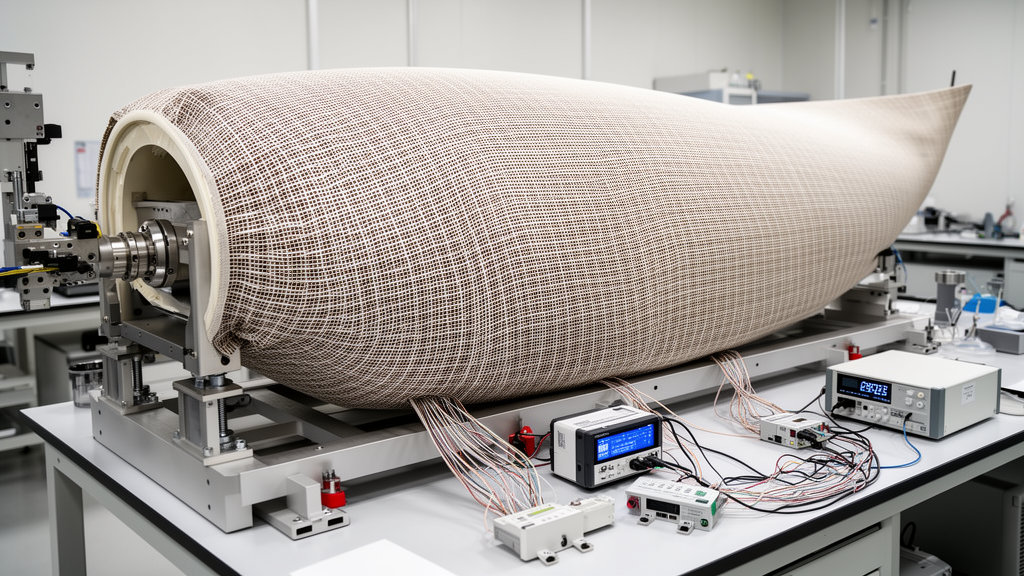
A flexible, textile-based piezoresistive sensor array has demonstrated full-field mapping of stress distributions on ship hull surfaces, including regions where localized loads concentrate. The 5 × 5 array reconstructed stress patterns that closely matched finite element simulations, with a reported coefficient of determination of R² = 0.96. When mounted on typical stress-concentrated areas of a ship hull, it captured both low-amplitude wave-induced cyclic stresses and high-amplitude slamming transients, according to the study published in the Journal of Materials Science .
The device is designed to overcome limitations associated with conventional structural monitoring systems. Strain gauges and fiber Bragg gratings are discrete instruments, meaning that widely separated measurement points provide sparse coverage of a hull. Their system complexity can also be high, and rigid sensors may conform poorly to curved hull surfaces.
The researchers addressed these constraints with a textile-compatible array built around grid-structured sensing electrodes. Its thin, flexible construction allows the device to cover a larger area while remaining mechanically compliant and capable of real-time signal acquisition. Each sensing pixel uses several functional materials.
The grid-structured electrodes were modified sequentially with MXene nanosheets and PEDOT:PSS. According to the study, this combination supports large structural deformation and abundant conductive pathways under pressure, allowing electrical resistance changes to represent applied loading. Screen-printed silver interdigitated electrodes provide the signal readout, while thin poly(vinylidene fluoride), or PVDF, encapsulation layers protect the active structure from water without compromising flexibility.
A row–column addressing system interrogates the 25 pixels, suppresses crosstalk between neighboring elements and supports reconstruction of the spatial stress distribution. At the individual-pixel level, the sensor delivered a reported sensitivity of 1,143.5 kPa⁻¹, a response and recovery time of 10 milliseconds and a detection limit as low as 1 pascal. The full-array comparison with finite element simulation produced the reported R² = 0.96 agreement between reconstructed and simulated stress distributions.
Marine durability was also assessed: the array retained more than 95% of its initial sensitivity after 15 days of salt-spray aging, and its baseline drift remained below 3% during dynamic seawater cycling. These results support the reported performance under the specified test conditions, but they do not establish equivalent durability across different hull designs, environmental conditions or complete operational lifetimes. The study presents a hull-mounted demonstration and a simulation comparison, providing a proof-of-concept for scalable, flexible monitoring of ship structural health rather than a vessel-wide performance record.
Subject of Research: Textile piezoresistive sensor arrays for ship hull stress mapping
Article Title: Large-area textile-based piezoresistive sensor array for hull stress distribution mapping
Article References: Xie, Y., & Zhang, Q. (2026). Large-area textile-based piezoresistive sensor array for hull stress distribution mapping. Journal of Materials Science, 61(40), 30976-30991. https://doi.org/10.1007/s10853-026-13667-y
Image Credits: AI Generated
DOI: 10.1007/s10853-026-13667-y
Keywords: ship structural health monitoring, textile sensors, piezoresistive arrays, hull stress mapping, MXene, PEDOT:PSS, real-time sensing, marine durability, finite element simulation, Large-area, textile-based, piezoresistive
Cite Scienmag News
Denise Maddox. (October 21, 2026). Research report: Large-area textile-based piezoresistive sensor array for hull stress distribution mapping. Scienmag. https://scienmag.com/research-report-large-area-textile-based-piezoresistive-sensor-array-for-hull-stress-distribution-mapping/
Denise Maddox. "Research report: Large-area textile-based piezoresistive sensor array for hull stress distribution mapping." Scienmag, 21 October 2026, https://scienmag.com/research-report-large-area-textile-based-piezoresistive-sensor-array-for-hull-stress-distribution-mapping/. Accessed 21 October 2026.
Denise Maddox. "Research report: Large-area textile-based piezoresistive sensor array for hull stress distribution mapping." Scienmag. October 21, 2026. https://scienmag.com/research-report-large-area-textile-based-piezoresistive-sensor-array-for-hull-stress-distribution-mapping/


