


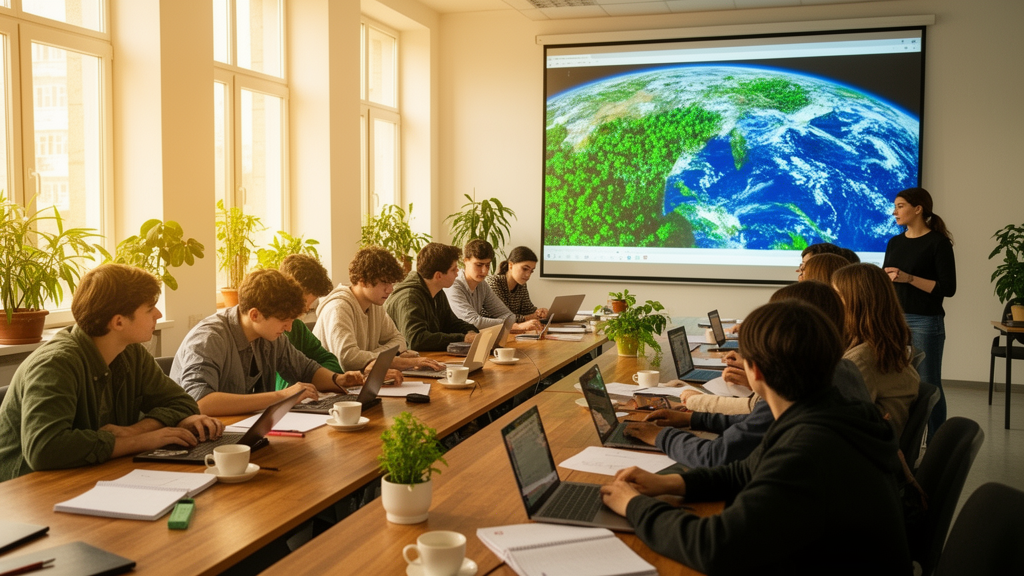
The event, dedicated to the International Year of Basic Sciences for Sustainable Development 2022, produced a special issue of eleven peer-reviewed contributions spanning four scientific topics, from heavy metal contamination to microplastics in the Black Sea. Europe's first conference on the environment took place in Menton in 1970, organized by Alfred Hassler on behalf of the Fellowship of Reconciliation, a pacifist and civil rights organization, together with other leading intellectuals. The forum conceived and issued the Menton Message, a collective public alert signed by 2,200 scientists demanding societal change to cope with the environmental crisis and the nuclear weapons race that could lead to destruction of life on Earth.
The statement was displayed at the 1972 United Nations Conference on the Human Environment in Stockholm, one of the earliest examples of scientists collectively demanding action. At the time of the Menton Message, the world's population numbered 3.5 billion; today it has reached 8 billion. Despite five decades of effort, the Stockholm+50 summit held in June 2022 concluded that environmental challenges had evolved deeper in their complexity and global impact.
Participants recognized the triple planetary crisis as a major prerequisite for hampering sustainable development, leading to poverty and the spread of diseases. The persistence of this crisis was cited as bringing the planet to tipping points beyond which there would be little chance of recovery. It is against this backdrop that the Seminar of Ecology, held annually in Sofia since 2007, has grown from a national meeting point into an international scientific forum, becoming a Seminar of Ecology with international participation in 2014 and an International Seminar of Ecology in 2019.
The first thematic session, Biotic and abiotic impact on the living nature. Ecological risk. Bioremediation, opened with a plenary lecture by Chankova et al. focusing on the ecological, agricultural, and medical aspects of genotype resistance to oxidative stress.
The role of chaperone proteins in DNA repair, a topic not so widely discussed in literature, was addressed and systematized as a review paper in the current special issue. The session continued with a lecture dedicated to the bacterial and fungal diversity in long-term copper contaminated soils of the highly industrialized Topolnitsa-Pirdop valley, where a number of mines and processing plants for copper and other non-ferrous metals have long operated. In a further lecture, Todorova et al. investigated the role of genotype in coping with lead chloride induced stress in model systems including the wild type Chlamydomonas reinhardtii strain 137C, Saccharomyces cerevisiae strain D7ts1, and Pisum sativum cultivar Ran1.
The experiment allowed for elucidating the mechanism of oxidative stress induction caused by lead chloride on the DNA molecule and photosynthetic pigments. Three posters presented in the session and published in the special issue included the work of Georgieva et al., who evaluated the presence and characteristics of microplastic particles in waters from the Bulgarian Black Sea coast, comparing protected, aquaculture, and industrial areas. Peteva et al. investigated the content of hydrophilic and lipophilic marine toxins in plankton samples taken in 2021 along the whole Bulgarian coastline, comparing their results with those from the previous period.
The third poster studied the physiological response of human erythrocytes subjected to in vitro irradiation by a high frequency magnetic field of 2.41 GHz. The second thematic session, Ecological agriculture. Ecological education, was represented by the oral presentation of Ilinkin et al. and two poster contributions by young researchers.
Ilinkin et al. investigated the potential for in vitro propagation and ex vitro adaptation of Tanacetum cinerariifolium, the Dalmatian pyrethrum of the Asteraceae family. Georgieva et al. studied the effects of the growth promoting rhizobacteria strain Pseudomonas putida 1046 on the germination of corn seeds, while Kirov et al. investigated the accumulation of potentially harmful feed ingredients in hen egg albumen with special attention to metal traces. The work of Kirov et al. presented the results of a comparative survey of metal content in egg albumen from industrial poultry farms compared with that of backyard and free-range hens.
In the experiment, the contents of heavy metals were analyzed, including chromium, copper, iron, manganese, and zinc, as well as aluminium, cadmium, nickel, and lead, together with boron, barium, strontium, calcium, and magnesium. The poster was awarded first place in the Young Researchers' Contest at the Seminar, a testament to the event's tradition of strengthening communication between Bachelor, Master, and PhD students and established scientists with lengthy expertise in the diverse aspects of ecology. The third thematic session, Biodiversity.
Conservation biology, was presented by the work of Spasova et al., who studied the plant communities and their utilization by mammals of two peat-shrub species habitats, those of Spiraea salicifolia and Potentilla fruticosa, boreal relicts among dominant coniferous forests in the Rhodope Mountains. The fourth thematic session, Ecosystem research and services. Landscape ecology, comprised the oral presentation of Grigorov et al., dealing with the forest habitat diversity of Godech Municipality according to the EUNIS habitat classification.
Full-text contributions presented at the event have been peer-reviewed and published in the Proceedings Book, with selected contributions of the last three years published in the journals Ecologia Balkanica, BioRisk, and Phytologia Balcanica. The Seminar of Ecology 2022 was the second consecutive forum held online in the yearly history of the event. Nevertheless, the dynamics of discussions and the scientific interest of the audience towards the research of the diverse range of presenting authors was well reflected.
Issues of major concern regarding the impact of human activities on the vital characteristics of ecosystems of different types were brought forward, with alerts raised that the threats of the triple planetary crisis have been evidenced to affect diverse living systems on the micro- and macroscale. The Seminar of Ecology 2023, entitled Cutting Edge Research of Ecology, has been planned as a hybrid event to take place both face-to-face and online in Sofia on 28–29 September, with the prospect of providing the opportunity to deepen research already initiated, as well as to search for scientifically based solutions to the problems identified.
Subject of Research: International Seminar of Ecology – 2022
Article Title: International Seminar of Ecology – 2022
Article References: Danova, K. (2023). International Seminar of Ecology – 2022. BioRisk, 20, 1-5. https://doi.org/10.3897/biorisk.20.104660
Image Credits: AI Generated
DOI: 10.3897/biorisk.20.104660
Keywords: International, Seminar, Ecology, scientific research, peer-reviewed research, research findings
Cite Scienmag News
Gavin Prescott. (October 20, 2026). Research report: International Seminar of Ecology – 2022. Scienmag. https://scienmag.com/research-report-international-seminar-of-ecology-2022/
Gavin Prescott. "Research report: International Seminar of Ecology – 2022." Scienmag, 20 October 2026, https://scienmag.com/research-report-international-seminar-of-ecology-2022/. Accessed 20 October 2026.
Gavin Prescott. "Research report: International Seminar of Ecology – 2022." Scienmag. October 20, 2026. https://scienmag.com/research-report-international-seminar-of-ecology-2022/


