


Artificial intelligence is reshaping curricula in Chinese higher vocational colleges, but a new study argues that strong policy incentives and the rapid spread of AI learning platforms do not automatically translate into curricula that genuinely serve student employability.
The study, conducted by Ying Cao of Fuzhou Polytechnic and Fu Jia and Kaixi Ye of Capital University of Economics and Business, draws on actor-network theory, and in particular Callon’s sociology of translation. This framework treats reform as a chain of translations in which different actors—policymakers, college administrators, teachers, students, and industry employers—each reinterpret what the reform is supposed to achieve. The researchers follow these translations through five stages: problematization, interessement, enrolment, mobilization, and provisional stabilization.
Methodologically, the work is an interpretive multiple-case study of Chinese higher vocational colleges. The analysis draws on policy and institutional documents, platform-related artifacts, and interviews with college administrators, teachers, students, and industry employers. This triangulation of sources allows the team to trace how a single reform objective—making curricula more responsive to employability—acquires different meanings at each level of the education system.
The findings show a clear division of labor in how the reform is enacted. At the top, policy authorities frame AI-enabled curriculum reform as a governance problem, setting the terms of what counts as success. Colleges then use AI learning platforms to coordinate the actors involved, relying on performance indicators, standards, infrastructure, and documented evidence of achieved objectives to hold the network together. In other words, the platform becomes the administrative hinge on which the entire reform turns.
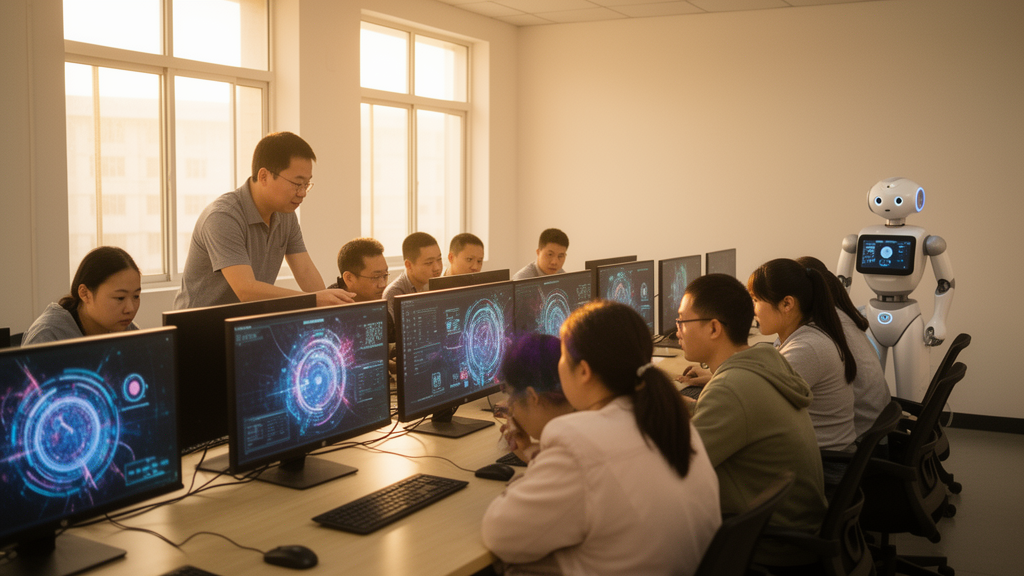
Further down the chain, teachers and students enact the reform through routine platform use. Mobilization—the stage at which the network actually produces reform activity—occurs through concrete platform functions: course delivery, knowledge bases, learning analytics, dashboards, and industry-education data interfaces. These tools do not merely support teaching; they constitute the observable form that curriculum reform takes on the ground.
A crucial caveat runs through the study’s conclusions. The researchers identify emerging and projected conditions for what they call provisional stabilization, rather than completed institutionalization. AI-supported routines may become normalized through repeated use and evaluation, but the authors stress that this normalization remains dependent on governance capacity, platform maturity, teachers’ engagement, and sustained policy support. Remove any of these supports, and the routines could fail to consolidate into lasting institutional practice.
The study’s broader significance lies in its reframing of a familiar debate.
The study, published as an open-access research article in Frontiers in Education, positions itself as a conceptual and empirical starting point for understanding AI-enabled curriculum reform as an ongoing, fragile process of translation rather than a finished achievement.
Subject of Research: AI-enabled curriculum reform as platform-mediated governance in Chinese higher vocational education
Article Title: From policy framing to platform routines: AI-integrated curriculum reform in higher vocational education
Article References: Cao, Y., Jia, F., & Ye, K. (2026). From policy framing to platform routines: AI-integrated curriculum reform in higher vocational education. Frontiers in Education, 11, 1936993. https://doi.org/10.3389/feduc.2026.1936993
Image Credits: AI Generated
DOI: 10.3389/feduc.2026.1936993
Keywords: artificial intelligence, curriculum reform, higher vocational education, actor-network theory, platform governance, employability, China, learning analytics, education policy, sociology of translation, policy, framing
Cite Scienmag News
Courtney Benton. (October 27, 2026). Research report: From policy framing to platform routines: AI-integrated curriculum reform in higher vocational education. Scienmag. https://scienmag.com/research-report-from-policy-framing-to-platform-routines-ai-integrated-curriculum-reform-in-higher-vocational-education/
Courtney Benton. "Research report: From policy framing to platform routines: AI-integrated curriculum reform in higher vocational education." Scienmag, 27 October 2026, https://scienmag.com/research-report-from-policy-framing-to-platform-routines-ai-integrated-curriculum-reform-in-higher-vocational-education/. Accessed 27 October 2026.
Courtney Benton. "Research report: From policy framing to platform routines: AI-integrated curriculum reform in higher vocational education." Scienmag. October 27, 2026. https://scienmag.com/research-report-from-policy-framing-to-platform-routines-ai-integrated-curriculum-reform-in-higher-vocational-education/


