


A cross-sectional screening study of 813 school students in Taizhou, China, has uncovered a striking anomaly in one of the most widely used tools for detecting adolescent scoliosis: an unexplained pile-up of trunk rotation measurements at exactly 5 degrees, the very cutoff that determines whether a child is flagged for further evaluation. The finding, published in Frontiers in Pediatrics, suggests that a substantial fraction of positive screening results may reflect measurement behavior rather than true spinal deformity, with potentially large consequences for how school-based screening programs interpret their numbers.
Adolescent idiopathic scoliosis, a three-dimensional spinal deformity defined by a coronal Cobb angle of at least 10 degrees on standing radiographs, affects an estimated 0.47 to 5.2 percent of school-aged children worldwide, with notable geographic and demographic variation. The condition predominantly affects females, with female-to-male ratios ranging from 1.5:1 to 5:1, particularly for curves exceeding 20 degrees. In China, large-scale analyses indicate a prevalence of roughly 1.2 percent among adolescents aged 10 to 18 years, and since 2021 the country has incorporated scoliosis screening into routine student health examinations under national technical guidelines.
Because radiographs are impractical for mass screening, the standard first-line tool is the Adam forward bend test combined with a scoliometer reading of the angle of trunk rotation, or ATR. The method is simple, non-invasive and reasonably reliable, but its accuracy as a standalone diagnostic criterion has been questioned, and international guidelines disagree on the referral threshold: the American Orthopaedic Society recommends 5 degrees, the International Society on Scoliosis Orthopaedic and Rehabilitation Treatment recommends 7 degrees, and some European programs use 10 degrees. That variability directly shapes reported prevalence rates and referral volumes, which is precisely why the Taizhou team set out to compare thresholds within a single population.
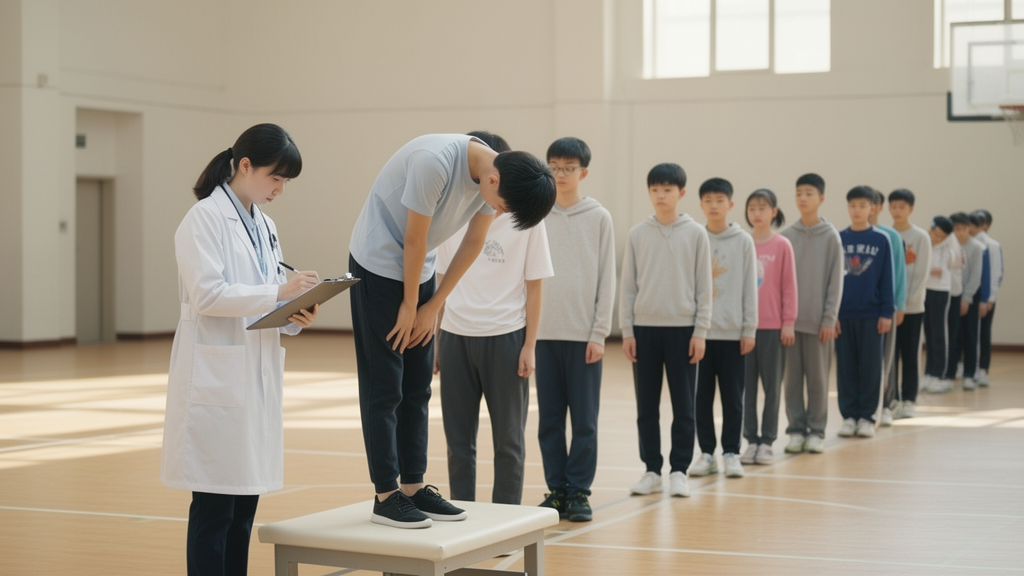
The study, conducted from May to June 2026, enrolled 813 students aged 10 to 17 years from two primary and two secondary schools in Taizhou, Zhejiang Province. Participants completed a standardized five-step protocol: general visual inspection for shoulder asymmetry, scapular prominence and pelvic tilt; the Adam forward bend test; scoliometer measurement at the point of maximum deformity; a spinal movement test consisting of 30 seconds hanging from a horizontal bar followed by re-measurement; and classification according to the 2021 Chinese national guidelines. A rehabilitation physician with six years of clinical experience performed the primary measurements, supervised by an attending physician with eight years of experience, and both completed a standardized one-hour training program before the study began.
The headline result concerns the distribution of ATR values. Of the 813 participants, 215, or 26.4 percent, were classified as screen-positive: 165 in Grade I (5 degrees or more but under 7), 40 in Grade II (7 to under 10 degrees) and 10 in Grade III (10 degrees or more). But the raw distribution tells a more troubling story. A full 144 students, 17.7 percent of the entire sample, recorded an ATR of exactly 5 degrees, while only 20 recorded 4 degrees and 19 recorded 6 degrees. A chi-square goodness-of-fit test, comparing the observed count at 5 degrees against an expected frequency of 19.5 estimated by linear interpolation from the adjacent values, yielded a statistic of 794.88 with one degree of freedom and a P value below 0.001. The ratio of measurements at 5 degrees to the average per-degree frequency across the surrounding values was 13.1:1 (95 percent CI 11.1 to 15.4), and the ratio of 5-degree readings to 6-degree readings was 7.6:1.
The authors are careful about what this clustering does and does not prove. Terminal digit preference, in which measurements cluster at round numbers, is a well-documented phenomenon in clinical measurement contexts such as vital signs and tumor diameter, and manual angle measurements in orthopedic practice are commonly recorded in 5-degree increments. Examiners may round values near the psychologically salient 5-degree cutoff to that value, and students may instinctively adjust their posture when being measured near a threshold they sense matters. However, the interpolation-based chi-square test may not capture the true underlying distribution of ATR values, and the study data cannot determine the cause of the aggregation. The authors describe their analysis as a descriptive quantification of the observed clustering rather than a confirmatory test of its origin, and note that controlled studies with blinded or instrument-based measurements would be needed to disentangle rounding from genuine postural behavior.
The threshold effect on prevalence estimates is dramatic. Using the 5-degree cutoff, the screen-positive rate was 26.8 percent, far above the international prevalence range of 0.47 to 5.2 percent. Using 7 degrees, the rate fell to 6.1 percent, much closer to what the literature would predict, though still above the 1.20 percent definitive prevalence reported in a recent population-wide analysis of 2.22 million Chinese adolescents confirmed by radiography, and above the 1.2 percent pooled estimate from a meta-analysis of 42 studies involving over 1.1 million subjects. The authors attribute the remaining gap to the fact that ATR-based screening identifies both structural and non-structural curves, and not all screen-positive cases are radiographically confirmed. Importantly, no radiographs were obtained in this study, so the diagnostic accuracy of the different thresholds could not be determined.
Beyond the clustering question, the study examined which factors were associated with screen-positive status at the stricter 7-degree threshold, which yielded 50 events among 776 participants with complete data. In a multivariable logistic regression model selected by Akaike’s Information Criterion, female sex showed the strongest association, with an odds ratio of 3.509 (95 percent CI 1.917 to 6.425, P < 0.001), consistent with the well-established female predominance of scoliosis. Screen time, measured in hours per day, was also independently associated, with an odds ratio of 1.391 (95 percent CI 1.070 to 1.809, P = 0.013). BMI showed only marginal significance (odds ratio 0.930, P = 0.052), and the authors caution that this apparent protective pattern may reflect detection bias, since higher BMI dampens scoliometer readings and can mask underlying asymmetries. The model showed acceptable discrimination with an area under the ROC curve of 0.714 and good calibration (Hosmer-Lemeshow P = 0.680).
Subgroup analyses added a notable nuance: screen time was significantly associated with screen-positive status only in females (odds ratio 1.70, P = 0.006) but not in males (odds ratio 1.03, P = 0.849), and the overall sex-by-screen-time interaction was significant (odds ratio 1.68, P = 0.046). The authors suggest that females may be more vulnerable to prolonged screen use, possibly due to differences in posture, muscle strength or hormonal factors, while stressing that the cross-sectional design cannot establish causality and that the study uses the term associated factors rather than risk factors throughout. By contrast, the secondary model using the 5-degree threshold included 13 variables from 658 participants and none reached statistical significance, with poor model fit (Pseudo R2 = 0.014, likelihood ratio test P = 0.638), which the authors interpret as evidence that questionnaire-based variables are insufficient to characterize positivity at that threshold rather than as a judgment on the threshold itself.
The spinal movement test, in which students hung from a horizontal bar for 30 seconds before ATR was re-measured, proved largely ineffective at filtering out false positives. Of the 280 students with an initial ATR of 5 degrees or more who underwent the test, reclassification rates were just 1.4 percent at the 5-degree threshold, 9.1 percent at 7 degrees and 16.7 percent at 10 degrees, with a mean ATR change of only minus 0.16 degrees. No student showed an increase in ATR after the exercise. The authors take this as evidence that most students with positive screening results have genuine trunk rotation rather than transient postural artifacts, though the test may hold more value at the highest threshold.
The study has limitations the authors acknowledge openly. It was conducted in a single city, limiting generalizability; lifestyle factors were self-reported and subject to recall bias; subgroup samples were small; and formal inter-rater and intra-rater reliability metrics were never calculated, since the dataset retained only final measurement values, precluding post-hoc reliability analysis. Still, the practical implications are concrete. The team recommends using a 7-degree referral threshold instead of 5 degrees to reduce the impact of measurement clustering and unnecessary referrals and parental anxiety, implementing examiner training that explicitly discourages rounding to 5-degree increments, giving particular attention to female students during puberty, and relying on clinical correlation rather than single ATR measurements for decisions. Whether the 5-degree pile-up reflects examiner rounding, student behavior, or something else entirely, the message for screening programs is clear: a number that looks like a clean cutoff may also be shaping the data that flow across it, and validation against radiographic confirmation remains the essential next step.
Subject of Research: Measurement clustering at the 5-degree ATR threshold in school scoliosis screening and its effect on screen-positive prevalence estimates
Article Title: Prevalence and associated factors of screen-positive scoliosis among primary and secondary school students in Taizhou, China: a cross-sectional analysis based on ATR thresholds with identification of the apparent 5° measurement clustering
Article References: Jiang, H.-T., Wang, G., Yang, S.-Y., Wu, F.-Z., Tang, T.-T., Wang, W.-Q., Wang, Z.-P., Liang, L.-H., Huang, X., Ge, Y., & Wu, M.-J. (2026). Prevalence and associated factors of screen-positive scoliosis among primary and secondary school students in Taizhou, China: a cross-sectional analysis based on ATR thresholds with identification of the apparent 5° measurement clustering. Frontiers in Pediatrics, 14, 1901184. https://doi.org/10.3389/fped.2026.1901184
Image Credits: AI Generated
DOI: 10.3389/fped.2026.1901184
Keywords: adolescent idiopathic scoliosis, scoliometer, angle of trunk rotation, school screening, measurement clustering, ATR threshold, cross-sectional study, screen time, female sex, BMI, China, prevalence
Cite Scienmag News
Ophelia Keating. (October 27, 2026). Scoliosis Screening in China Reveals Suspicious Clustering at the 5-Degree Threshold. Scienmag. https://scienmag.com/scoliosis-screening-in-china-reveals-suspicious-clustering-at-the-5-degree-threshold/
Ophelia Keating. "Scoliosis Screening in China Reveals Suspicious Clustering at the 5-Degree Threshold." Scienmag, 27 October 2026, https://scienmag.com/scoliosis-screening-in-china-reveals-suspicious-clustering-at-the-5-degree-threshold/. Accessed 27 October 2026.
Ophelia Keating. "Scoliosis Screening in China Reveals Suspicious Clustering at the 5-Degree Threshold." Scienmag. October 27, 2026. https://scienmag.com/scoliosis-screening-in-china-reveals-suspicious-clustering-at-the-5-degree-threshold/


