


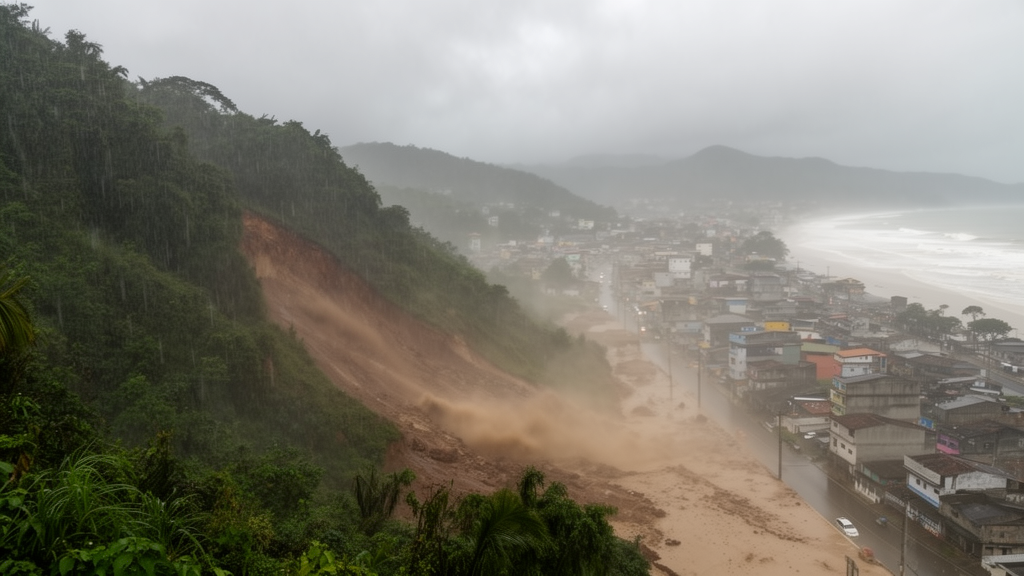
Extreme rainfall in São Sebastião, Brazil, removed suspended particles from the air before particulate pollution rebounded after the February 2023 landslides, according to an observational study of the coastal city. Researchers analyzed hourly PM10 and PM2.5 measurements with rainfall and meteorological data from December 2021 through February 2025. Mean PM10 concentrations rose from 10.67 to 23.91 micrograms per cubic metre between February 19 and 20, an increase of 124%, while PM2.5 rose from 4.46 to 8.62 micrograms per cubic metre, or 93.3%.
The measurements establish a post-event rebound, but the study could not determine whether landslides were responsible or how long any disaster-related effect persisted. The case study focused on rainfall that began on the evening of February 18 and continued into February 19, when total precipitation reached 680 millimetres. The event was associated with a stationary cold front intensified by the orographic influence of the Serra do Mar mountain range.
Landslides blocked roads, disrupted water and food supplies, caused fatalities and displaced many residents. A separate mapping study cited by the researchers identified 983 landslide areas after the disaster. São Sebastião’s only automatic air-quality station was approximately 30 kilometres from the epicentre in Vila Sahy, limiting how directly its measurements could represent conditions in the most severely affected area.
To distinguish the event from ordinary seasonal and meteorological variation, the researchers converted hourly monitoring records into daily values and used k-means clustering to classify days according to meteorological conditions alone. Particulate matter was deliberately excluded from the classification, so the resulting groups were not selected according to pollution levels. The algorithm placed the February 18 and 19 event days in a smaller high-rainfall group alongside other days with similar conditions.
Of the 1,187 days in the full analysis period, 849 had complete records for all five meteorological variables and were retained for clustering; 337 days, or 28.41%, were excluded. A Silhouette analysis favored two clusters, while the Elbow method favored three, and the researchers selected the three-cluster solution to isolate the high-rainfall group. Hourly records revealed behavior that daily averages alone could obscure.
When rain began around 7 p.m. on February 18, PM10 initially ranged from 16 to 18 micrograms per cubic metre and PM2.5 from 6 to 10. During the most intense interval, from 9 p.m. on February 18 to 4 a.m. on February 19, hourly precipitation reached 34.31 millimetres at Juquehy and 101.59 millimetres at Barra do Una. Concentrations subsequently fell, with PM10 declining to between 6 and 16 micrograms per cubic metre and PM2.5 to between 0 and 7.
This sequence was consistent with wet scavenging, in which intense precipitation removes suspended particles from the atmosphere. After rainfall weakened or stopped at most stations late on February 19, PM concentrations began rising again as atmospheric washout declined and pollutant accumulation resumed. Theil–Sen analyses examined daily PM trends over one-, three- and seven-day post-event windows.
In all three scenarios, the estimated slopes were close to zero and their confidence intervals included the null value, meaning the short-term trends were not statistically significant. That result did not erase the pronounced day-to-day fluctuations: the measurements showed a rapid decline during heavy rain followed by a rebound as the rain subsided. The analysis therefore documents a temporal sequence rather than demonstrating a sustained increase in particulate matter.
It also shows why a trend statistic based on a short period can characterize differently from an hourly analysis of the same event. Wind conditions and topography offered only partial explanations for the rebound. During the event, elevated concentrations were associated mainly with low-speed easterly and east-southeasterly winds, consistent with weak ventilation and local accumulation before rainfall began.
In the northwestern part of the municipality, winds above 6 metres per second were linked to lower concentrations. After the event, elevated particle levels occurred under several wind directions rather than in a single transport corridor. Westerly winds accounted for approximately 30% of observations from February 20 to 22 and occurred predominantly at speeds of 1 to 3 metres per second; mean wind speed across the period was about 1.8 metres per second.
Weak winds would reduce dispersion, while the recurrent westerly and southwesterly flow was compatible with transport from western areas, including the landslide-affected region, but the monitoring data could not identify the origin of the measured particles. Changes in local human activity offered another possible influence. The disaster occurred during the 2023 Carnival holiday, when unusually heavy traffic was expected along the SP-055 coastal highway.
The study cited an estimate of 223,718 vehicles using the route during Carnival and reported that eastbound daily traffic on February 21 and 22 was approximately twice the typical level for the month, reaching about 6,395 vehicles per day. Rescue operations, excavators, trucks and other heavy machinery may also have disturbed soil and deposited material. Port operations, vessels and road traffic could have supplied additional particles, while newly exposed landslide soil could have been resuspended.
These mechanisms are compatible with the observed rebound, but the researchers did not measure emissions, soil composition or source contributions, so they could not quantify the role of any one process. Two other heavy-rain periods helped test whether the February pattern was unique. The researchers examined March 19–20, 2022, when no landslides were identified in the available records, and June 13, 2023, which meteorological clustering placed near the February event.
In both comparisons, PM10 and PM2.5 declined during intense rainfall, again consistent with wet scavenging. Their behavior after the rain differed: the March 2022 concentrations recovered gradually as rainfall diminished, while concentrations after the June 2023 event remained below their pre-rainfall levels during the period examined. Following the February event, both particle fractions increased rapidly and remained elevated over the following days.
The comparison shows that a post-rain increase is not unique to landslides, but neither rainfall cessation nor landslide occurrence alone fully explains the faster and more persistent February rebound. The findings fit São Sebastião’s broader seasonal pollution pattern. Across the monitoring record, the highest average particle concentrations occurred mainly from July through September, during the relatively cool and stable part of the year, rather than in the wet summer when the disaster occurred.
The Serra do Mar can restrict low-level circulation, while weaker winter winds favor pollutant accumulation. Air-quality data cited in the study indicated that all valid 24-hour PM2.5 measurements in 2025 were classified as good, while 97.3% of valid PM10 measurements were also classified as good. Concentrations during the February event week remained below the national daily standards applied in the analysis: 120 micrograms per cubic metre for PM10 and 60 micrograms per cubic metre for PM2.5.
The post-event increase was therefore an acute change in measured pollution rather than evidence of a prolonged regional standard violation. The study’s principal limitation is the mismatch between the disaster footprint and the monitoring network. Gaps in the daily record, the use of a single station and its distance from Vila Sahy may have obscured the strongest local peaks.
The researchers also could not separate resuspended landslide material from traffic, machinery, port activity, regional pollutant transport or ordinary post-rain recovery. Their comparison events reinforce that caution: the observed sequence of particle decline and rebound was real, but the available data do not establish a landslide-specific causal effect or its duration. Denser monitoring networks, stations closer to affected slopes, continuous measurements and targeted source analysis would be needed to determine whether and for how long post-disaster activity raises particulate concentrations in the most affected parts of São Sebastião.
Subject of Research: Observed particulate-matter changes during and after extreme rainfall and landslides in São Sebastião, Brazil
Article Title: Can extreme rainfall associated with landslides affect air quality? A case study in a coastal city (São Sebastião, São Paulo State, Brazil)
Article References: Magalhães, L. R., Pozza, S. A., & Nogarotto, D. C. (2026). Can extreme rainfall associated with landslides affect air quality? A case study in a coastal city (São Sebastião, São Paulo State, Brazil). Environmental Monitoring and Assessment, 198(11), Article 1241. https://doi.org/10.1007/s10661-026-16071-w
Image Credits: AI Generated
DOI: 10.1007/s10661-026-16071-w
Keywords: air quality, particulate matter, PM10, PM2.5, landslides, extreme rainfall, São Sebastião, wet scavenging, particle resuspension, Brazil, extreme, rainfall
Cite Scienmag News
Russell Cooper. (October 22, 2026). Research report: Can extreme rainfall associated with landslides affect air quality? A case study in a coastal city (São Sebastião, São Paulo State, Brazil). Scienmag. https://scienmag.com/research-report-can-extreme-rainfall-associated-with-landslides-affect-air-quality-a-case-study-in-a-coastal-city-sao-sebastiao-sao-paulo-state-brazil/
Russell Cooper. "Research report: Can extreme rainfall associated with landslides affect air quality? A case study in a coastal city (São Sebastião, São Paulo State, Brazil)." Scienmag, 22 October 2026, https://scienmag.com/research-report-can-extreme-rainfall-associated-with-landslides-affect-air-quality-a-case-study-in-a-coastal-city-sao-sebastiao-sao-paulo-state-brazil/. Accessed 22 October 2026.
Russell Cooper. "Research report: Can extreme rainfall associated with landslides affect air quality? A case study in a coastal city (São Sebastião, São Paulo State, Brazil)." Scienmag. October 22, 2026. https://scienmag.com/research-report-can-extreme-rainfall-associated-with-landslides-affect-air-quality-a-case-study-in-a-coastal-city-sao-sebastiao-sao-paulo-state-brazil/


