


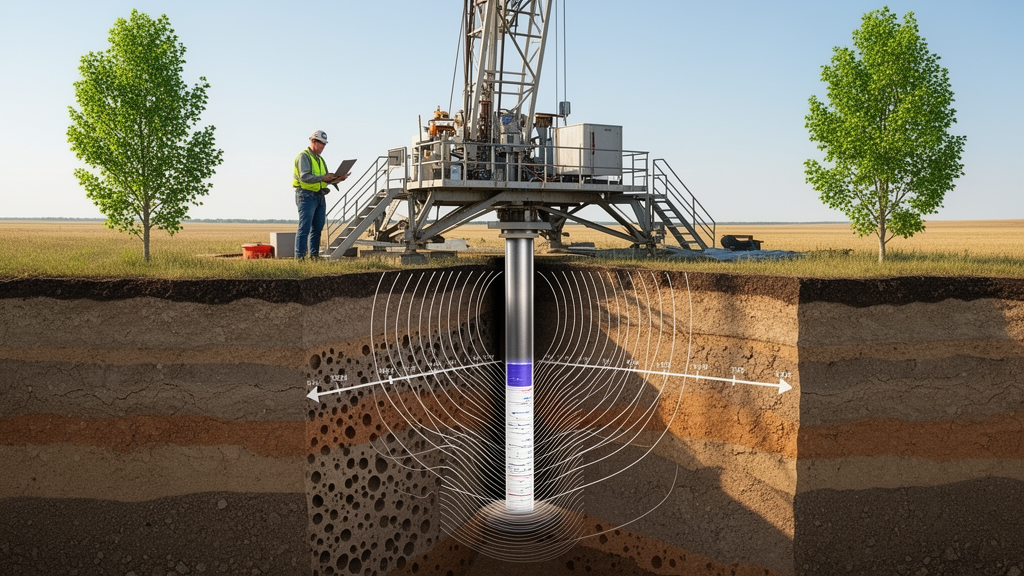
A formation-specific machine-learning workflow reconstructed compressional- and shear-wave transit times from conventional well logs and then estimated three dynamic elastic properties in a single well in the Williston Basin. The study compared Random Forest, Light Gradient Boosting Machine, Extra Trees and Extreme Gradient Boosting models, finding that Extra Trees produced the most accurate sonic predictions. On the held-out test set, its coefficient of determination was 0.974 for compressional transit time and 0.976 for shear transit time. These results demonstrate strong point prediction within the sampled well interval, but they do not establish transferability to other wells, formations or basins.
The data came from well 20,457 in the Little Knife Field and were obtained from the North Dakota Department of Mineral Resources, Oil and Gas Division database. The model inputs were deep resistivity, gamma ray, caliper, neutron porosity and bulk-density logs, while compressional slowness, designated DTCO, and shear slowness, designated DTSM, served as prediction targets. This design addresses a practical problem in reservoir characterization: sonic coverage may be incomplete because of operational constraints, tool failures, cost or decisions to log only selected intervals. The aim was not to replace direct sonic acquisition, but to use routinely available conventional logs where sonic information is missing.
Before modelling, the researchers replaced the missing-value marker of −999.25 with null values, removed rows containing any missing observation and excluded records with non-physical negative values in the input features. They also applied the interquartile range method to identify and remove outliers from all variables. These steps reduced noise and preserved complete observations, although they also restricted the analysis to the portion of the well represented by usable, internally consistent measurements. The resulting dataset contained 14,409 data points, divided into 70% training, 15% validation and 15% testing subsets.
Each of the four algorithms was tuned with randomized hyperparameter search and five-fold cross-validation, while the separate validation set supported model comparison and the test set was reserved for final evaluation. Tree-based ensembles were selected because they can represent nonlinear relationships and interactions in tabular well-log data without requiring the larger parameterization of deep neural networks. Random Forest and Extra Trees represented bagging and highly randomized tree strategies, while LightGBM and XGBoost represented gradient-boosting implementations. Deep-learning models were not evaluated because the dataset came from only one well and did not provide the multiwell diversity needed to justify their greater flexibility and associated overfitting risk.
Extra Trees achieved the lowest test errors among the four models. For DTCO, it recorded an R-squared of 0.973831, a mean absolute error of 2.196897 and a root mean squared error of 3.755113. For DTSM, the corresponding values were 0.975876, 6.161564 and 10.022929. The extra-randomized splitting strategy used by Extra Trees can reduce model variance by averaging trees with randomized feature and cut-point choices. Visual comparisons against measured logs showed that all four models reproduced major trends in the sonic profiles, with Extra Trees generally following the measured curves most closely. These metrics describe agreement on withheld samples from the same well; they are not confidence bounds for individual depths.
Interpretability analysis identified neutron porosity and bulk density as especially influential predictors, with gamma ray also consistently among the leading variables. In the XGBoost model, neutron porosity received an importance score of 0.92 for DTCO and 0.83 for DTSM, while Random Forest and Extra Trees ranked neutron porosity and bulk density among their two most important features. SHAP analysis of the Extra Trees model added detail at the level of individual predictions: higher neutron-porosity values generally contributed to higher predicted transit times, bulk density had a more context-dependent influence, and deep resistivity contributed more to DTSM than to DTCO. These are learned model relationships rather than proof that any feature directly causes a particular change in acoustic response.
The predicted shear transit time was also compared with a conventional empirical relationship known as the Castagna correlation. That correlation showed poor agreement with the measured DTSM data in this well. A separate ordinary least-squares relationship between DTCO and DTSM had an R-squared of 0.8977, represented as DTSM equals 2.5353 multiplied by DTCO minus 35.0291, and explained about 90% of the observed DTSM variance. However, its errors were larger than those of the Extra Trees predictions, with a mean absolute error of 19.02, mean squared error of 598.83 and root mean squared error of 24.47. The comparison indicates that a formation-specific empirical fit may not reproduce the accuracy of a model trained directly on the available well logs.
The authors then inserted measured or predicted DTCO and DTSM values, together with bulk density, into established rock-physics equations to calculate Poisson’s ratio, Young’s modulus and shear modulus. Shear modulus, which depends on density and shear transit time, showed close agreement between profiles derived from measured and predicted logs. Young’s modulus and Poisson’s ratio generally tracked their measured-log counterparts but displayed more variability. Both formulas become sensitive when DTCO and DTSM are nearly equal: the denominator in the expressions can approach zero, producing unusually high, negative or otherwise non-physical estimates. Such anomalies highlight how small sonic errors or poor measurements can be amplified when elastic properties are derived mathematically.
The study’s central contribution is therefore a two-stage connection between data-driven sonic reconstruction and physics-based elastic-property estimation, strengthened by feature-importance analysis and SHAP interpretation. The results also demonstrate why predictive performance should not be separated from input quality. Caliper contributed relatively little globally, but local borehole-enlargement signals may still identify intervals requiring caution. Likewise, the absence of explicit lithological or stratigraphic variables may limit performance where facies vary. The estimated properties are dynamic values inferred from sonic measurements, and no core-based laboratory data were available to test their absolute accuracy or calibrate them against static elastic moduli commonly used in geomechanical models.
After independent multiwell validation, the workflow could support mechanical earth models, mud-weight windows, wellbore-stability assessments and fracture-design workflows by filling missing sonic intervals and identifying stiffness contrasts. Deployment would nevertheless require automated log-quality checks, applicability-domain screening, uncertainty estimates and periodic recalibration as new sonic or core observations become available. The authors recommend multiwell testing, methods such as bootstrapping, Monte Carlo simulation or probabilistic modelling, and validation against laboratory measurements. Until those steps are completed, the high within-well accuracy supports the method for the studied Little Knife Field interval rather than an automatic claim of field-scale or cross-basin performance.
Subject of Research: Machine-learning reconstruction of sonic logs and dynamic elastic properties from conventional well logs in the Williston Basin
Article Title: Integrating ensemble learning with empirical rock-physics equations for sonic-log reconstruction and geomechanical property estimation: a case study from the Williston basin
Article References: Nkok, L. Y., Fadairo, A. S., Oguntade, T. I., & Nkansah, C. (2026). Integrating ensemble learning with empirical rock-physics equations for sonic-log reconstruction and geomechanical property estimation: a case study from the Williston basin. Earth Science Informatics, 19(12), Article 223. https://doi.org/10.1007/s12145-026-02280-x
Image Credits: AI Generated
DOI: 10.1007/s12145-026-02280-x
Keywords: Williston Basin, Little Knife Field, sonic-log reconstruction, ensemble machine learning, Extra Trees, well-log analysis, geomechanical properties, SHAP analysis, rock physics, machine-learning limitations, Integrating, ensemble
Cite Scienmag News
Violet Maxwell. (October 22, 2026). Extra Trees reconstructs sonic logs in one Williston Basin well. Scienmag. https://scienmag.com/extra-trees-reconstructs-sonic-logs-in-one-williston-basin-well/
Violet Maxwell. "Extra Trees reconstructs sonic logs in one Williston Basin well." Scienmag, 22 October 2026, https://scienmag.com/extra-trees-reconstructs-sonic-logs-in-one-williston-basin-well/. Accessed 22 October 2026.
Violet Maxwell. "Extra Trees reconstructs sonic logs in one Williston Basin well." Scienmag. October 22, 2026. https://scienmag.com/extra-trees-reconstructs-sonic-logs-in-one-williston-basin-well/


