


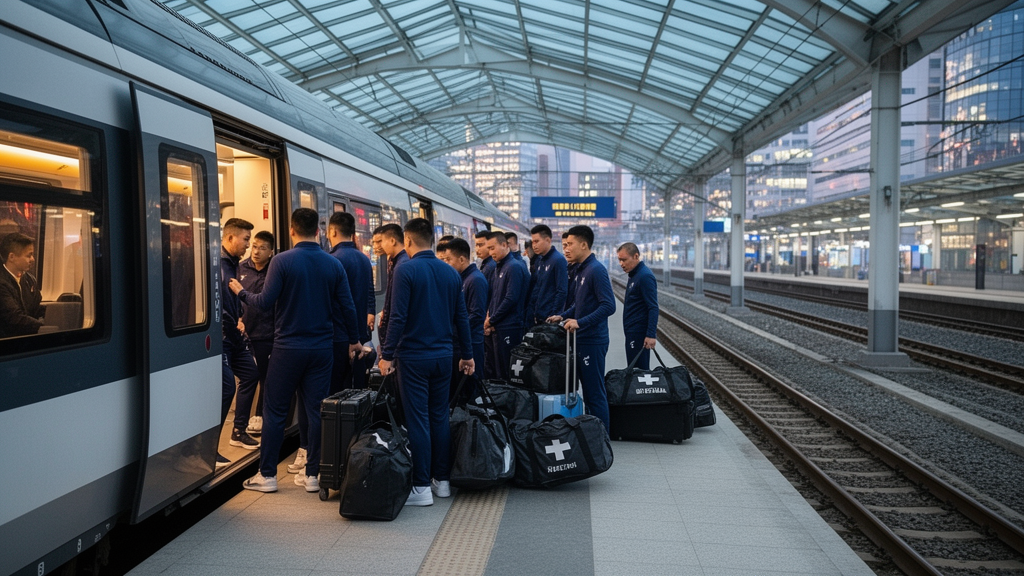
A route-level scenario analysis of the 2025 Chinese Super League found that replacing eligible air journeys with high-speed rail could reduce modeled operating-stage carbon dioxide emissions by 29.54%. The study covered all 240 away-team round trips and 480 directional travel legs, with 40 travelers assigned to each leg. Under an air-intensive reference scenario, the complete season generated 2,100.06 metric tonnes of carbon dioxide. Screening individual rail services by scheduled duration produced an eight-hour scenario with total emissions of 1,479.72 tonnes, a difference of 620.34 tonnes from the reference. These are conditional accounting estimates rather than measured reductions from what clubs currently do, and the rail schedules used in the analysis came from a September 2026 snapshot rather than the 2025 competition itself.
The researchers developed the analysis as a deterministic counterfactual. All fixtures, home venues and team travel demands remained fixed while the assigned transport mode changed under explicit rules. The reference scenario, called S0, assigned travel to a coach when the stadium-to-stadium road distance was 300 km or less and to air when it was longer. That rule sent 24 of the 480 legs to coach and 456 to air, producing 12 all-coach and 228 all-air round trips. Two substitution scenarios then replaced reference air legs with direct G-, D- or C-series rail services when a verified no-transfer train had a minimum scheduled duration of no more than six hours in S1 or eight hours in S2. Access and waiting time were not included in these thresholds.
The six-hour scenario assigned 196 legs to rail, 24 to coach and 260 to air. It yielded 98 all-rail, 12 all-coach and 130 all-air round trips, with total emissions of 1,621.07 tonnes. Relative to S0, that was 478.99 tonnes, or 22.81%, lower. The eight-hour scenario added 36 eligible rail legs and 141.35 tonnes of further modeled savings. It contained 115 all-rail round trips, two mixed rail-air itineraries, 12 all-coach trips and 111 all-air trips. The mixed cases demonstrate why the investigators evaluated outbound and return travel separately: a rail service may qualify in one direction while the opposite direction remains eligible for air travel.
Travel options were assembled from 93 city pairs in both directions, producing 186 directional railway queries. China Railway 12306 searches used 20 September 2026 as a common reference date, with information captured on 10 and 11 September. Among the queries, 125 yielded a verified single-train minimum, 52 returned no result within the documented search scope, six showed only ordinary services, two contained only same-vehicle continuation schemes and one minimum remained unconfirmed. The two same-vehicle-only minima, 716 and 749 minutes, exceeded both rail screens. The unconfirmed Beijing–Tianjin minimum did not affect the reported results because coach travel remained the priority for those legs under every tested distance threshold.
For each eligible query, the model minimized scheduled time among trains that did not require a change of vehicle. Where shortest-duration services were tied, selection favored the combination with the smaller total of outbound and return road access, followed by earlier departure and train identifier. Stadium, station and airport access was calculated with the OSRM driving service, which returned a 69-by-69 matrix containing 362 directed road segments used in the analysis. Great-circle distances were calculated from independently sourced OpenStreetMap coordinates. Rail line-haul distance was approximated as 1.10 times stadium-to-stadium great-circle distance, while aviation used great-circle distance without a multiplier. These proxies simplify physical paths and do not reconstruct exact station-to-station rail mileage.
The base accounting assigned carbon dioxide intensities of 0.0326 kilograms per passenger-kilometer to coach travel, 0.0102 to rail and 0.0972 to air. The rail factor originated from 2019 Beijing–Shanghai high-speed rail data and was transferred across the modeled G, D and C services as a common-factor assumption. These values allocate average passenger emissions; they do not measure the fuel consumption of an individual team charter, the marginal emissions of adding 40 people to a scheduled service, or the emissions avoided if a flight or train were canceled. The system boundary covered intercity movement and road access to stations and airports, but excluded supporters, accommodation, food, stadium energy, freight, infrastructure construction, induced demand and aviation effects other than carbon dioxide.
Savings were concentrated among a small group of clubs under the eight-hour scenario. Beijing Guoan had the largest modeled reduction at 64.20 tonnes, followed by Shenzhen Peng City at 62.48 tonnes, Wuhan Three Towns at 60.78 tonnes, Henan at 56.15 tonnes and Zhejiang at 51.51 tonnes. Together, those five clubs accounted for 47.57% of the scenario’s league-wide savings. Wuhan Three Towns had the highest percentage reduction among clubs, at 55.04%, while Shenzhen Peng City’s away trip to Beijing Guoan produced the largest single-fixture difference, 13.46 tonnes or 88.10% of its reference emissions. By contrast, Yunnan Yukun had the highest reference emissions but no leg qualified for rail substitution, illustrating how geographic exposure differed from operational opportunity.
Deterministic sensitivity tests showed that the modeled percentage savings were not confined to a narrow set of assumptions. Across 36 combinations of party size, coach threshold, aviation factor and rail-time screen, S1 savings ranged from 22.35% to 23.79%, while S2 savings ranged from 29.11% to 30.76%. These ranges are not confidence intervals because the complete modeled season was analyzed under fixed rules rather than sampled from a statistical population. Rail-distance multipliers from 1.05 to 1.50 produced S1 savings of 21.74% to 22.94% and S2 savings of 28.15% to 29.71%. Halving or doubling the rail factor expanded the respective S1 range to 19.86%–24.28% and the S2 range to 25.72%–31.45%.
An additional illustration assumed that each eligible itinerary had a uniform 50% chance of being adopted, with the reference journey used otherwise. Under that assumption, expected S1 emissions were 1,860.57 tonnes, representing savings of 239.49 tonnes or 11.40% against S0. Expected S2 emissions were 1,789.89 tonnes, corresponding to savings of 310.17 tonnes or 14.77%. The adoption rate was an assumption, not an estimate of existing rail use or a behavioral forecast, and selective uptake could distribute the effects differently. Overall, the framework offers clubs a transparent way to identify candidate rail journeys, but its thresholds are screening tools rather than proof of door-to-door feasibility. A qualifying scheduled train says little by itself about baggage, security, seat availability, disruption, athlete recovery or compatibility with kick-off times, leaving verified travel records and operational pilots as necessary next steps.
Subject of Research: Scenario modeling of high-speed rail substitution for Chinese Super League team travel
Article Title: Direct high-speed rail substitution for Chinese Super League team travel: a directional carbon dioxide scenario assessment
Article References: Yin, Z., Zhang, Y., Li, H., Feng, C., & Xiao, H. (2026). Direct high-speed rail substitution for Chinese Super League team travel: a directional carbon dioxide scenario assessment. Frontiers in Environmental Science, 14, Article 1963916. https://doi.org/10.3389/fenvs.2026.1963916
Image Credits: AI Generated
DOI: 10.3389/fenvs.2026.1963916
Keywords: Chinese Super League, high-speed rail, team travel, carbon dioxide, transport emissions, route-level modeling, counterfactual analysis, rail substitution, professional football, Direct, high-speed, rail
Cite Scienmag News
Violet Maxwell. (October 22, 2026). Modeled rail substitution cuts Chinese Super League team-travel emissions by nearly 30%. Scienmag. https://scienmag.com/modeled-rail-substitution-cuts-chinese-super-league-team-travel-emissions-by-nearly-30/
Violet Maxwell. "Modeled rail substitution cuts Chinese Super League team-travel emissions by nearly 30%." Scienmag, 22 October 2026, https://scienmag.com/modeled-rail-substitution-cuts-chinese-super-league-team-travel-emissions-by-nearly-30/. Accessed 22 October 2026.
Violet Maxwell. "Modeled rail substitution cuts Chinese Super League team-travel emissions by nearly 30%." Scienmag. October 22, 2026. https://scienmag.com/modeled-rail-substitution-cuts-chinese-super-league-team-travel-emissions-by-nearly-30/


