


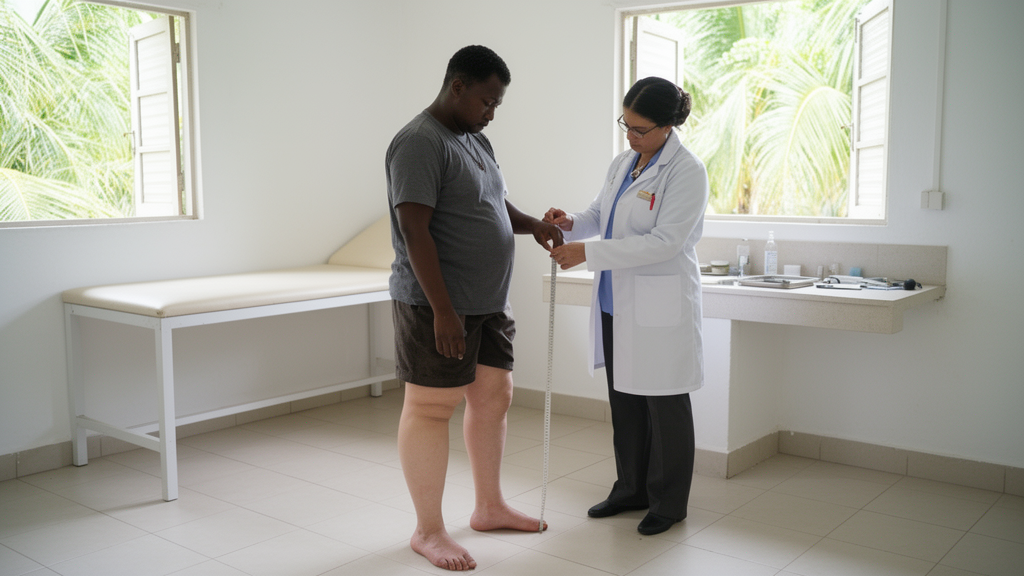
An exploratory, open-label interventional study in Odisha, India, reported improvements in health-related quality of life, skin-related measures and limb volume after one year of individualized homoeopathic treatment among adults with grade III or IV lower-limb lymphoedema associated with lymphatic filariasis. The researchers enrolled 104 participants, but 61 dropped out and 43 completed all monthly follow-ups, making the high attrition an important constraint on interpretation. The study’s results provide preliminary evidence of potential benefit, particularly for patient-reported outcomes, rather than establishing that homoeopathy is an effective treatment for advanced filarial lymphoedema.
The single-site trial was conducted at the Regional Research Institute for Homoeopathy in Puri and included adults with grade III or IV unilateral or bilateral lower-limb lymphoedema associated with lymphatic filariasis. Each participant received individualized homoeopathic medicines, with assessments conducted monthly over 12 months. The investigators measured limb circumference according to Australasian Lymphology Association standards and limb volume using the water displacement method.
Health-related quality of life was assessed with the 7D5L scale, while the Dermatology Life Quality Index captured dermatological changes. Clinical outcomes included entry lesions, ulcers, skin health, acute adenolymphangitis episodes and fungal infections. Serum levels of the markers Og4C3 and TNF-α were also evaluated.
The trial was prospectively registered with the Clinical Trials Registry-India under the identifier CTRI/2018/06/014591. The study reported statistically significant improvements in the quality-of-life and dermatological indices, with p-values below 0.0001. It also documented alleviation of limb volume, decreases in Og4C3 and TNF-α levels, resolution of entry lesions and ulcers, and a reduction in the occurrence of fungal infections.
These findings indicate changes across physical, symptom-related and laboratory measures during the treatment period. The supplied abstract does not give numerical effect sizes or confidence intervals, and the open-label, exploratory format does not permit the observed changes to be interpreted as a definitive treatment effect. Only 43 of the 104 enrolled participants completed every follow-up, while 61 dropped out.
This substantial loss to follow-up could make the final results less representative of everyone enrolled and complicates interpretation of the changes reported. The open-label format may also have influenced subjective assessments, including patient-reported quality of life and dermatological status. Objective measurements such as limb circumference and water-displacement volume provide complementary information, but the available abstract does not specify how missing observations were handled.
The report likewise does not establish whether all recorded changes persisted beyond the 12-month study period. These features mean that the findings should be regarded as exploratory signals that require confirmation in larger controlled studies. Lymphatic filariasis remains a major public-health burden in endemic regions, where millions of people live with chronic lymphoedema and hydrocele.
Mass drug administration is intended to restrict transmission, but effective management of the associated morbidity remains a significant challenge. The trial focused on a population in which evidence is limited: adults with advanced, grade III or IV disease in one or both lower limbs. The investigators said their findings indicate the potential of individualized homoeopathy to improve quality of life in advanced filarial lymphoedema and called for further controlled research with larger samples.
Subject of Research: Individualized homoeopathic treatment of advanced lower-limb lymphoedema associated with lymphatic filariasis
Article Title: Evaluating the impact of homoeopathy in managing the morbidity associated with grade III and IV lower limb lymphoedema in adults with lymphatic filariasis
Article References: SUHANA, P. A., Shruti, J. V., Choudhury, S., Gupta, J., Guddattu, V., Sahoo, P. K., Sehgal, C., Bhandari, P., Das, M., Varamballi, P., & Kaushik, S. (2026). Evaluating the impact of Homoeopathy in managing the morbidity associated with Grade III and IV lower limb lymphoedema in adults with Lymphatic Filariasis. Frontiers in Parasitology, 5, 1939673. https://doi.org/10.3389/fpara.2026.1939673
Image Credits: AI Generated
DOI: 10.3389/fpara.2026.1939673
Keywords: lymphatic filariasis, advanced lymphoedema, homoeopathy, open-label trial, quality of life, skin health, limb volume, Og4C3, TNF-α, India, Evaluating, impact
Cite Scienmag News
Ophelia Keating. (October 22, 2026). Exploratory trial reports improved outcomes in severe filarial lymphoedema. Scienmag. https://scienmag.com/exploratory-trial-reports-improved-outcomes-in-severe-filarial-lymphoedema/
Ophelia Keating. "Exploratory trial reports improved outcomes in severe filarial lymphoedema." Scienmag, 22 October 2026, https://scienmag.com/exploratory-trial-reports-improved-outcomes-in-severe-filarial-lymphoedema/. Accessed 22 October 2026.
Ophelia Keating. "Exploratory trial reports improved outcomes in severe filarial lymphoedema." Scienmag. October 22, 2026. https://scienmag.com/exploratory-trial-reports-improved-outcomes-in-severe-filarial-lymphoedema/


