


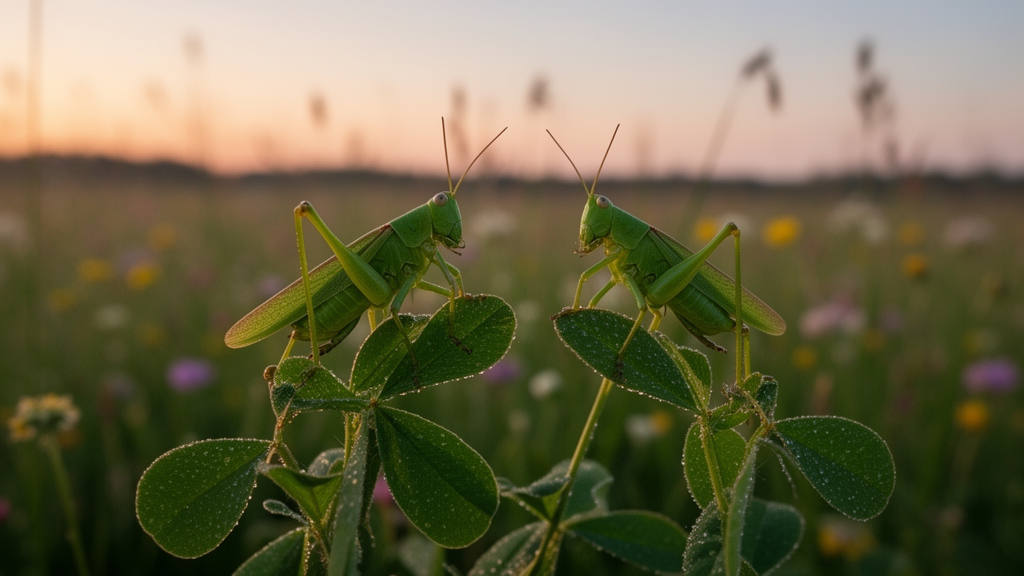
A field and laboratory study of katydids in western North Carolina identified two new species in the Amblycorypha rotundifolia complex: Amblycorypha zipticka and A. monticola. Both can be distinguished from previously described members primarily by their calling songs, which contain multiple acoustic elements not found in the other known species of the complex. The study recorded males calling in the field and duets in the laboratory, analyzed signal timing and temperature relationships, and compared the morphology of preserved specimens.
The work focused on the southern Appalachian Mountains, where local populations may be separated by elevation gradients and river systems. Members of the rotundifolia complex are flightless, which the authors suggest may reduce gene flow among populations and increase the possibility of isolation and speciation. The Phaneropterinae, which contains more than 2,900 species worldwide, is the most speciose subfamily of Tettigoniidae.
Amblycorypha zipticka, named the Zip Ticker Round-winged Katydid, is currently known from one population on Rich Mountain in Madison County, North Carolina. The population was found by Tamara Goodman while surveying for Scudderia septentrionalis, and extensive local surveys have not documented it elsewhere. Its male song contains clicks, zips and ticks.
Clicks comprise one or two brief impulse trains followed by a longer terminal train, while each zip is a single train of impulses. At 25°C, clicks were produced at an average of 1.5 per second and zips at 3.8 per second. Both rates increased linearly with temperature, and the typical sequence progressed from slow clicks to faster zips and then to ticks.
No other described member of the rotundifolia complex produces zips. The click rate of A. zipticka also differed from that of nearby northern A. alexanderi: at 25°C, the respective rates were 1.5 and 3.3 per second, and A. alexanderi clicks were about half as long at the same temperature. The spectra of the clicks, zips and ticks were broadband, with most energy between 12 and 15 kHz.
In addition to its distinctive song, A. zipticka was generally smaller than other species in the complex. Females were significantly smaller than female A. monticola in every measured character except tibial length, while males differed significantly in pronotal length and tegminal length and width. Amblycorypha monticola, named the Montane Round-winged Katydid, was recorded from high-elevation oak-hickory forests in the southern Blue Ridge Mountains, including sites in Buncombe, Graham, Haywood and Madison counties.
Populations generally occurred above about 1,000 metres, unlike many other members of the complex. Its males produce groups of four to seven syllables called echemes, a structure not found in the songs of other described rotundifolia species. Syllables within echemes were produced at about 45 per second at 25°C, the fastest rate measured in the complex and approximately twice that of A. rotundifolia.
Male A. monticola emitted echemes at two distinct rates. A slow sequence, produced while males moved through vegetation, averaged 1.6 echemes per second at 25°C. This transitioned to faster sequences reaching 3.1 echemes per second, with one or two ticks between later echemes.
The authors considered male calling song, rather than external morphology, the clearest way to distinguish A. monticola from A. alexanderi and A. rotundifolia, whose nearby populations can be morphologically cryptic. To investigate the temporal relationship between male ticks and female replies, researchers recorded duetting pairs with Sennheiser ME66 shotgun microphones and two-channel recorders. The microphones were positioned at right angles, 0.5 metres from individuals whose cages were separated by 1 metre, and acoustic foam was used to reduce noise and echoes.
Tick timing was measured as a proportion of the interval between song elements to reduce temperature-related variation. ANOVA and Tukey’s HSD post hoc comparisons were applied to logit-transformed proportions. In A. zipticka, the first male tick was emitted at about 25% of the interval between the final zip and the next click, while the overall average across ticks was about 65% of the interval between clicks.
Corresponding mean distributions did not differ significantly between solo calling and duetting. Female replies occurred at about 50% of the zip-to-click interval and generally did not differ from the corresponding male averages. In A. monticola, a single male tick occurred at about 75% of the interval between echemes; two ticks were distributed at approximately 60% and 90%.
Male distributions were similar during solo calling and duetting, although the second of two ticks differed significantly, and female replies resembled male ticks in most respects. These observations are consistent with the authors’ hypothesis that male ticks may serve as an acoustic countermeasure to eavesdropping by rival males, but the study did not directly test whether ticks deter eavesdroppers or alter male or female phonotaxis. Female response timing was variable, and the researchers did not identify a precisely timed trigger.
The geographic evidence is also limited: A. zipticka remains known from one locality, while A. monticola was studied in a restricted portion of western North Carolina. The authors called for phylogenetic analysis and field and laboratory experiments to determine the evolutionary origins of the two songs and directly test the proposed functions of their multiple sound elements.
Subject of Research: Taxonomic and acoustic study of two new Amblycorypha katydid species in western North Carolina
Article Title: Calling songs and duets of two new species in the Amblycorypha rotundifolia complex ( Tettigoniidae , Phaneropterinae )
Article References: Forrest, T. G., Hamel, J. A., & Holbrook, C. T. (2025). Calling songs and duets of two new species in the Amblycorypha rotundifolia complex (Tettigoniidae, Phaneropterinae). Journal of Orthoptera Research, 34(2), 233-248. https://doi.org/10.3897/jor.34.145640
Image Credits: AI Generated
Keywords: Amblycorypha zipticka, Amblycorypha monticola, katydid taxonomy, calling songs, duetting, acoustic signaling, eavesdropping, southern Appalachians, animal behavior, species identification, Calling, songs
Cite Scienmag News
Arthur Russell. (October 20, 2026). Research report: Calling songs and duets of two new species in the Amblycorypha rotundifolia complex ( Tettigoniidae , Phaneropterinae ). Scienmag. https://scienmag.com/research-report-calling-songs-and-duets-of-two-new-species-in-the-amblycorypha-rotundifolia-complex-tettigoniidae-phaneropterinae/
Arthur Russell. "Research report: Calling songs and duets of two new species in the Amblycorypha rotundifolia complex ( Tettigoniidae , Phaneropterinae )." Scienmag, 20 October 2026, https://scienmag.com/research-report-calling-songs-and-duets-of-two-new-species-in-the-amblycorypha-rotundifolia-complex-tettigoniidae-phaneropterinae/. Accessed 20 October 2026.
Arthur Russell. "Research report: Calling songs and duets of two new species in the Amblycorypha rotundifolia complex ( Tettigoniidae , Phaneropterinae )." Scienmag. October 20, 2026. https://scienmag.com/research-report-calling-songs-and-duets-of-two-new-species-in-the-amblycorypha-rotundifolia-complex-tettigoniidae-phaneropterinae/


