


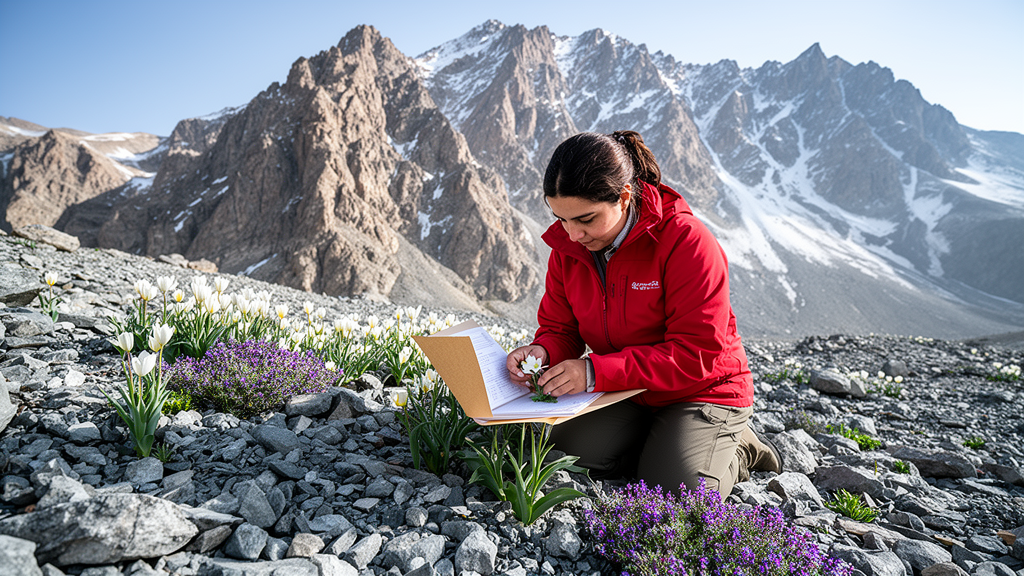
A biogeographic compilation and a 2019 field survey of the Dena Mountains in southern Iran found 242 vascular plant taxa endemic to the Iranian Plateau, including 22 restricted to Dena, and supported the description of two previously undescribed plant associations in sparse subnival scree habitat above about 4,100 metres. The study combined updated records of Iranian endemics with phytosociological sampling of vegetation at the mountain range’s highest elevations.
The Dena Mountains form a calcareous system in the southern Zagros, approximately 60 km long and 10 km wide. Nearly 100 peaks exceed 4,000 m above sea level, and the highest reaches 4,409 m, making it the highest summit in the Zagros. The range is described as the second-richest centre of plant endemism in Zagros and the fourth-richest in Iran. Its climate has cold, wet winters and warm, dry summers; western slopes receive more precipitation than eastern slopes, and annual precipitation exceeds 1,000 mm in the alpine zone.
For the biogeographic component, the researchers combined a published inventory of endemic vascular plants of Iran with updated occurrence data. They used records from the Azerbaijan Plateau, Alborz, Kopet Dagh, Yazd-Kerman and Zagros to assess floristic connections among the principal Iranian areas of endemism. This was a descriptive synthesis of existing and updated distribution records rather than a longitudinal study of changes in plant diversity.
To examine subnival vegetation, the team conducted an expedition to elevations above 4,100 m during summer 2019. It sampled 19 plots at subnival scree sites, with each plot measuring 10 by 10 m. Following the Braun-Blanquet approach, investigators estimated proportional cover of vegetation, scree, soil and rock. Plot data were entered into Turboveg, and classification used Modified TWINSPAN in JUICE 7.1 with four cut levels: 0%, 5%, 25% and 50%. Associations were then evaluated with ordination, constancy and fidelity values.
Among the 242 Iranian Plateau endemics recorded in Dena, 22 taxa—21 species and one variety—were restricted to the mountain system. A further 122 taxa were endemic to Zagros as a whole, while 120 were shared with other Iranian mountain ranges. Dena had its strongest floristic connection with the Yazd-Kerman massif, sharing 84 taxa with it, compared with 51 shared with Alborz, 37 with the Azerbaijan Plateau and 15 with Kopet Dagh-Khorassan. Endemic diversity was greatest in the 2,200–2,600 m belt and decreased gradually toward both lower and higher elevations.
Thirty-eight taxa were recorded in the subnival zone above 4,100 m, where scree and rocks dominated and vegetation cover reached no more than 20%. Of these taxa, 68% were endemic to the Iranian Plateau. Within that endemic group, 42% were also endemic to Zagros and Yazd-Kerman, while 21% were endemic to Zagros. This proportion was much higher than the roughly 10% share of Zagros endemics among the approximately 1,200 plant taxa previously reported for Dena as a whole.
The 19 sampled subnival plots contained 33 species, with three to 11 species per plot. Modified TWINSPAN separated the plots into two associations, and detrended correspondence analysis also distinguished the groups. Aethionemetum umbellati was characterized by Aethionema umbellatum, Nepeta lasiocephala and Silene daenensis, with Euphorbia aucheri as a differential species. It occurred on steep, mainly south- to west-facing slopes with a mean inclination of 33 degrees. Scree and gravel covered about 85% of the ground, vegetation cover averaged about 13%, and species richness averaged seven species per plot.
Zerdanetum anchonioidis was characterized by Astragalus zerdanus, Erigeron daenensis, Myopordon persicum, Veronica kurdica subsp. filicaulis and Zerdana anchonioides. It occurred mainly on north- to northeast-facing slopes with a mean inclination of about 20 degrees. Scree covered roughly 55% of the ground, with larger proportions of rock and open soil than in the other association; average vegetation cover was about 20%, and plots averaged eight species. Aethionemetum umbellati was described as endemic to Dena, whereas the distributions of its characteristic species led the authors to expect Zerdanetum anchonioidis to occur more broadly in the subnival zone of central and southern Zagros.
Both associations were placed in a newly proposed alliance, Galion pseudokurdici, within the class Didymophyso aucheri-Dracocephaletea aucheri. The alliance was characterized by Astragalus melanodon, Bromus frigidus, Galium pseudokurdicum and Stachys obtusicrena, and its ecological characteristics were considered closest to the Didymophysion aucheri alliance of central Alborz. The proposed classification remains bounded by the 19 sampled plots and by the need for additional data from Zagros and Yazd-Kerman to determine whether the alliance fits an existing order or requires a new one.
The study identified conservation concerns without testing a conservation intervention. Because many subnival species occupy a narrow, small area near the summits, the authors considered them vulnerable to habitat contraction and losses associated with a warmer climate, for which no alternative high-elevation habitat may be available. They also identified overgrazing and tourism as additional pressures. The Dena range lies within a protected area, but the authors cautioned that protection alone would not prevent climate-related habitat loss or degradation caused by grazing and tourism.
Subject of Research: Biogeographic and phytosociological study of endemic plants and subnival vegetation in Iran’s Dena Mountains
Article Title: Plant biogeography, endemism and vegetation types of Dena Mts, Zagros, West Iran
Article References: Noroozi, J., Talebi, A., Suen, M., & Schneeweiss, G. M. (2024). Plant biogeography, endemism and vegetation types of Dena Mts, Zagros, West Iran. Vegetation Classification and Survey, 5, 185-202. https://doi.org/10.3897/vcs.118433
Image Credits: AI Generated
DOI: 10.3897/VCS.118433
Keywords: Dena Mountains, Iran, Zagros Mountains, plant endemism, biogeography, phytosociology, subnival vegetation, alpine scree, plant conservation, floristic affinities, Plant, endemism
Cite Scienmag News
Margaret Porter. (October 20, 2026). Field survey maps endemic flora and two subnival plant communities in Iran’s Dena Mountains. Scienmag. https://scienmag.com/field-survey-maps-endemic-flora-and-two-subnival-plant-communities-in-irans-dena-mountains/
Margaret Porter. "Field survey maps endemic flora and two subnival plant communities in Iran’s Dena Mountains." Scienmag, 20 October 2026, https://scienmag.com/field-survey-maps-endemic-flora-and-two-subnival-plant-communities-in-irans-dena-mountains/. Accessed 20 October 2026.
Margaret Porter. "Field survey maps endemic flora and two subnival plant communities in Iran’s Dena Mountains." Scienmag. October 20, 2026. https://scienmag.com/field-survey-maps-endemic-flora-and-two-subnival-plant-communities-in-irans-dena-mountains/


