


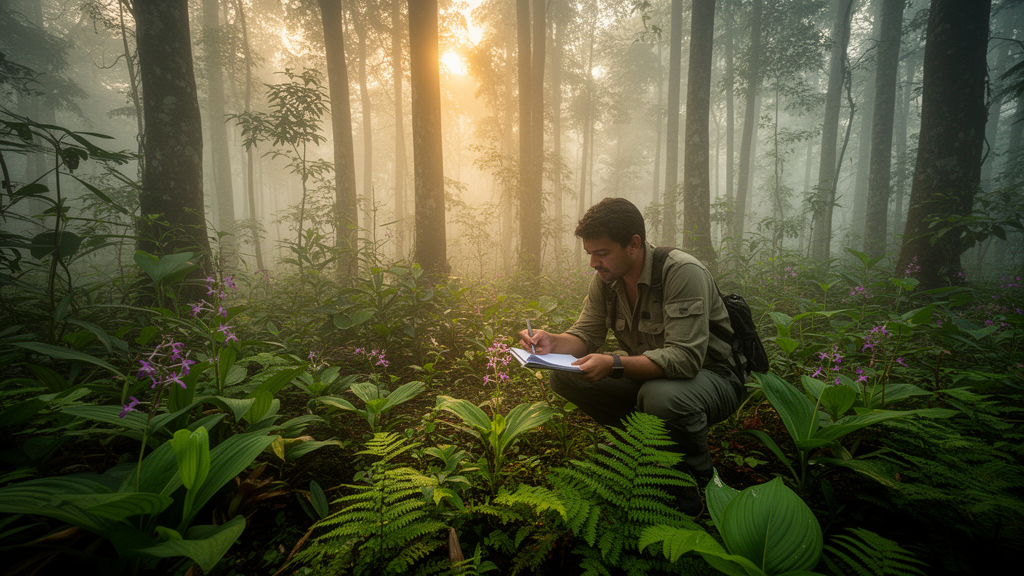
A field survey of tropical semi-evergreen forests in Assam’s Cachar Hills recorded 52 tree species in the overstorey and 72 species across the sapling-shrub and herb-seedling layers. The study, which sampled non-protected forest along the Kopili River in September 2014, also found that only 23% of the recorded tree species showed good regeneration, indicating uneven renewal within the surveyed stands.
The sampling area extended through the North Cachar hills in the Karbi-Anglong and Dima Hasao districts, formerly known collectively as North Cachar Hills. It included forest classified as 2B/C2 Cachar tropical semi-evergreen forest and 4E/RS1 tropical riparian fringing forest, with Dipterocarpus, Artocarpus and Gluta identified as dominant forest genera. The region receives annual rainfall of 1,500–3,750 mm, mainly from June through August, and has temperatures ranging from 5 to 32 °C.
Researchers used four belt transects, each 200 m long and 10 m wide, positioned at 7–8 km intervals perpendicular to the road from southern Panimore-Patherkore to Longphu-Digram. Ten randomly positioned 10 m × 10 m quadrats were established along each transect, producing 40 quadrats in total. Trees with circumference at breast height of at least 31.4 cm were sampled in the 10 m × 10 m plots, shrubs and saplings were recorded in nested 5 m × 5 m plots, and herbs were counted in nested 1 m × 1 m plots.
The investigators calculated density, abundance, frequency and dominance for each vegetation stratum. They also used species richness, the Shannon-Wiener diversity index, Pielou’s evenness index, Sorenson’s similarity index and the Importance Value Index. Trees were assigned to ten circumference-at-breast-height classes, while regeneration status was determined from the numbers of seedlings, saplings and adults in each tree population.
The overstorey contained 445 tree individuals representing 52 species, 44 genera and 28 families, with a density of 445 individuals per hectare and total basal area of 50.87 m² per hectare. Euphorbiaceae and Moraceae were the most species-rich families, each with five species. Holarrhena pubescens had the highest tree density at 35 individuals per hectare and the highest Importance Value Index at 29.67, whereas Protium serratum had the largest basal area at 19.78 m² per hectare.
Other species with high Importance Value Index values were Mangifera sylvatica at 14.69, Homonoia riparia at 13.74, Ficus benghalensis at 12.70 and Machilus parviflora at 11.86. The tree-layer Shannon-Wiener diversity index was 3.631, the Simpson index was 0.036 and the evenness index was 0.069. The low evenness value was consistent with an uneven distribution of individuals among species, with a smaller number of species accounting for a disproportionate share of the community.
The understorey contained 3,870 sapling or shrub individuals from 31 species and 157,250 herb or seedling individuals from 41 species, including seven pteridophyte species. Bambusa tulda and Chromolaena odorata were the most frequent species in these layers and had the highest Importance Value Index values. Poaceae was the most species-rich and most important family in both the sapling and seedling layers. Almost 80% of the dominant shrub and herbaceous species were native, with centres of origin in the Indian subcontinent, Indo-China, Southeast Asia and the Himalayan region.
Tree populations followed an overall reverse J-shaped size-class curve. Stand density and species richness were highest in the 30–60 cm girth class and declined as girth increased through 270 cm. Basal area reached 34.45 m² per hectare in the 90–120 cm class and was lowest, at 9.91 m² per hectare, in the 0–30 cm class. Homonoia riparia, Lepisanthes senegalensis and Machilus parviflora showed reverse J-shaped population structures, while Protium serratum had an interrupted curve.
Regeneration was limited across much of the tree assemblage. Of the 52 tree species, 23% had good regeneration, 17% poor regeneration and 3% fair regeneration, leaving 57% outside those three categories. Homonoia riparia, Lepisanthes senegalensis and Holarrhena pubescens had established saplings and seedlings. Aquilaria agallocha, Ixonanthes reticulata, Lithocarpus elegans, Magnolia gustavii, Protium serratum, Balakata baccata and Terminalia citrina were classified as non-regenerating.
The study was limited to one sampling season and a set of 40 quadrats in non-protected forests along one river corridor, so its results describe the surveyed stands rather than all forests in Northeast India. The authors noted that recurring disturbance, including shifting cultivation known locally as Jhum, timber extraction and expanding monoculture plantations of betelnut and rubber, was affecting forests in the study area. They concluded that quantitative analysis of tree and shrub diversity, particularly for rare, endemic and globally threatened species, would assist conservation and forest management in the Cachar Hills.
Subject of Research: Vegetation diversity, composition and tree regeneration in tropical semi-evergreen forests of Assam’s Cachar Hills
Article Title: Investigation of the vegetation structure, diversity and composition in the tropical semi-evergreen forests of Northeast India
Article References: Nautiyal, D. C., & Manish, K. (2025). Investigation of the vegetation structure, diversity and composition in the tropical semi-evergreen forests of Northeast India. Italian Botanist, 19, 31-43. https://doi.org/10.3897/italianbotanist.19.143517
Image Credits: AI Generated
DOI: 10.3897/italianbotanist.19.143517
Keywords: forest ecology, vegetation structure, understorey diversity, tree regeneration, tropical semi-evergreen forest, Cachar Hills, Assam, Kopili River, species richness, forest disturbance, Investigation, vegetation
Cite Scienmag News
Margaret Porter. (October 20, 2026). Field survey documents tree and understorey diversity in Assam’s Cachar Hills. Scienmag. https://scienmag.com/field-survey-documents-tree-and-understorey-diversity-in-assams-cachar-hills/
Margaret Porter. "Field survey documents tree and understorey diversity in Assam’s Cachar Hills." Scienmag, 20 October 2026, https://scienmag.com/field-survey-documents-tree-and-understorey-diversity-in-assams-cachar-hills/. Accessed 20 October 2026.
Margaret Porter. "Field survey documents tree and understorey diversity in Assam’s Cachar Hills." Scienmag. October 20, 2026. https://scienmag.com/field-survey-documents-tree-and-understorey-diversity-in-assams-cachar-hills/


