


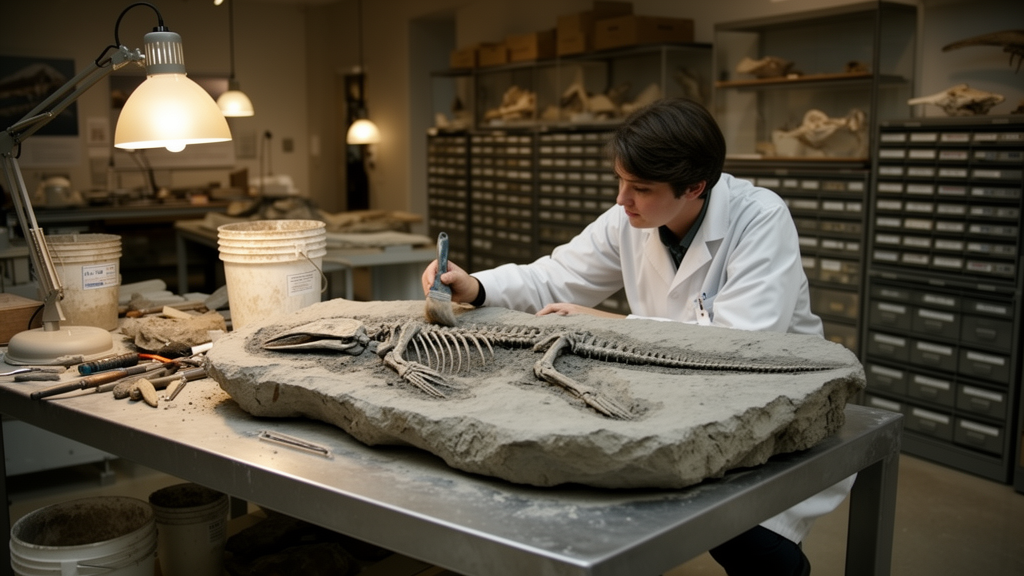
A computational analysis of the Mesozoic plesiosaur fossil record found that rock availability and collection effort were associated with observed taxic diversity but did not fully explain its major peaks and troughs. Separate negative-binomial models based on fossiliferous marine formations and fossil marine collections left several high- and low-diversity stages outside their 95% confidence intervals, indicating that sampling proxies alone could not account for the entire pattern.
The study used the plesiosaurian dataset of O’Keefe et al. (2025), supplemented with sampling data downloaded from the Paleobiology Database on June 26, 2025. Taxic diversity estimates, or TDE, were the counts of plesiosaur taxa observed within geological stages. The researchers separately regressed TDE against two global proxies: the number of fossiliferous marine formations, which broadly represents available marine rock, and the number of fossil marine collections, which more directly reflects human collection effort.
For each proxy, the authors compared simple linear, Poisson and negative-binomial models. Akaike information criterion selected the negative-binomial model for both analyses, a choice consistent with the overdispersion in the count data. Modelled diversity estimates were then generated from the preferred models, and residual diversity estimates were calculated as the logarithm of observed TDE minus the logarithm of modelled diversity. Positive or negative residuals identify intervals whose observed diversity was higher or lower than predicted by the relevant proxy.
The two sampling series showed broadly similar temporal trends, including peaks in the Pliensbachian and Toarcian, a decline in the Aalenian, recovery through the Middle and Upper Jurassic, a trough in the Coniacian and prominent peaks in the Campanian. The fossil marine collections proxy reached a relatively stronger peak in the Pliensbachian–Toarcian interval. These common trends are correlations between the proxies, not evidence that a combined correction was applied.
In the formation-based model, TDE exceeded modelled diversity in the Hettangian, Toarcian, Callovian, Tithonian, Hauterivian and Maastrichtian. It fell below modelled expectations in the Rhaetian, Pliensbachian, Aalenian, Bajocian, Bathonian, Oxfordian, Valanginian and Coniacian. The collection-based model produced a broadly similar pattern, with the Toarcian falling within the model’s confidence interval while the Turonian lay above it. Thus, the principal result did not depend on using only one of the two proxies.
Some modelled differences corresponded to intervals of taxonomic change documented in the fossil record. The Hettangian association with early rhomaleosaurids and the Callovian abundance of pliosaurids and cryptoclidids accompanied peaks not fully predicted by formation counts. Similarly, the Tithonian increase was associated with Pliosaurus and the final appearances of several cryptoclidid genera, while the Hauterivian and Maastrichtian peaks coincided with the appearance or diversification of elasmosaurid groups.
Not all low-diversity intervals could likewise be attributed to reduced sampling. The Pliensbachian and Aalenian–Bathonian declines were below model expectations in both sampling analyses, as was the Oxfordian “Corallian Gap.” The Valanginian and Coniacian also had low TDE that the proxies did not fully explain. By contrast, the Berriasian decline was consistent with the expected diversity from both proxy models. The authors cautioned that these residuals may represent genuine biological changes or sampling artefacts, both of which would require further investigation.
The researchers also calculated phylogenetic residuals as the difference between phylogenetic diversity estimates, which incorporate inferred ghost lineages, and TDE. They combined these residuals with each sampling proxy separately in stage-level priority classifications. Intervals with high phylogenetic residuals but comparatively low proxy values were classified as higher-priority targets, whereas intervals with low residuals and high proxy values were classified as lower priority. The resulting categories differed between proxies in several cases: the Pliensbachian and Toarcian shifted from high to medium priority when collections were used, while the Aptian shifted from medium to high.
Three intervals—the Aalenian–Bathonian interval and the Valanginian and Coniacian—combined low TDE that was not explained by either sampling proxy with comparatively limited rock or collection data and high phylogenetic residuals. The authors identified these as priorities for testing the two analytical approaches through fieldwork. The analysis was limited by its dependence on broad marine sampling proxies, the assumption that residuals may indicate biological or hidden diversity, and the imperfect record of the fossil record. The priority scheme was a model-based classification rather than a forecast of discovery, and an examination of seven plesiosaur species described from 2020 to 2025 showed that notable finds could also occur in intervals assigned lower priority.
Subject of Research: Computational assessment of sampling biases in Mesozoic plesiosaur taxic diversity
Article Title: Assessing the effect of sampling proxies on plesiosaur taxic diversity with comments on implications for Mesozoic sampling design
Article References: Aspromonte, F. R., & O'Gormán, J. P. (2025). Assessing the effect of sampling proxies on plesiosaur taxic diversity with comments on implications for Mesozoic sampling design. Fossil Record, 28(2), 397-410. https://doi.org/10.3897/fr.28.173497
Image Credits: AI Generated
DOI: 10.3897/fr.28.173497
Keywords: plesiosaurs, Mesozoic, taxic diversity, sampling bias, fossil record, negative-binomial models, phylogenetic diversity, paleobiology, fieldwork priorities, Assessing, effect, sampling
Cite Scienmag News
Violet Maxwell. (October 20, 2026). Computational study finds rock availability and collection effort do not fully explain plesiosaur diversity patterns. Scienmag. https://scienmag.com/computational-study-finds-rock-availability-and-collection-effort-do-not-fully-explain-plesiosaur-diversity-patterns/
Violet Maxwell. "Computational study finds rock availability and collection effort do not fully explain plesiosaur diversity patterns." Scienmag, 20 October 2026, https://scienmag.com/computational-study-finds-rock-availability-and-collection-effort-do-not-fully-explain-plesiosaur-diversity-patterns/. Accessed 20 October 2026.
Violet Maxwell. "Computational study finds rock availability and collection effort do not fully explain plesiosaur diversity patterns." Scienmag. October 20, 2026. https://scienmag.com/computational-study-finds-rock-availability-and-collection-effort-do-not-fully-explain-plesiosaur-diversity-patterns/


